Connecting the world and beyond

ITU Statistics Update - July 2026

WHAT’S NEW IN ICT STATISTICS

TOPIC SPOTLIGHT - Behind the scenes of the 2026 data collection campaign


The annual ICT data collection campaign through ITU’s Questionnaire on ICT Access and Use by Households and Individuals and the World Telecommunication/ICT Indicators (WTI) Questionnaire may have closed on 29 May 2026, but for ITU statisticians the most intensive phase is only beginning. In less than two months, a team of around ten staff members must validate tens of thousands of data points, calculate indicators, and prepare the datasets for publication in late July.

Validation is a meticulous and time-consuming process. Each submission is reviewed against a country’s historical trends, comparable economies, and related indicators to identify possible inconsistencies or unusual changes. Extensive exchanges with national focal points and desk research are often needed to clarify figures, confirm revisions, or resolve missing values. Some countries also request extensions to finalize their submissions, adding further complexity to the process.

Recent improvements to the online data collection platform have helped streamline this work. Built-in live validation rules now flag possible data entry errors, inconsistencies, missing values, and significant deviations from past trends during submission. This pre-validation has improved data quality, reduced the time needed for manual checks, and accelerated the “time to market” of official ICT statistics.

UPCOMING Activities

DID YOU KNOW?


Measuring connectivity beyond access: Capturing the traffic in networks and use of Internet

Across regions, countries continue to strengthen data collection on connectivity. While traditional indicators provide essential information on network availability and access, understanding how connectivity translates into real benefits requires going further in measuring beyond basic measures. 

For example, measuring connectivity only through infrastructure or subscriptions is like counting roads without knowing how many vehicles use them. Broadband traffic data provides this missing dimension, revealing how connectivity is actually used, the intensity of network activity, and its role in supporting digital services, economic activity, and everyday interactions.

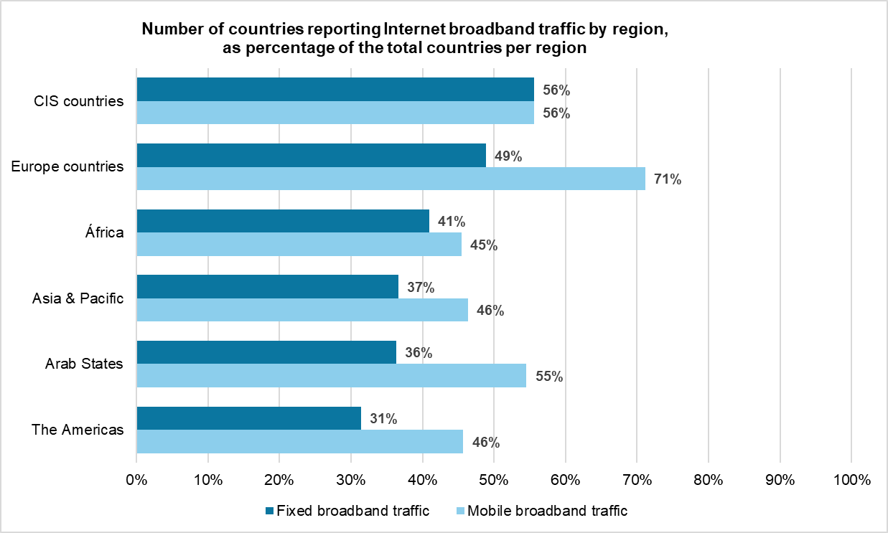
Overall, 29% of countries reported fixed broadband traffic and 37% reported mobile traffic (see figure below). Continued efforts are needed to improve data availability, reporting practices, and coverage across countries.


Another example is measuring how the internet is used. Indicators such as internet banking, disaggregated by gender, provide a more complete picture of how people use connectivity in practice, offering valuable insights into digital engagement across different groups. However, only 28% of countries currently report this indicator (see figure below), underscoring important data gaps that limit a full understanding of digital participation. 


Collecting these data requires dedicated household surveys, robust statistical processes, and sustained effort from countries to produce detailed and comparable information. By investing in the ICT statistics system, countries are helping to build a clearer understanding of the digital transformation and enabling more effective, targeted policies to maximize the impact of connectivity and ensure it delivers real benefits for all.

Join the conversation


Have questions or insights? We’d love to hear from you! Share your thoughts with the ICT Data and Analytics Division, BDT on social media using the hashtag #ICTStats, or get in touch via e-mail for suggestions and questions.

​Share the subscribe link | Unsubscribe​