 | 2026
Nuevo!
Timely warning of natural disasters, accurate climate prediction and the sustainable management of scarce natural resources are essential for economic development. Information on weather, climate, water, environmental conditions and disasters is therefore of critical importance to the global community.
Such information largely depends on measurements obtained, transmitted and distributed through radiocommunication systems. These systems are fundamental for monitoring the Earth's climate and supporting mitigation of and adaptation to climate change. As they rely on the radio-frequency spectrum - a limited natural resource - ensuring access to interference-free frequency bands is essential for the reliable operation of Earth observation systems.
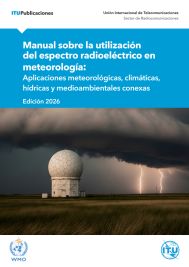
This Handbook provides an overview of the World Meteorological Organization global infrastructure and its observing components, together with the technical and operational characteristics of key meteorological and environmental systems. It describes the radio-frequency bands used, criteria for assessing harmful interference, and the potential impact of such interference on data, forecasts and early warning services. The Handbook may serve as a useful reference for professional users, policymakers, regulators and the radiocommunications community. |
|