* This is a machine translation. It is fully automated and involves no human intervention. The quality and accuracy of machine translation can vary from one text to another and between different language pairs. The ITU does not guarantee the accuracy of the translation and accepts no liability for possible errors.
30 June 2026

On June 27, 2026, the final of the Regional Hackathon for creating green and digital solutions for the sustainable development of Central Asia took place at Issyk-Kul (Kyrgyz Republic). The event brought together 32 finalists – representing 12 youth teams from Kazakhstan, the Kyrgyz Republic, Tajikistan, and Uzbekistan, with three teams from each country. Young developers, environmentalists, and entrepreneurs presented practical digital solutions aimed at the sustainable development of the economy and society in Central Asia to experts and potential investors.
The winners of the hackathon are: - 1st place – the project "Reusable Filters Based on TiC 4". Team: Vladislav Denisov, Sayat Zakerov, Leonid Izmailov, and Dias Yerbolat (Ust-Kamenogorsk, Kazakhstan).
-
2nd place – the Akkan Suu project, developed by Nazim Toktombaeva (Kant, Kyrgyz Republic), Saadat Kubanychbekova and Aidana Zhanyshova (Bishkek, Kyrgyz Republic), and Biloli Bobozoda (Khujand, Tajikistan).
-
3rd place – the GreenLine Energy project. Team: Aizirek Nazarkulova, Madina Oktamzhanova, and Nurbolot Erkinbaev (Osh, Kyrgyz Republic).
-
Special Nomination "Women in Leadership" – the AquaGuard project, developed by Gulira Shadybekova and Akmaral Nurlanova (Bishkek, Kyrgyz Republic).
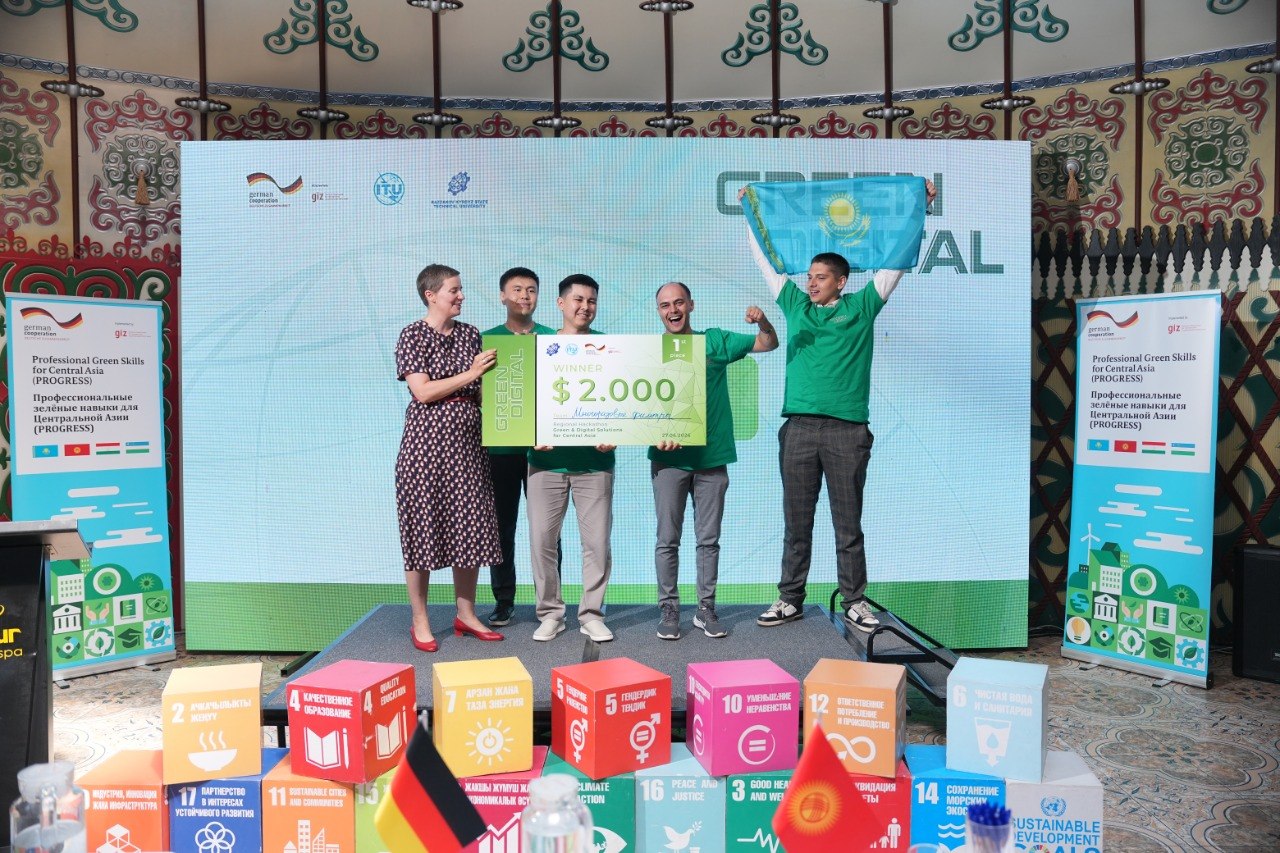
Hackathon winner – the "Reusable Filters Based on TiC 4" project for air and water purification at industrial enterprises
The total prize pool of the hackathon amounted to $5,000 and was distributed among the winning teams.
The hackathon was organized by the International Telecommunication Union (ITU), the regional project "Professional Green Skills for Central Asia" (PROGRESS) implemented by GIZ (Deutsche Gesellschaft für Internationale Zusammenarbeit) on behalf of the German government, and the Kyrgyz State Technical University named after I. Razzakov.
The mission of the ITU, as the United Nations specialized agency for ICTs, is to ensure universal internet access and equip every individual with the digital skills needed for self-realization, creativity, and socio-economic development.

Hackathon winner – the GreenLine Energy team – intelligent monitoring and energy consumption management in buildings
ITU Programme Coordinator Farid Nakhli emphasized that in Central Asia, the ITU is focused on bridging the digital divide – both between the countries of the region and within them, among different segments of the population – and that working with young people to create startups allows the ITU to address these challenges..
"We pay special attention to the green economy. Here we see two sides: first, minimizing the environmental footprint from the production and disposal of mobile devices and telecom equipment; and second, using digital technologies for environmental protection. For example, water resource optimization is highly relevant for Central Asia, and satellite systems and artificial intelligence tools help us here: projects working at the intersection of these areas are already yielding practical results," he added.
The main thematic tracks of the projects were renewable energy and energy efficiency, digital water resource management, circular economy and waste management, as well as climate monitoring using satellite data and geographic information systems.

Winner in the "Women in Leadership" nomination – AquaGuard – lake water quality monitoring
Monika Lenhard, Ambassador Extraordinary and Plenipotentiary of the Federal Republic of Germany to the Kyrgyz Republic, noted that initiatives like the Regional Hackathon, which brought together participants from four countries, help strengthen cooperation among the countries of the region, unite them, and jointly seek solutions to common challenges.
"Today we talk a lot about the green transition, digitalization, and innovation. But ultimately, it all starts not with technologies. It all starts with people – with their knowledge, ideas, willingness to take responsibility, and create something new. This hackathon is an example of how educational institutions, business representatives, international organizations, mentors, and young innovators can join forces for a common goal – creating digital solutions and training a new generation of green economy leaders," added Ms. Lenhard.
The final pitching marked the culmination of a two-stage educational program that launched in March 2026: initially, about 130 teams from four countries underwent intensive online training in idea generation, business model development, creating a minimum viable product (MVP), and preparing effective presentations. Following the selection process, 34 teams advanced to the national semi-finals, and then 12 of them went on to the final at Issyk-Kul.
The day before the final, the teams attended a series of training sessions by international experts and received individual consultations from leading industry specialists. Mentors included representatives from GIZ, IT Park Uzbekistan, the International Telecommunication Union, Qostanai Hub, Aman, and other IT companies and organizations. The experts helped the participants refine their technical solutions, build sustainable business models, hone their public presentation skills, and prepare for interactions with potential investors.
A special feature of the final day was the participation of private sector representatives and potential employers. For the young developers, this opened up real opportunities for the further commercialization of their projects, internships, and employment in relevant companies.
The members of the hackathon jury were:
—
Damir Mnaidarov, CEO Qostanai Hub
—
Zhanat Dzhabasova, Startup Tracker, Project Planner at HOTEZA LIMITED
—
Chubak Temirov, Deputy Director of the High Technologies Park of the Kyrgyz Republic
—
Fatima Kushkhova, Startup Manager at IT Park Uzbekistan
—
Elmur Konushbaev, Deputy Chairman of the Council of the Chamber of Commerce and Industry of the Kyrgyz Republic.

Also, as guest experts at the hackathon final, Chyngyz Zhantaev, Director of the State Institution "Innovation Center" under the Ministry of Science, Higher Education and Innovations of the Kyrgyz Republic, and Mirlan Chynibaev, Rector of the Kyrgyz State Technical University named after I. Razzakov, took part.
The Green & Digital Solutions for Central Asia Regional Hackathon became not just a competition, but an initiative that fosters the development of entrepreneurial skills, supports startups, and expands career opportunities for young professionals in the green economy.
As Farid Nakli noted, projects that are focused not on a single country, but on the entire region as a whole, have the greatest potential – it is interstate cooperation that allows finding effective solutions to the global challenges facing Central Asia.

Hackathon winner – Akkan Suu – a water usage recommendation platform for farms.
Biloli Bobozoda from Khujand, a member of the Akkan Suu team, shared that their project helps farmers save up to 30% of water using satellite data and soil moisture sensors that synchronize with the developed platform and provide precise irrigation recommendations. Many farmers do not know how much water is needed for the soil in the areas where they grow crops, or what exactly is best to grow in a particular location. This leads to a huge amount of water being wasted, while the farmer loses their harvest.
"Over the two and a half months of working on the hackathon, we attracted 20 farmers, 7 of whom have already become paying customers. This year we plan to establish ourselves in the local market, and in 2027 – to scale up across Central Asia. I am working in a team with three girls from the Kyrgyz Republic, to whom I am very grateful. As for the educational program, the most valuable things were the organizers' support in working on the presentation and business models, and their useful advice on further project development," shared Biloli Bobozoda.
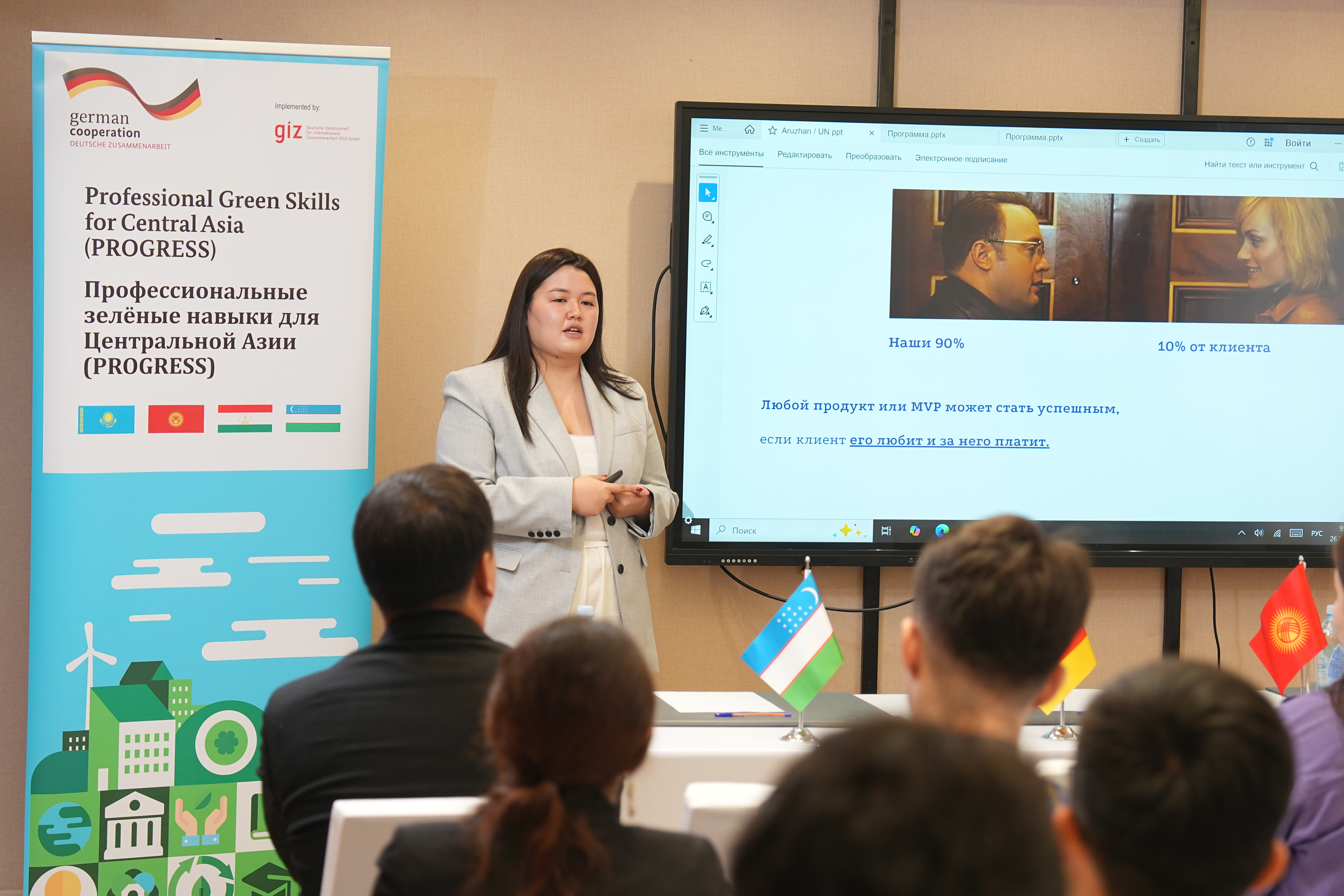
Guest expert and hackathon mentor – Aruzhan Mede, founder of the AMAN startup.
The concluded hackathon confirmed that young people from the Central Asian region are ready to offer bold, technological, and environmentally responsible solutions, and that the joint efforts of organizers, experts, and participants create a solid foundation for a sustainable future.
|