Satellites play a critical role in disaster preparedness and early warning by providing timely, accurate, wide-area observations and essential data that cannot be obtained from the ground alone. They also deliver voice and data connectivity in remote areas where terrestrial mobile or fixed networks cannot reach. By supplying this real-time connectivity and information, satellites enable government authorities to make informed decisions in advance, helping to protect communities and save lives.

In the context of early warning systems, advances in satellite technology promise incredible advances to send alerts directly to mobile phones and new opportunities to reach people at risk. For example, satellite technology has advanced significantly, emerging to direct-to-device (D2D) connectivity. New generations of low-Earth orbit (LEO) satellites can now link directly with new generation of mobile phones, bypassing traditional ground-based satellite gateways. This evolution allows users in remote or disaster-affected areas to access voice and data services complementing terrestrial networks. With the complementarity between the alert by satellite and the alert via
cell broadcast (CB) and/or location-based short message service (LB-SMS), and seeing its global coverage—including for communities in remote areas without connection—satellite communications ensure that people at risk could be alerted even when the connectivity is down or affected by disasters.
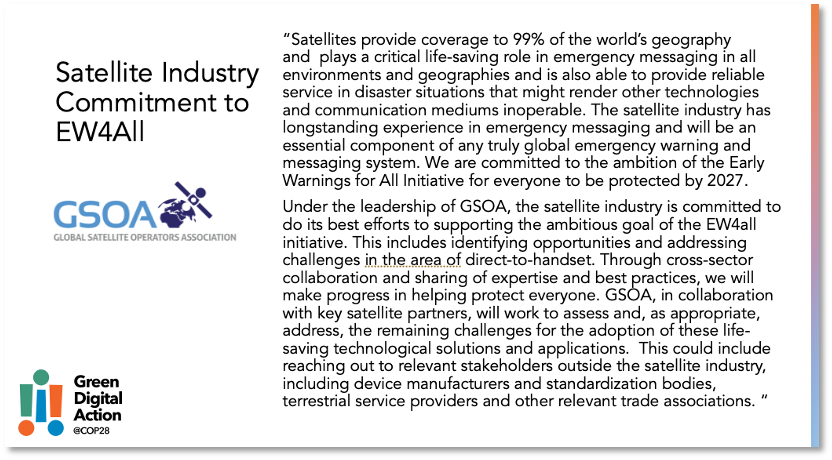
Collaboration with the Global Satellite Operator's Association for early warnings
ITU works with partners, like the Global Satellite Operator's Association (GSOA), to explore and scale satellite-based solutions for resilient alerting systems. Committed to
EW4All, GSOA and its partners are dedicated to enhancing direct-to-handset services and overcoming challenges through cross-sector collaboration, including engaging with device manufacturers, standardization bodies, and other key stakeholders.
Collaboration with the European Space Agency for early warnings
Through a partnership, ITU also works with the
European Space Agency (ESA) through a joint statement on the Rapid and Resilient Crisis Response (R3) Accelerator, in support of EW4All. Together, ITU and ESA are committed to tackling challenges around user engagement and adoption of space solutions, while fostering a collaboration framework that maximizes mutual benefits for resilience and early warning systems.
The partnership focuses on driving technological innovation, piloting space-based solutions in EW4All priority countries, and supporting inclusive participation in the demonstration and validation of space-enabled services. In addition, ITU and ESA collaborate on activities under EW4All, including work with the ITU-led
AI for Group of EW4All, to strengthen life-saving multi-hazard early warning systems and resilience efforts worldwide.
Other ITU collaborations
In addition to the rapidly evolving standards-based Non-Terrestrial Network (NTN), ITU is monitoring and assessing emerging satellite-to-phone alerting concepts, including Bluetooth Low Energy–based broadcast alerts from space, as well as waveform innovations that enable alerts to be received through low-cost end-user receivers connected to phones. ITU also follows the Emergency Warning Satellite Service (EWSS) European initiative, which leverages the Galileo GNSS (Global Navigation Satellite System) signal-in-space to broadcast emergency warning messages in a Common Alerting Protocol (CAP)-compliant alert format.