Protecting radio astronomy and our shared human heritage


By Gyula I. G. Józsa, Scientific Staff and Spectrum Manager, Max-Planck-Institute for Radio Astronomy, Germany, and Boris Sorokin, Radio-Spectrum Engineer, SKA Observatory, United Kingdom
Throughout history, the dark and quiet sky has inspired humankind, and astronomy has contributed to pivotal scientific discoveries that have, over time, changed society. To continue this path of evolution, the ITU Radiocommunication Sector (ITU-R) and its members have the opportunity, and obligation, to preserve the quiet sky for future generations.
Origins
Imagine a clear, moonless night in a remote place. You switch off every light and look up. The stars seem to draw nearer, almost close enough to touch. They glow in different colours and gather into familiar patterns. A pale white band shimmers across the sky, threaded with dark shadows.
The dark and quiet sky represents humanity’s oldest heritage. Our ancestors stood beneath that same wonder, held by its celestial spell. Beneath it, they began asking questions whose answers now underpin our society.
A wealth of archaeological evidence shows that the interpretation of celestial objects by day and by night has played a central role in the cosmogony of practically every culture. Ancient astronomical observatories like Nabta-Playa (Egypt, 5000 BC), Goseck (Germany, 4900 BC), Adeukgi (Korean Peninsula, 3000 BC), Taosi (China, 2100 BC), and many more across the globe testify to this.
Across history, the search to understand creation has been inseparable from watching the sky. Astronomy – the observation of objects in the heavens – may be as old as humankind itself.
The past
Astronomy has also shaped more recent history. The Copernican Revolution marked both the beginning of the age of the exact sciences and a profound cultural shift. Nicolaus Copernicus (1473-1543) proposed a cosmological model with the Sun, rather than Earth, at its centre.
Later, the planetary orbits described by Johannes Kepler’s (1571-1630) laws were explained through Isaac Newton’s first unified theory of gravity and motion. Newton (1642-1727) also created calculus to support his theory with a mathematical foundation. Modern physics was born – and astronomy was at its heart.
Ever since, astronomy has continued to shape fundamental research and, in turn, the technologies of the modern world, including space exploration.
The first two experimental arguments for the validity of Albert Einstein’s (1879-1955) theory of General Relativity came from astronomy: The peculiar motion of Mercury around the Sun and the bending of starlight observed in proximity to the Sun during the solar eclipse of 1919.
Modern life is unthinkable without General Relativity. For example, taking into account in particular time dilation in different gravitational fields is essential for the global navigation satellite service (GNSS) and the navigation of satellites themselves.
The present
Tests of general relativity continue in extreme environments that are only accessible at astronomical distances, such as by observing the pulsed radio emissions of rotating neutron stars or by imaging black holes at the centre of galaxies.
Astronomy has shown how the universe began with the Big Bang and continues expanding.
The Cosmic Microwave Background (CMB) – an afterglow of the young Universe – was first detected in a famous radio astronomy experiment by Arno Penzias (1933-2024) and Robert Wilson (1936) at around 4 gigahertz (GHz).
Astronomy also revealed that all visible matter contributes only about 5 per cent of the Universe’s total mass-energy density. Far more is dark matter (around 26 per cent), not yet discovered on Earth.
Observations of the neutral hydrogen line, with a rest frequency of 1420.4 megahertz (MHz), are crucial in characterizing dark matter in galaxies. More mysterious still is the dark energy driving accelerating expansion and accounting for about 69 per cent of the total mass-energy budget across the Universe.
We cannot predict which revolutionary technologies such discoveries will one day unlock. But imagine a world without general relativity – and thus lacking any reliable satellite navigation.
Astronomy also bore technological by-products like electronic image sensors and Wi-Fi, without which modern life is unthinkable. It also plays a fundamental role in geodesy and, with that, geolocation.
Through the continuous observation and detection of Potentially Hazardous Asteroids, modern astronomy might preserve us from extinction due to unlikely but devastating events like the asteroid strike that sealed the fate of the dinosaurs.
The future
Since 1933, when Karl Jansky (1905-1950) reported on the detection of the Milky Way at a frequency of 20.5 MHz, radio astronomy has become an indispensable component of astronomical research. Since then, it has contributed increasingly to everyday modern life.
At the same it, the latest projects and technologies continue the proud tradition of generations of astronomers in humankind’s history.
Today, however, communication technologies hold the potential to obscure our views of both the night sky and the radio sky, threatening a vital source of inspiration and groundbreaking technological innovation.
If we do not want to deny future generations that celestial wonder, we need to protect this shared heritage.
The International Telecommunication Union (ITU) and its members in the Radiocommunication Sector (ITU-R), therefore, are in a historic position.
The upcoming World Radiocommunication Conference (WRC-27) offers the chance to find good compromises, give clear guidance, preserve the night and radio sky, and ensure the coexistence of astronomy with the vital radio services on which we all depend.
This is a critical moment for us and for those who come after.
Let us not fail.
Radio astronomy is a topic to be discussed at WRC-27.
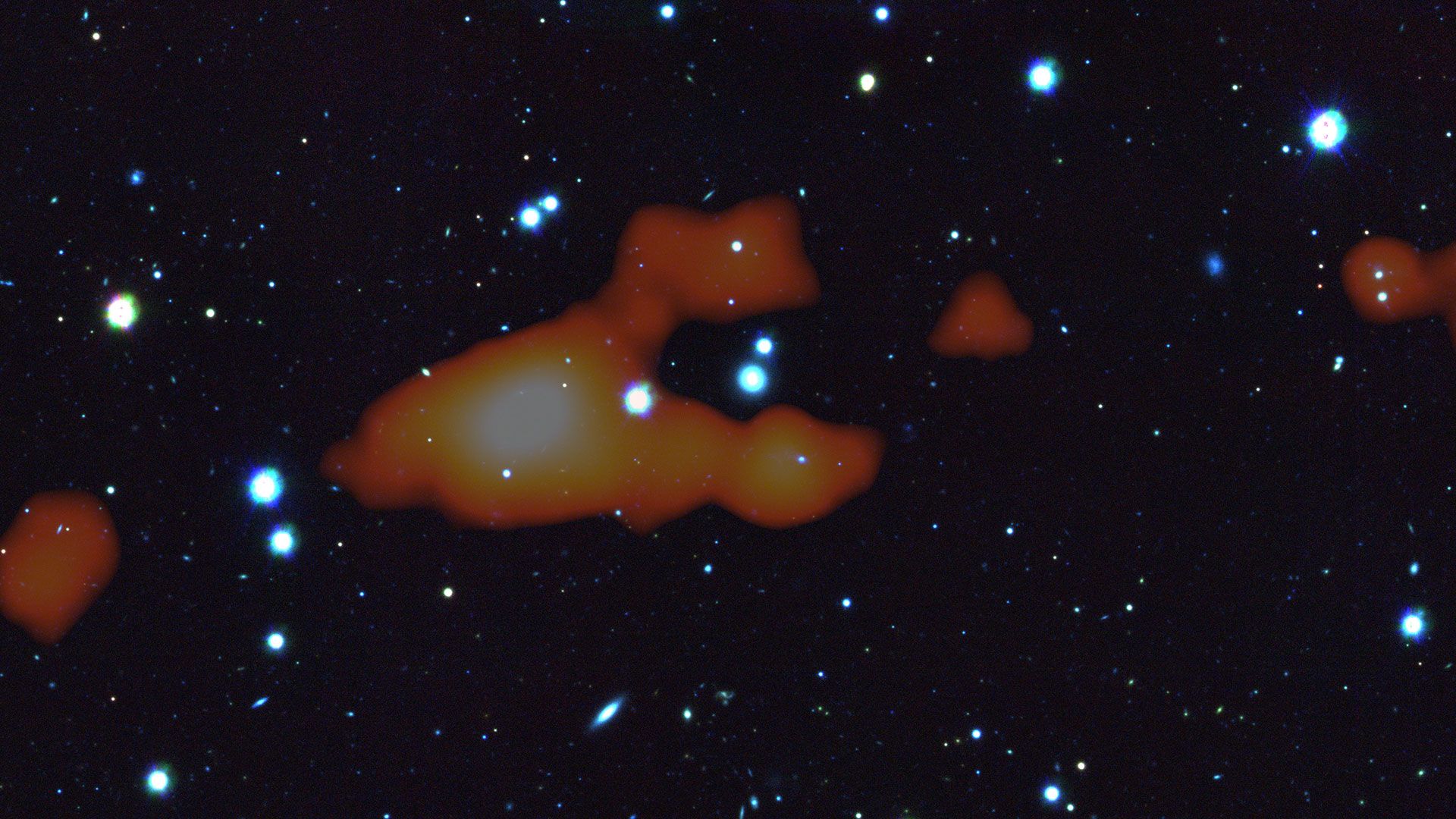
Below are two radio astronomical observations of the neutral hydrogen line (orange), overlaid on optical images and one purely optical observation.


Credit: G. I. G. Józsa, M. Cluver, T. Jarrett.

Credit: B. Sorokin
Header image credit: G. I. G. Józsa, M. Cluver, T. Jarrett
