Cosmology from the Moon in a radio-quiet environment


By Emma van der Wateren, Instrument Scientist, ASTRON, the Netherlands Institute for Radio Astronomy, The Committee on Radio Astronomy Frequencies (CRAF) and Jack Burns, Professor Emeritus and Associate Director, Colorado Space Policy Center, and affiliated to University of Colorado Boulder
The exploration of the early evolutionary stages of our Universe – the Cosmic Dawn, the Epoch of Reionization, and the even earlier Dark Ages – addresses a key gap in our understanding of the Universe.
These epochs are primarily probed through extremely faint, highly redshifted emissions of neutral hydrogen atoms, requiring an exceptionally clean radio spectrum.
Such conditions are uniquely available on the far side of the Moon. However, the rapidly increasing global use of the radio spectrum threatens this pristine environment, making the protection of radio astronomy from the moon more critical than ever.
Science cases
The highly redshifted 21-centimetre (cm) signal from neutral hydrogen atoms provides a sensitive probe of the Dark Ages, when the Universe was still largely homogeneous and governed by fundamental processes, whose properties allow us to directly infer global properties of the Universe. Measurements in this regime offer access to the primordial matter distribution, enabling stringent tests of inflation and the nature of dark matter, free from the complexities of later astrophysical processes.
As structure formation progresses into the Cosmic Dawn, the first stars and black holes begin to heat and ionize their surroundings. The 21-cm signal encodes information on the formation of these first luminous objects and the thermal evolution of the intergalactic medium.
This continues into the Epoch of Reionization, during which the Universe transitions from neutral to ionized, providing insights into galaxy formation and evolution.
Beyond cosmology, ultra-quiet low-frequency observations enable the search for narrowband signals from extraterrestrial technologies through the search for extraterrestrial intelligence (SETI), where distinguishing artificial signals from human-made interference is critical.
In addition, radio observations below 100 megahertz (MHz) may allow the detection of magnetospheric emission from exoplanets, offering a direct probe of planetary magnetic fields and interior properties, and potentially their habitability.
Radio astronomy from the Moon
Radio astronomy from the Moon benefits from the unique conditions in the shielded zone of the Moon (SZM), defined as the region of the lunar far side and adjacent space that is naturally shielded from radio emissions originating within 100,000 km of the Earth.

as the region of the Moon’s surface and adjacent space shielded from emissions originating within a distance of 100,000 km from the centre of the Earth.
Credit: Issler, Pla & Desplats (2024).
This area, located more than 23.2° beyond the lunar limb as seen from Earth, constitutes the most accessible pristinely radio-quiet environment in the inner solar system, free from both terrestrial interference and ionospheric effects. This shielding can be modelled in electrodynamic simulations of radio wave propagation around and through the Moon at 30 kilohertz (kHz), which demonstrate the attenuation achieved.

A growing number of pathfinder and future facilities aim to exploit this environment.
Early missions such as ROLSES (Radio-wave Observations at the Lunar Surface of the photo-Electron Sheath – U.S.) and NCLE (Netherlands–China Low-Frequency Explorer) have demonstrated low-frequency observations from the lunar surface and in cislunar orbit, while also characterizing the local radio environment.
Upcoming experiments, including LuSEE-Night (Lunar Surface Electromagnetics Experiment–Night – U.S.) and PRATUSH (Probing ReionizATion of the Universe using Signal from Hydrogen – India), will build on this by targeting the global 21-cm signal and validating key technologies for stable, calibrated observations during the lunar night.
Additional concepts under development, such as China’s DSL (Discovering the Sky at the Longest wavelength) satellite array and large interferometers like the U.S. FARSIDE and FarView, envisage distributed arrays on the lunar far side or in orbit, operating over frequency ranges from kHz to tens of MHz.
These systems aim to combine global signal measurements with interferometric imaging, providing access to previously unexplored wavelengths and enabling high-sensitivity studies of the early Universe as well as planetary and heliospheric radio emission.
Protection of the SZM
The SZM is the only internationally recognized radio-quiet zone and therefore benefits from the strongest regulatory protection for radio astronomy. The Radio Regulations (Nos. 22.22–22.25) – maintained by the International Telecommunication Union (ITU) – prohibit emissions causing harmful interference to passive services across the entire spectrum within the SZM. They only allow limited exceptions for essential space services, including communications and active sensing required to support lunar missions.
The same kinds of systems are also required for the operation of lunar radio astronomy facilities themselves, meaning that coexistence must be achieved without compromising the radio-quiet conditions on which the science depends.
Recommendation RA.479 of the ITU Radiocommunication Sector (ITU-R) calls for explicit consideration of SZM observations in spectrum planning, prioritization of frequency bands inaccessible from Earth, and coordination between active and passive services. It highlights the importance of access to frequencies below 2 gigahertz (GHz) and across the wider spectrum for key spectral lines and continuum studies.
However, the operational requirements of lunar missions, including communication links and radar systems, imply that such conditions cannot be fully realized in practice, reinforcing the need for effective coordination.
Defining lunar interference risks
An important challenge is that the level of harmful interference in the SZM is not yet well defined. Existing thresholds based on terrestrial observations, such as in ITU-R Recommendation RA.769, must be adapted to the lunar environment, where experiments involve significantly longer integration times and wider bandwidths.
In addition to intentional transmissions, unintended electromagnetic radiation (UEMR) from spacecraft systems represents a growing concern. This radiation can span wide frequency ranges and may exceed acceptable limits, particularly at low frequencies, while their regulatory treatment remains unclear.
Ongoing work in the ITU Radiocommunication Sector (ITU-R) – particularly within Working Party 7B, 7D, and the Space Frequency Coordination Group – is addressing these challenges through sharing studies, the development of protection criteria, and coordination in support of future missions.
Looking ahead to WRC-27
Continued work within ITU-R will be essential in the lead-up to the World Radiocommunication Conference (WRC-27). Priorities include advancing sharing studies in the SZM, establishing protection thresholds tailored to lunar observations, assessing the scientific and regulatory impact of UEMR, and recognizing such impact across ITU-R and the space and communications industries.
Progress in these areas will support informed decision-making at WRC-27 and ensure that appropriate regulatory measures are in place to protect the radio astronomy service, while enabling the sustainable development of lunar activities.
Ultimately, the future of radio astronomy on the Moon will depend on the collective efforts of all stakeholders to preserve the lunar environment as a radio-quiet domain.
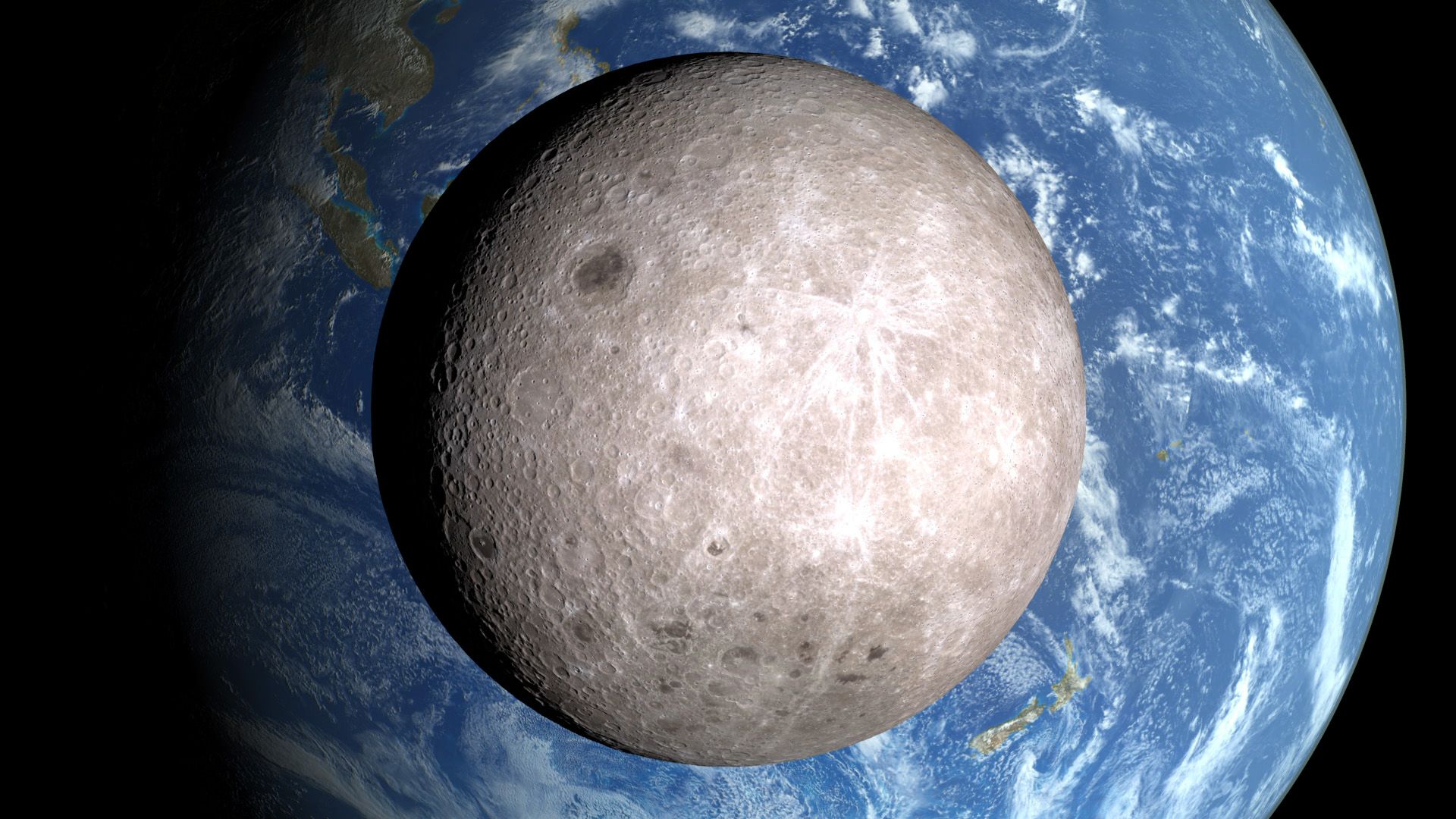
Header image credit: NASA’s Scientific Visualization Studio
