1. Misson of Q5: AI-enabled multimedia applications
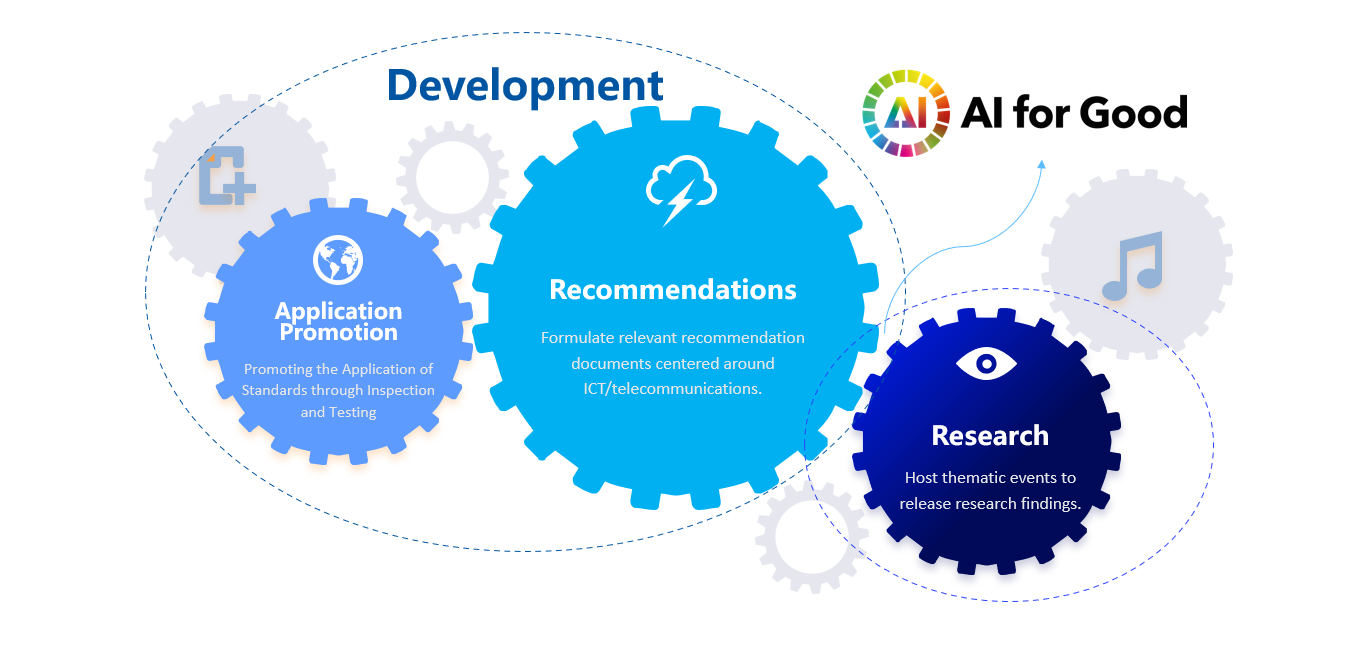
Question 5/21 (Q5/21) focuses on artificial intelligence-enabled multimedia applications, aiming to identify challenges, to analyse the impact, and to boost and innovate the development of multimedia as well as AI industry. Q5/21 collaborates with the ITU AI for Good Summit, to deliver AI-related work through three mutually-reinforcing pillars: Standardization, Promotion and Research. It develops ICT-focused normative documents, drives standard adoption via inspection and testing, and produces evidence-based insights through thematic events.
ITU INTERVIEW: Yuntao Wang, Rapporteur of Question 5 (Q5/21)
"AI-enabled multimedia applications"
| 2. Position of Q5
Internally, Q5/21 liaises with other ITU-T study groups, joint coordination activities and focus groups to gather information on the core elements of AI. Externally, Q5/21 maintains liaisons with ITU-T SG13 and SG17, ISO/IEC JTC 1/SC 29 and SC 42, the and JPEG AI. These liaisons align work plans and terminology and avoid duplication across SDOs. Various study groups are exploring applications and standardization research around information and communication technologies and AI, making use of per-standardization efforts within focus groups, for example to support healthcare (FG-AI4H), autonomous driving (FG-AI4AD) or embodied AI (FG-EAI). SG21 serves as the primary front for AI-enabled multimedia initiatives, complementing the work of other Study Groups. Q5/21 also represents ITU-T externally: it contributes to international AI Standards related conferences and events, support ITU efforts to promote its AI-related standards work with various communication activities, including the recording of experts video interviews, the organization of workshops etc. |
3. Traditional Multimedia VS Intelligent multimedia
Traditional multimedia could be described as a combination of text, audio, image and video resources. Its core workflows cover playback, editing, indexing and format conversion. However, it is constrained by limited semantic understanding and poor cross-media reasoning capacity, only processing the surface-level form of content. Intelligent multimedia, by contrast, has no universally agreed definition yet, but it already differs markedly from traditional multimedia. It is expected to leverage AI to process not only text, audio, image and video, but also human behaviour data. It features understanding-oriented logic, adaptive interaction and active cognition. It delivers cross-media perception, semantic mining and personalized user experiences. These differences—in the data it handles, in the way it processes content, and in the experience it delivers—mark a clear break from traditional multimedia even in the absence of a formal definition. The workflow chain below visualizes the evolution path: starting from basic text-audio-image-video processing, moving into interaction, semantic understanding, and finally generating intelligent responses.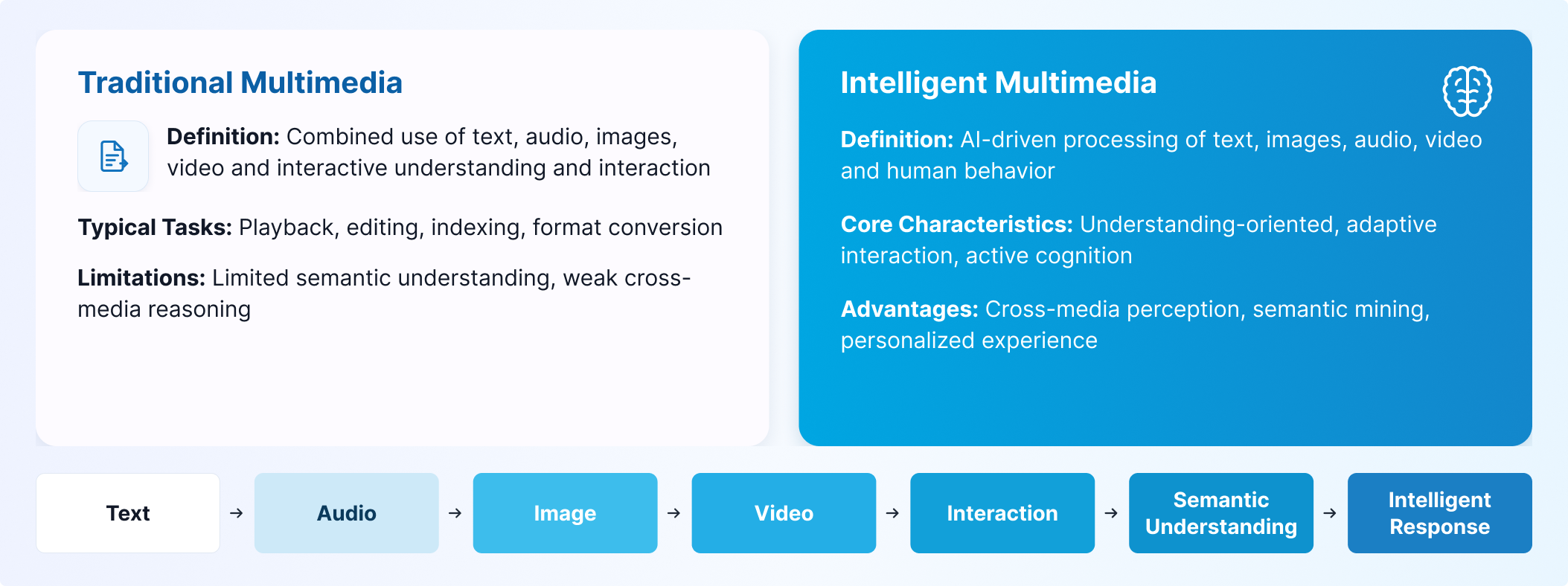
4. Identifying Missing link….
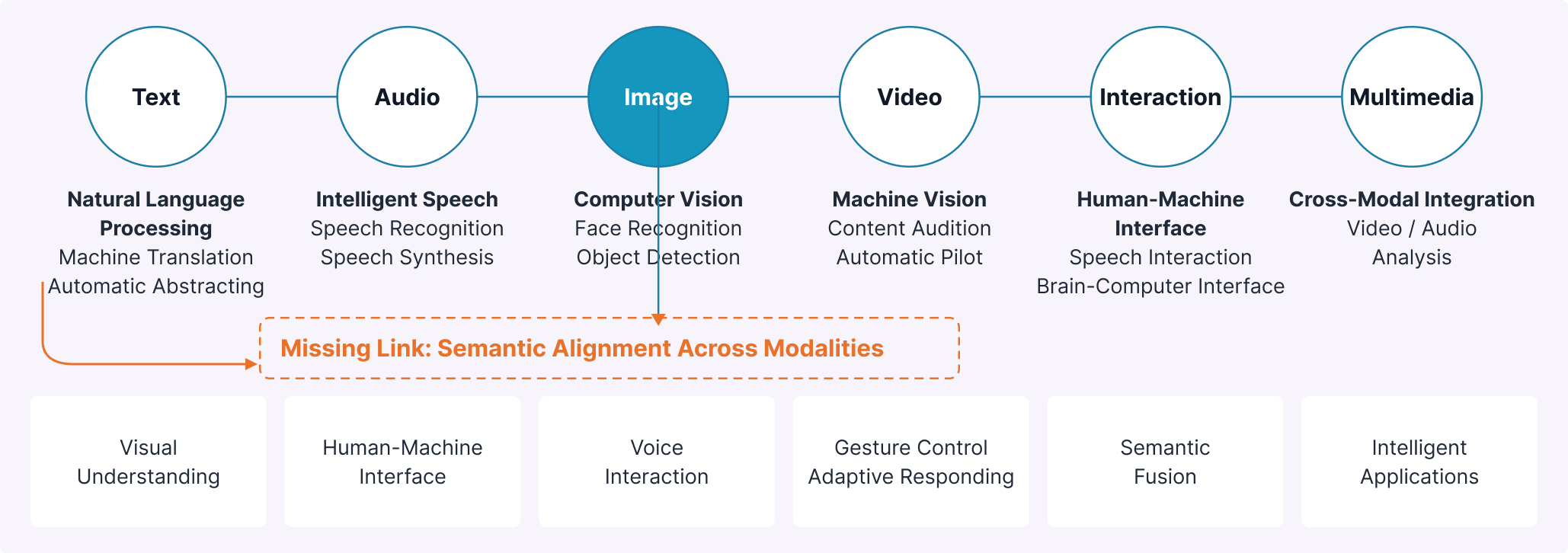
Multimedia is commonly understood as the simple aggregation of multiple modalities: text, audio, image, video, and interaction. Each individual modality has mature, well-developed AI-driven technical branches. Text is powered by Natural Language Processing, covering machine translation, automatic abstracting, content generation and more. Audio is supported by intelligent speech technologies including speech recognition, speech synthesis and question-answering systems. Image and Video benefit from computer and machine vision capabilities such as face recognition, object detection, content audition and automatic pilot. Interaction is realised through human-machine interface techniques, ranging from speech interaction to brain-computer interfaces. While individual-modality AI technologies have achieved remarkable progress, most existing research and standards focus heavily on single-domain capabilities. The "missing link" refers to the lack of systematic cross-modal integration: technologies for combining text, audio, visual content and human-machine interaction into unified, coherent multimedia systems remain insufficiently standardised. This gap forms one of the core challenges addressed by ITU-T SG21 Question 5. Q5 targets AI-enabled multimedia applications, identifying such real-world technical bottlenecks, analysing industry impacts, and driving innovation for both multimedia and AI ecosystems.
5. What should Q5/21 do?
-
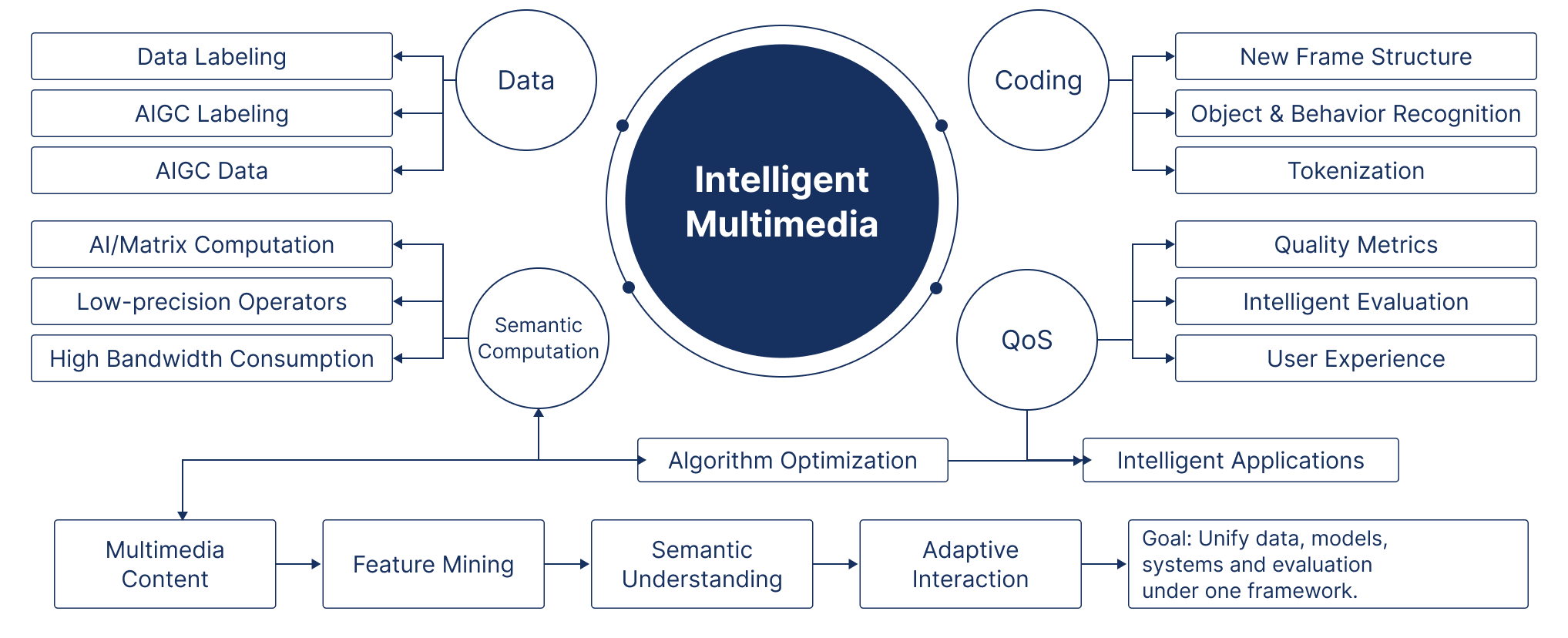
Figure out the framework: Applications are booming; we need to identify the common technical barriers behind all these applications and figure out the Intelligence Enablers.
-
Data preparation: As the gasoline of the modern AI industry, life-cycle AI data management has brought new requirements and challenges.
-
Computation and system impact: AI focused computation differs from general computation. Matrix-oriented optimization brings new technical demands. “Deep learning is transforming how we design computers."
-
Representation and coding: To facilitate intelligent data mining, new frame structures will be needed.
-
QoS: New QoS metrics and assessment methodology are required to evaluate the intelligent part.
6. SG21 AI-enabled ecosystem
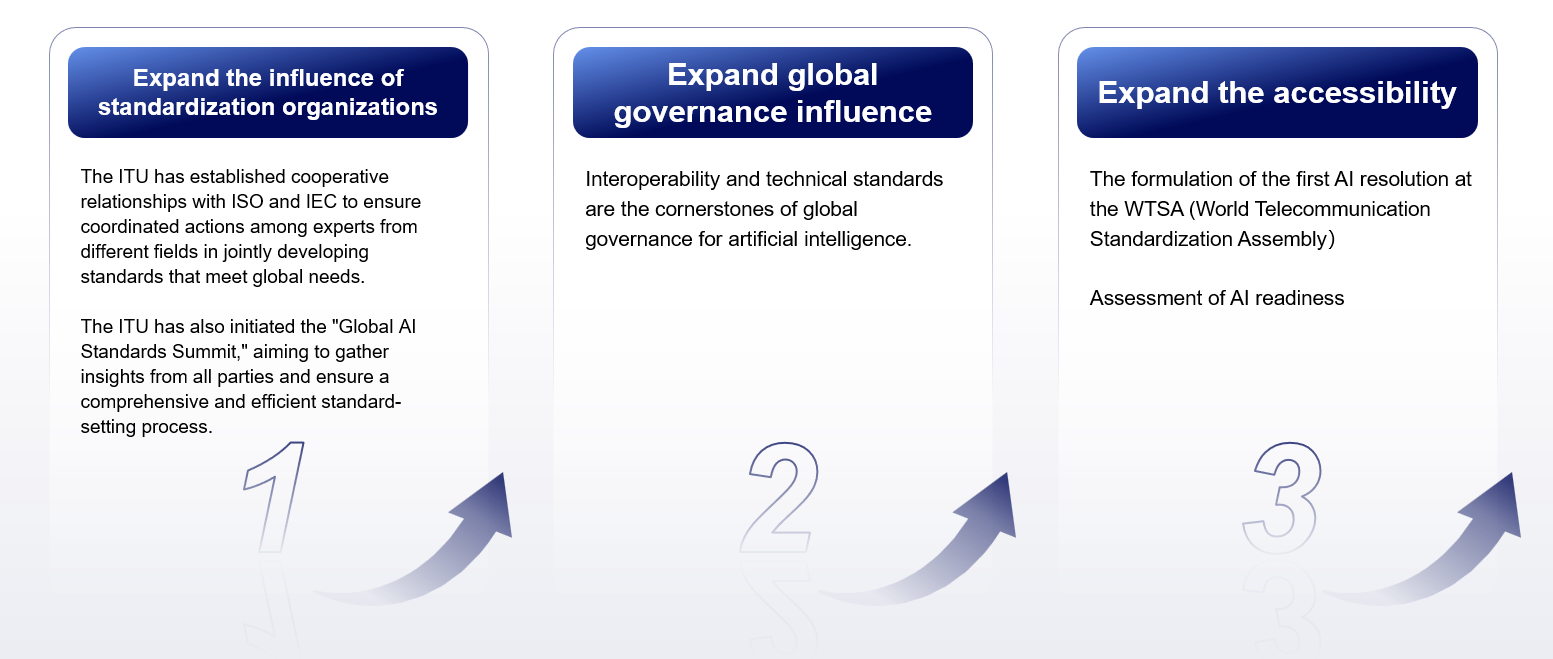
7. Standardization Work - Continuously Expanding the Influence of Standards
Global AI standard-setting advances along three pillars: strengthening coordination among international standards bodies, facilitating global AI governance through interoperability and multi-stakeholder events, and support AI-readiness assessment work.