


Page 663 - AI for Good Innovate for Impact
P. 663
AI for Good Innovate for Impact


               •    REQ-05: It is critical that we have teacher training on using AI-powered creative tools


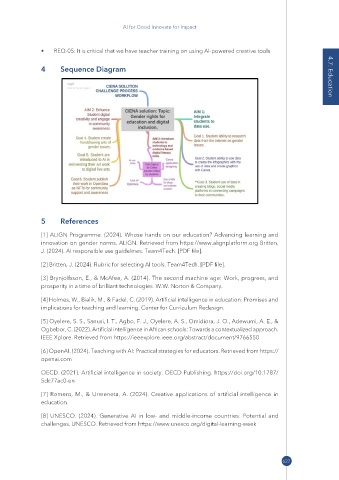
               4      Sequence Diagram                                                                              4.7: Education


               5      References

               [1] ALIGN Programme. (2024). Whose hands on our education? Advancing learning and
               innovation on gender norms. ALIGN. Retrieved from https:// www .alignplatform .org Britten,
               J. (2024). AI responsible use guidelines. Team4Tech. [PDF file].

               [2] Britten, J. (2024). Rubric for selecting AI tools. Team4Tech. [PDF file].

               [3] Brynjolfsson, E., & McAfee, A. (2014). The second machine age: Work, progress, and
               prosperity in a time of brilliant technologies. W.W. Norton & Company.

               [4] Holmes, W., Bialik, M., & Fadel, C. (2019). Artificial intelligence in education: Promises and
               implications for teaching and learning. Center for Curriculum Redesign.

               [5] Oyelere, S. S., Sanusi, I. T., Agbo, F. J., Oyelere, A. S., Omidiora, J. O., Adewumi, A. E., &
               Ogbebor, C. (2022). Artificial intelligence in African schools: Towards a contextualized approach.
               IEEE Xplore. Retrieved from https:// ieeexplore .ieee .org/ abstract/ document/ 9766550

               [6] OpenAI. (2024). Teaching with AI: Practical strategies for educators. Retrieved from https://
               openai .com

               OECD. (2021). Artificial intelligence in society. OECD Publishing. https:// doi .org/ 10 .1787/
               5dc77ac0 -en

               [7] Romero, M., & Urmeneta, A. (2024). Creative applications of artificial intelligence in
               education.

               [8] UNESCO. (2024). Generative AI in low- and middle-income countries: Potential and
               challenges. UNESCO. Retrieved from https:// www .unesco .org/ digital -learning -week


                                                                                                    627

