


Page 668 - AI for Good Innovate for Impact
P. 668
AI for Good Innovate for Impact


                      •    Examples: Devices similar to Fitbit, Huawei Band, or affordable alternatives that support
                           health data APIs.
                      •    Calibration: These are factory-calibrated but can be adjusted based on demographic
                           norms (e.g., age or body mass index). Periodic validation with institutional health
                           practitioners is planned.

                      B) Agriculture & Environmental Sensors (Meal Program Optimization):
                      •    Capabilities: Soil pH, temperature, humidity, light intensity, rainfall detection, and pest
                           activity.
                      •    Examples: Arduino-based and off-the-shelf IoT sensor kits.
                      •    Calibration: Calibration follows manufacturer guidelines and is checked bimonthly,
                           especially for field sensors, using standard reference measures and physical sample
                           testing.

                      Data from these devices is integrated via local hubs (e.g., Raspberry Pi or mobile phones) and
                      transferred to a cloud-based analytics system.

                      REQ-03 - Operational Requirements:

                      •    Training for staff in ICT department(s) and/or system administrators, on using the system.
                      •    Collaboration with stakeholders, including government agencies, NGOs, and local
                           communities.
                      •    Policy frameworks for data privacy, ethical AI, and equitable access to the platform.
                      •    Funding for pilot implementation in selected institutions.
                      •    Long-term investment in scaling the platform across different regions.

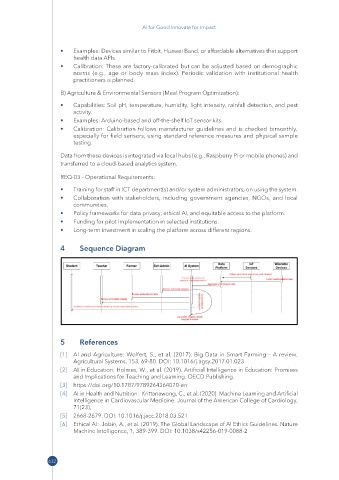
                      4      Sequence Diagram


                      5      References

                      [1]  AI and Agriculture: Wolfert, S., et al. (2017). Big Data in Smart Farming – A review.
                           Agricultural Systems, 153, 69-80. DOI: 10.1016/j.agsy.2017.01.023
                      [2]  AI in Education: Holmes, W., et al. (2019). Artificial Intelligence in Education: Promises
                           and Implications for Teaching and Learning. OECD Publishing.
                      [3]  https:// doi .org/ 10 .1787/ 9789264364070 -en
                      [4]  AI in Health and Nutrition:  Krittanawong, C., et al. (2020). Machine Learning and Artificial
                           Intelligence in Cardiovascular Medicine. Journal of the American College of Cardiology,
                           71(23),
                      [5]  2668-2679. DOI: 10.1016/j.jacc.2018.03.521
                      [6]  Ethical AI:  Jobin, A., et al. (2019). The Global Landscape of AI Ethics Guidelines. Nature
                           Machine Intelligence, 1, 389-399. DOI: 10.1038/s42256-019-0088-2


                  632

