Leaders TalkX 5 - Building Resilience: Secure and Trusted Digital Public Infrastructure
WSIS
Session 483
When a farmer in a landlocked developing country accesses a government service through a shared digital platform, or a small business owner completes a transaction through an open payment system, they are benefiting from something that markets alone did not build and cannot sustain. Digital public infrastructure and digital public goods, from open-source software and open data to open AI models and interoperable standards, are the shared
foundations that make inclusive digital transformation possible on a broader, global scale. Still, it is clear that investment in digital public infrastructure remains uneven, governance frameworks need to be improved, and many developing countries lack the institutional capacity to design, implement, and sustain the shared digital systems their populations need. With global alignment on digital public goods growing stronger through the WSIS framework and the Global Digital Compact, and financing institutions beginning to mainstream digital infrastructure into their investment strategies, momentum is building. However, momentum must translate into durable, secure, and trusted systems that serve people throughout their lifetimes. Join us as we push the conversation from principle to practice, and examine what it takes to design, finance, and govern digital public infrastructure that is genuinely resilient, inclusive, and built to last.

Cheryl Miller is Vice President of Digital Policy. Miller is an accomplished technology executive and a strong advocate for a safe, secure, interoperable and open Internet. She joined USCIB in 2024 and brought with her a broad range of experience in the digital space across government agencies, the private sector and the nonprofit sector.
Miller’s experience in government includes serving as Assistant Chief Counsel for Telecommunications and Technology and the US Small Business Administration’s Office of Advocacy, and Deputy Staff Director for Technology and Innovation for the US Senate’s Small Business Committee. In both roles she worked closely with key agencies such as the FCC, FTC, DOJ, and US State Department on key regulatory and legislative issues in the digital space.
Her previous private sector roles include serving as the Director of International Public Policy and Regulatory Affairs for Verizon, an International Organizations Policy Manager for Meta, and a Manager for Regulatory Affairs at France Telecom. She has also served as a private sector member of the United Nations’ Multistakeholder Advisory Group (MAG) for the Internet Governance Forum, a Vice Chair for the Internet Corporation for Assigned Names and Numbers (ICANN’s) NomCom Committee which reviews and selects ICANN board members and has been a part of numerus international delegations on digital issues.
Miller is also a former professor at The George Washington University, where she helped to launch their Intellectual Property Law Program as part of their Paralegal Studies Program. She is dedicated to helping disadvantaged students access advanced technology, and in her past role as Executive Director of the Kuma Foundation, helped to launch their first Kuma Lab in Pune, India.
Miller is a graduate of Georgetown University and received her law degree from the Catholic University’s Columbus School of Law.
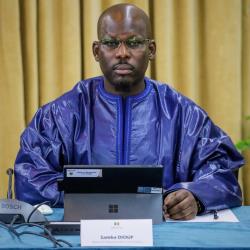

H.E. Mohamed Adam Moalim Ali is a distinguished statesman whose extensive career in public service has shaped Somalia’s governance and policy landscape. Appointed as Minister of Communications and Technology on April 7, 2024, he also serves as a Member of the House of the People in the Federal Parliament of Somalia, where he plays a key role in national legislation and development.
He has held several high-profile ministerial positions, including Minister of Livestock, Forestry & Range and Minister of Public Works, Reconstruction & Housing, leading sectoral reforms, infrastructure projects, and sustainable resource management. His leadership in these roles has driven economic growth and resilience in key industries.
Beyond public service, H.E. Mohamed Adam Moalim Ali has a strong background in the private sector, bringing valuable insights that enhance his governance approach. He is also a dedicated humanitarian, supporting social welfare initiatives through organizations like the Welfare Projects Society and various NGOs, advocating for the well-being of vulnerable communities.
Academically, he holds a Master’s Degree in Business Administration from MAHSA University in Malaysia, alongside specialized diplomas from ALISON in Ireland. This solid educational foundation equips him with strategic foresight and analytical skills, enabling him to engage effectively on national and international platforms.
Since his appointment, H.E. Mohamed Adam Moalim Ali has focused on advancing Somalia’s digital transformation, strengthening digital infrastructure, and positioning Somalia in the global digital economy. One of his key achievements has been the re-establishment of the Postal Department and revival of postal services, a significant step in modernizing the country’s communication sector.
Through his strategic leadership, policy expertise, and commitment to national development, he continues to drive transformative change, fostering innovation and progress for the Somali people.

Undersecretary Sarah Maria Q. Sison serves as the Undersecretary for Policy and Legal and the Head of the Gender and Development (GAD) Program of the Department of Information and Communications Technology (DICT). In this capacity, she exercises direct supervision over the National ICT Planning, Policy, and Standards Bureau and the Legal Service.
Completed her Bachelor of Arts Major in Humanities at the Ateneo de Manila University where she also obtained her Juris Doctor degree in 2008. Upon passing the bar in 2009, she commenced litigation practice with the Escudero Marasigan Vallente and E.H. Villareal Lawfirm. She then worked in the Office of the President and the Presidential Communications Development and Strategic Planning Office in Malacañang Palace from 2010 to 2016. She became a Partner at Reyes Rojas and Associates Lawfirm in 2022.
She moved to Geneva, Switzerland for further studies and in 2017 obtained her LL.M in International Dispute Settlement from the University of Geneva and Graduate Institute of International and Development Studies. In 2018, she obtained her second LL.M in International Arbitration and Dispute Resolution from the National University of Singapore where she was an NUS Center for International Law Merit Scholar. She is a founding member of the Young Philippine Institute of Arbitrators and is currently the VP for International Initiatives of the Philippine Institute of Arbitrators.
.jpg?maxwidth=250)
Rafał Rosiński holds a PhD in Economics and works at Koszalin University of Technology,
where he served as Vice-Dean for Student Affairs. In 2008, he obtained his PhD in
Economics from the Faculty of Economics at the University of Gdańsk. His academic
output includes over 50 publications, including two monographs and several articles in
international journals. In 2009, he won the main prize in the “Złote Skrzydła Gazety
Prawnej” awards for the best book in the “taxes” category.
Previously, Rafał Rosiński served as Deputy Marshal of the West Pomeranian Voivodeship
and was a long-standing member of the Voivodeship Assembly.
Rafał Rosiński has been associated with the Polish Economic Society for over 15 years;
from 2020 to 2024 he was president of the PTE branch in Koszalin, a member of the PTE
National Board, and is a member of the PTE Scientific Council.
.jpg?maxwidth=250)
Shri Anil Kumar Lahoti, Chairman, Telecom Regulatory Authority of India (TRAI) is an
officer of the Indian Railway Service of Engineers from the 1984 batch. He had superannuated as Chairman & CEO, Railway Board on 31st August 2023 after a career spanning about 37 years Indian Railway. He is a graduate in Civil Engineering from Madhav Institute of Technology and Science, Gwalior, with gold medal and has master’s degree in engineering (Structures) from IIT Roorkee. He has worked in various positions in the Central, Northern, North Central, Western, and West Central Railway, as well as in the Railway Board.
Besides Chairman & CEO, Railway Board, some of the important positions held by Shri
Anil Kumar Lahoti include Member Infrastructure, Railway Board, General Manager of Central Railway and Western Railway, Divisional Railway Manager, Lucknow, Northern Railway, Chief
Administrative Officer (Construction), Northern Railway and Executive Director, Railway Board. Post his retirement, Ministry of Railway had appointed him to a One-Man Expert Committee for improvement in inspection and maintenance of track. In December 2023, Gati Shakti
Vishvavidyalaya, Vadodara, a Central University appointed him as a Distinguished Visiting
Professor.
His expertise includes railway operations, track maintenance, project execution and station
redevelopment. During his illustrious career, Shri Lahoti initiated several reforms in execution of infrastructure projects and took several initiatives to modernize and mechanize track maintenance on Indian Railways. During his stints as CRB & CEO, GM and DRM, he brought about significant improvement in freight transport performance and took several customer friendly initiatives to improve the quality of service and ease the customer interface. He has also extensively contributed to planning and structuring of station redevelopment projects in various positions served by him.
Shri Lahoti has travelled to various countries in Europe, North America, Asia, and Australia
in connection with official assignments. He has undertaken executive training programmes at Carnegie Mellon University, Pittsburgh, USA, SDA Bocconi Business School, Milan, Italy and
Indian School of Business, Hyderabad.
He was born to Freedom Fighter Late Shri Ratan Lal Lahoti and Late Smt. Kanchan Devi
Lahoti at Guna, M.P. and is the younger brother of former Chief Justice of India Late Justice R.C. Lahoti. His wife is a homemaker and his son is a working professional in Bangaluru.

Mr. David Mugonyi is the Director General and Chief Executive Officer of the Communications Authority of Kenya (CA). He assumed office on January 15th, 2024.
Mr. Mugonyi has over 20 years of experience in leadership roles spanning public service, media, and strategic communications.
Prior to his appointment, Mr. Mugonyi served in various capacities, including leading strategic communications for the Government of Kenya for over a decade.
As the Head of the Presidential Communications Service, he played a pivotal role as the primary advisor on communications, perception and reputation management at the highest level in the Republic of Kenya.
Mr. Mugonyi had a stellar career in the media, starting as a reporter and rising through the ranks to senior editorial roles at Kenya's leading media house, the Nation Media Group.
In recognition of his distinguished service to the nation, Mr. Mugonyi was feted with the Elder of the Order of the Burning Spear (EBS) award by the President of Kenya, H.E Uhuru Kenyatta, in 2016.
He holds a Masters Degree in International Journalism from City University in the United Kingdom, a Bachelors Degree in Education from the University of Nairobi and a Postgraduate Diploma in Mass Communication from the same institution.
.jpg?maxwidth=250)
Currently serving as the Executive Vice Chairman and Chief Executive Officer of the Nigerian Communications Commission (NCC), Dr. Maida plays a pivotal role in shaping Nigeria's telecommunications landscape. Under his leadership, the NCC continues to advance connectivity, foster innovation, and promote a competitive and inclusive telecommunications industry.
Dr. Maida’s career includes significant contributions to leading global organizations such as British Telecom, Cisco Systems, and EE Ltd. He was also a pioneering engineering team member at UbiquiSys Ltd, a groundbreaking small-cell technology startup acquired by Cisco Systems in 2013.
Prior to his current role, Dr. Maida was the Executive Director of Technology and Operations at the Nigeria Inter-Bank Settlement Systems PLC (NIBSS). There, he spearheaded the modernization of Nigeria’s central digital payments infrastructure, reinforcing its role as a critical enabler of the country’s financial ecosystem.
In November 2024, as CEO, NCC, Dr. Maida joined the International Institute of Communications (IIC) as a Board Director.
Dr. Maida holds a Ph.D. in Electrical and Electronic Engineering from the University of Bath, an MEng in Information Systems Engineering from Imperial College London, and a Postgraduate Diploma in Entrepreneurship from the Cambridge Judge Business School.

Ingrid-Gabriela Hoven is Managing Director of Deutsche Gesellschaft für Internationale Zusammenarbeit (GIZ) GmbH since October 2020. Ms. Hoven is a development economist with more than 30 years of international experience focusing strongly on sustainability, gender and climate issues as well as digital transformation. From 2010 to 2014, she served as World Bank Group Executive Director representing Germany. Prior to this assignment and thereafter, she held various high-level positions in the BMZ (German Federal Ministry for Economic Cooperation and Development). During this time, Ms. Hoven spearheaded new global initiatives such as the NDC Partnership and AFR100, as well as multistakeholder partnerships in the field of climate risk insurance and finance. She is a member of, amongst others, the Supervisory Board of the German Energy Agency (dena), the Board of Trustees of the Max Planck Institute for Tax Law and Public Finance, the Agora Verkehrswende Council and the Insurance Development Forum (IDF) Steering Committee. Ms. Hoven studied economics and political science at Justus-Liebig University Giessen and Université Paris IX/Dauphine. She is alumna of the postgraduate program of the German Development Institute (now IDOS).
.jpg?maxwidth=250)
Ms. Bernadette Lewis was appointed Secretary-General of the Commonwealth Telecommunications Organisation in August 2020. This was a historic appointment as she is the first female Secretary General in the 122-year history of the CTO.
Breaking the glass ceiling is not new to Ms. Lewis; she was also the first female Secretary-General of the Caribbean Telecommunications Union (CTU) since 2003 and is credited for making the CTU the foremost information and communication technology (ICT) inter-governmental institution in the Caribbean.
Ms. Lewis has a wealth of experience and knowledgeable in national and international ICT issues, having also worked in senior positions at the Caribbean Association of National Telecommunications Organisations (CANTO) and Telecommunications Services of Trinidad and Tobago when significant technological changes and convergence were transforming the industry.
Ms. Lewis is passionate about ensuring that the Commonwealth citizens and beyond have affordable access also benefit from effective use of ICT.

Tatyana Kanzaveli is an entrepreneur, investor, and global leader in artificial intelligence and innovation. She is the Founder of WomenInGenAI, a global platform and community advancing women leaders, founders, investors, and operators in artificial intelligence through intelligent connections, knowledge exchange, and opportunity creation. She is also the Founder of Open Health Network, where she has led innovation at the intersection of AI, digital health, and patient-centered care.
Ms. Kanzaveli has addressed international audiences on the implications of emerging technologies for society, industry, and the public good. She has spoken at the United Nations, delivered TEDx talks, and presented at the inaugural White House Demo Day. Her career spans senior enterprise leadership and startup innovation, with extensive experience helping organizations apply advanced technologies to drive transformation, inclusion, and meaningful impact.
Her work focuses on the responsible and strategic use of AI across sectors, with particular emphasis on inclusion, healthcare, the future of work, and the creation of infrastructure that expands access to opportunity. She is widely recognized for her cross-sector perspective on how artificial intelligence can contribute to a more connected, equitable, and forward-looking future.
-
 C1. The role of governments and all stakeholders in the promotion of ICTs for development
-
 C2. Information and communication infrastructure
-
 C3. Access to information and knowledge
-
 C4. Capacity building
-
 C5. Building confidence and security in use of ICTs
-
 C6. Enabling environment
-
 C7. ICT applications: benefits in all aspects of life — E-government
-
 C7. ICT applications: benefits in all aspects of life — E-business
-
 C7. ICT applications: benefits in all aspects of life — E-learning
-
 C7. ICT applications: benefits in all aspects of life — E-health
-
 C7. ICT applications: benefits in all aspects of life — E-employment
-
 C7. ICT applications: benefits in all aspects of life — E-environment
-
 C7. ICT applications: benefits in all aspects of life — E-agriculture
-
 C7. ICT applications: benefits in all aspects of life — E-science
-
 C8. Cultural diversity and identity, linguistic diversity and local content
-
 C9. Media
-
 C10. Ethical dimensions of the Information Society
-
 C11. International and regional cooperation
-
 Goal 1: End poverty in all its forms everywhere
-
 Goal 2: End hunger, achieve food security and improved nutrition and promote sustainable agriculture
-
 Goal 3: Ensure healthy lives and promote well-being for all
-
 Goal 4: Ensure inclusive and equitable quality education and promote lifelong learning opportunities for all
-
 Goal 5: Achieve gender equality and empower all women and girls
-
 Goal 6: Ensure access to water and sanitation for all
-
 Goal 7: Ensure access to affordable, reliable, sustainable and modern energy for all
-
 Goal 8: Promote inclusive and sustainable economic growth, employment and decent work for all
-
 Goal 9: Build resilient infrastructure, promote sustainable industrialization and foster innovation
-
 Goal 10: Reduce inequality within and among countries
-
 Goal 11: Make cities inclusive, safe, resilient and sustainable
-
 Goal 12: Ensure sustainable consumption and production patterns
-
 Goal 13: Take urgent action to combat climate change and its impacts
-
 Goal 14: Conserve and sustainably use the oceans, seas and marine resources
-
 Goal 15: Sustainably manage forests, combat desertification, halt and reverse land degradation, halt biodiversity loss
-
 Goal 16: Promote just, peaceful and inclusive societies
-
 Goal 17: Revitalize the global partnership for sustainable development

- Objective 1: Close all digital divides and accelerate progress across the Sustainable Development Goals
- Objective 2: Expand inclusion in and benefits from the digital economy for all
- Objective 3: Foster an inclusive, open, safe and secure digital space that respects, protects and promotes human rights
- Objective 4: Advance responsible, equitable and interoperable data governance approaches
- Objective 5: Enhance international governance of artificial intelligence for the benefit of humanity