Leaders TalkX 4 - Information Without Barriers: Making Knowledge Accessible
WSIS
Session 470
Access to information and knowledge is essential for human dignity, economic opportunity, and sustainable development. However, millions of people remain unable to fully participate in the information society due to barriers outside of just connectivity alone. These include a lack of locally relevant content, limited multilingual digital resources, low digital literacy, and the persistent underrepresentation of Indigenous peoples and minority language speakers in the online world. With the 2030 Agenda deadline rapidly approaching, the UNGA’s renewed global commitment to aligning the WSIS Action Lines with the Global Digital Compact means that next few years represent a critical moment. Join the discussion around what it will take to tackle these challenges before 2030, and thereafter.

Tara Harris is Group IP Lead – Digital & Regulatory at Prosus (Euronext Amsterdam; PRX), a leading Dutch-listed technology company and one of the world's largest tech investors. Prosus is the power behind leading lifestyle ecommerce brands across Europe, India, and Latin America, unlocking an AI-first world for 2 billion customers. Tara is a strategic intellectual property leader with over 25 years of global experience across all fields of IP law, specializing in digital asset protection, online enforcement, and IP strategy in the rapidly evolving technology landscape.
Her background includes working at international IP law firms including Adams & Adams, Deneys Reitz, and WilmerHale (across Johannesburg and London), followed by independent IP consultancy serving high-profile clients. She has a proven track record of aligning IP portfolios with business objectives, particularly during mergers, acquisitions, and governance transformations spanning over 100 countries and has over ten years in-house experience as IP counsel.
As Group IP Lead, Tara oversees the company's intellectual property strategy, manages global IP risk, and protects digital assets while navigating emerging global regulations. Her tenure is marked by innovation-driven leadership, contributing to Prosus' AI governance frameworks and commercial AI deployment strategy.
Tara is passionate about the intersection of AI and emerging technologies with intellectual property, regularly speaking on topics including AI and IP policy, digital trust, disinformation, cybercrime, and DNS abuse. She recently presented at the 2024 Internet Governance Forum (IGF) in Saudi Arabia on the topic of DNS abuse. Tara is a certified trademark practitioner having completed the Trademark Practitioner exams at the South African Institute of Intellectual Property Law (SAIIPL), covering international trademark law, copyright, patents, and designs. She has completed executive education at Harvard University in Cybersecurity: Managing Risk in the Information Age (2023) and the Executive Management Development Program at Wharton School, University of Pennsylvania (2025). She is also certified as an AI Governance Professional (AIGP) through the International Association of Privacy Professionals (IAPP). Tara serves on the International Trademark Association (INTA) Technology Transformation Committee. In recognition of her influence and achievements, she was nominated for the 2025 WIPR Most Influential Woman in IP Award and shortlisted for the 2025 Lexology European Individual IP In-House Award. Tara’s team won the Lexology best in-house IP Team in Europe award in 2026.
.jpg?maxwidth=250)
H.E. Mr. Sidali Zerrouki is the current Minister of Post and Telecommunications of the People’s Democratic Republic of Algeria. A telecom executive, innovation strategist, and serial entrepreneur, he has held several high-level CxO positions across the ICT and digital sectors, bringing over 20 years of experience at the intersection of technology, entrepreneurship, and public leadership.
Before assuming ministerial responsibilities, Minister Zerrouki was a key architect of Algeria’s startup ecosystem, where he played a transformative role in scaling national innovation platforms, launching funding mechanisms, and boosting regional competitiveness. As a founding force behind several strategic initiatives, he redefined the entrepreneurial landscape in Algeria, paving the way for a generation of innovators and digital creators.
Minister Zerrouki is an IT engineer by training, holding a Master’s degree from Sorbonne University and an MBA from Paris Dauphine University. His academic and operational background allows him to bridge technological insight with policy execution, positioning Algeria as a regional leader in telecom modernization, digital inclusion, and sovereign infrastructure.
Under his leadership, Algeria has accelerated the rollout of national fiber-optic coverage, initiated 5G deployment, established AI and cybersecurity skill centers, and introduced regulatory frameworks for digital trust and data protection. Minister Zerrouki is currently leading Algeria’s strategic engagement in regional and multilateral digital cooperation, including its active contribution to shaping the African Union’s Digital Transformation Agenda and advancing the principles of the WSIS process toward inclusive, secure, and future-ready digital societies.

President, General Authority for Communications and Informatics – Libya
His Excellency Eng. Abdulbaset Al-Baour is the President of the General Authority for
Communications and Informatics (GACI) of Libya, where he leads the national digital
transformation agenda, telecom sector development, and the modernization of digital
government services. He also chairs several national high-level committees, including:
• the National Committee for Digital Transformation,
• the National Strategy Committee for Artificial Intelligence,
• the National Data Governance Committee, and
• the National Telecommunications Strategy Committee.
His Excellency oversees major national platforms and strategic programs, including the National
Digital Identity (LY-DNID), the National Data Exchange Platform (LY-NDEX), the National Open
Data Initiative, and the development of Libya’s cloud, data center, and cybersecurity ecosystem.
At the regional and global levels, Eng. Al-Baour represents Libya in key international forums
such as the ITU, WSIS, AI for Good, UN ESCWA, Smart Africa, and the African Union digital
initiatives. He is actively engaged in shaping Libya’s position in emerging technologies, including
AI governance, 5G development, spectrum management, and digital economy growth.
His Excellency holds extensive experience in ICT policy-making, digital infrastructure
development, and public-sector innovation, and is contributing to global discussions on the
transition from the information society to the intelligent society.

Dr Wijayasuriya is the Chief Advisor to the President of Sri Lanka on Digital Economy. He is also the
Chairman of the Information & Communication Technology Agency (ICTA) of Sri Lanka.
Dr Wijayasuriya stepped down from his position as Chief Executive Officer – Telecommunications Business and Group Executive Director at Axiata Group (one of Asia’s largest Digital Connectivity Providers), in January 2025 to accept an invitation from the President of Sri Lanka to lead the country’s Digital Transformation Agenda in the capacity of the Chief Advisor to the President on Digital Economy.
Dr Wijayasuriya’s career in the Telecommunication’s Industry spans 30 Years, over 25 of which have been at CEO level. Dr Wijayasuriya was honored (in 2024) with the “Chairman’s Award” by the GSM Association in recognition of outstanding contribution to the global mobile industry. Previously in 2017, Dr Wijayasuriya was the recipient of the “Outstanding Contribution to the Asian Mobile Industry” Award in its inaugural year of award.
Dr Wijayasuriya served as a member of the Board of Directors of the GSMA during the period 2022-24. Dr Wijayasuriya is also a Past Chair of GSM Asia Pacific, the regional interest group of the GSMA and also served on the Board of the tmforum.
Dr Wijayasuriya is a Past Chair of the Ceylon Chamber of Commerce and has played an active role in Sri Lanka’s ICT sector and broader public sector on an honorary basis. Dr Wijayasuriya is a Past Chairman of the Arthur. C. Clarke Institute for Modern Technologies and has served on the founding boards of the Information and Communications Technology Agency of Sri Lanka (ICTA), and the Sri Lanka Institute for Nano-Technology (SLINTEC).
In his previous role as the CEO for Telecommunications Business at Axiata, Dr Wijayasuriya led the pan-region Telecommunications Operations of the Axiata Group Bhd., spanning the markets of Malaysia, Indonesia, Bangladesh, Sri Lanka and Cambodia. Dr Wijayasuriya served on the Board of the Axiata Group in the capacity of Group Executive Director, and was also the Founding CEO of Axiata Digital Services – the Group’s Digital Services Business and the Founding Chair of Axiata Digital Labs, the multi-country Software Innovation and Digital Transformation unit of the Axiata Group.
Dr. Wijayasuriya graduated from the University of Cambridge UK in 1989. He subsequently obtained his PhD in Digital Mobile Communications from the University of Bristol UK in 1994. A Chartered Engineer and Fellow of the Institute of Engineering Technology UK, Dr. Wijayasuriya also holds an MBA from the University of Warwick UK.
_(2).jpg?maxwidth=250)
Monsieur Célestin KADJIDJA est un ingénieur en Informatique, avec 30 ans d’expérience dans le domaine des réseaux et management des systèmes d’information, ce dans les secteurs bancaire, transport aérien et la sécurité sociale.
Initialement, il a été formé à l’Ecole d’Ingénieur de Constance en Allemagne après ses études secondaires au Lycée National Léon MBA de Libreville au Gabon.
Il commence sa carrière professionnelle au début des années 1990 dans le secteur bancaire. Par la suite, il intègre le domaine du transport aérien, puis le secteur de la Santé en pilotant des projets informatique et télécom dans le domaine de la Sécurité sociale.
Durant son parcours, il a occupé différentes fonctions, à savoir :
Chef de Projet à la Direction informatique de la Banque BICIG, Groupe BNP-Paribas ;
Directeur Adjoint de la Monétique à la BICIG, Groupe BNP-Paribas ;
Directeur Informatique et Télécommunications au sein de la Compagnie aérienne nationale, Air-Gabon ;
Directeur des Systèmes d’information de la Caisse Nationale de Sécurité Sociale (CNSS) du Gabon ;
Conseiller technique en Systèmes d’information du Directeur Général de la CNSS ;
Conseiller technique en Sécurité des Systèmes d’information du Directeur Général de la CNSS.
En août 2023, il est nommé Président du Conseil de régulation de l’ARCEP Gabon par le Général de Brigade, Brice Clotaire OLIGUI NGUEMA, Président de la Transition, Chef de l’Etat, Président de la République gabonaise.
Pour ce poste, une feuille de route avec des axes de travail ci-après lui a été confiée :
Amélioration de la Gouvernance de l’ARCEP ;
Accélération du développement du service universel ;
Optimisation de la Gestion des ressources en fréquence ;
Assainissement des finances de l’Institution.
Ces directives constituent les ligne directrices de l’action managériale de Monsieur Célestin KADJIDJA depuis sa prise de fonction effective le 5 octobre 2023.
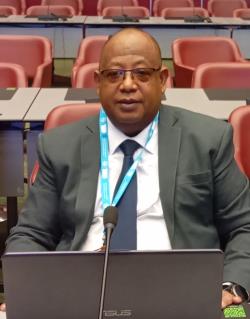
Johanesa ANDRIAMIHAJA
Directeur Général p.i – ARTEC Madagascar
À la tête de l’Autorité de Régulation des Technologies de Communication (ARTEC), Johanesa ANDRIAMIHAJA pilote la transformation du secteur numérique malgache dans un contexte d’accélération technologique et d’ouverture des marchés.
Manager stratégique, il œuvre à concilier innovation, exigences règlementaires et développement économique avec une ambition claire : faire du numérique un levier structurant de croissance, d’inclusion et de souveraineté pour Madagascar.
Son action s’articule autour de priorités majeures :
· Structurer le développement du secteur à travers des feuilles de route favorisant la gouvernance et l’efficacité opérationnelle de l’ARTEC.
· Développer l’influence de Madagascar, en nouant des partenariats stratégiques avec les instances régionales et internationales (UAT, GSMA)
· Moderniser la régulation, en apportant des réponses concrètes et adaptées aux mutations rapides du numérique
Reconnu pour son approche pragmatique et orientée résultats, il s’attache à bâtir un écosystème numérique résilient, inclusif et compétitif au service du développement durable du pays.
.jpg?maxwidth=250)
Mr. Ömer Abdullah Karagözoğlu has been the Chairman of the Board and President of the
Information and Communication Technologies Authority (BTK) of the Republic of Türkiye since
August 2018. He was re-appointed for a second term in August 2022 after completing his first 4
year term in this position.
He was born in Glasgow, Scotland in 1975. He is an Electrical and Electronic Engineer graduated
from Eastern Mediterranean University.
Mr. Karagözoğlu worked as a software engineer at Istanbul Water and Sewerage Administration
(ISKI) of Istanbul Metropolitan Municipality (IMM) from 2002 to 2004. Between 2004 and
2016, he held various managerial positions at BELBIM, a technology company of IMM.
He served as the Adviser to the Chairman and Board Member of BTK before his appointment.
.jpg?maxwidth=250)
Kurt Erik “Kurtis” Lindqvist is a seasoned technology executive and business leader who
became President and Chief Executive Officer (CEO) of the Internet Corporation for
Assigned Names and Numbers (ICANN) on 9 December 2024. With more than 30 years
of experience in engineering and business development of Internet service providers,
Internet Exchange Points, and global network carriers, Lindqvist has dedicated his
career to advancing the stability, security, and accessibility of the Internet.
Prior to joining ICANN, Lindqvist served as CEO of the London Internet Exchange
(LINX), a leading operator of worldwide interconnection services, from 2019 to 2024.
Prior to this, he was CEO of Netnod from 2002 to 2015. Lindqvist also chaired the
European Internet Exchange Association (Euro-IX) from 2003 to 2020, which
underscores his long-standing leadership in Internet infrastructure organizations.
Lindqvist has been a leading voice in Internet governance (IG) and technical
development. He served on the Internet Architecture Board (IAB) and led working
groups within the Internet Engineering Task Force (IETF) and RIPE, where his efforts
helped shape critical Internet standards and policies. Additionally, he has advised the
Swedish government on IG, broadband policy, and other key areas, fostering
collaboration between public and private sectors.
Lindqvist studied Computer Science at Uppsala University, Sweden, and holds an
Executive MBA from the International Institute for Management Development (IMD) in
Lausanne, Switzerland.

Es ingeniero en Ciencias de la Computación y complementó su formación con posgrados
en Administración de Negocios y posee una especialización Políticas Tecnológicas de la
Universidad de Washington; con amplia trayectoria en la gestión de proyectos
tecnológicos y empresariales.
A lo largo de su carrera, ha ocupado roles clave en diversas organizaciones, destacando
su labor y participando activamente en diversas organizaciones de gobernanza de Internet
como ICANN, IETF, NANOG, ARIN y otras, así como miembro de la Junta Directiva de
Racsa y presidente fundador de ISOC Costa Rica.
Además, ha ocupado varios puestos ejecutivos, incluidos Gerente de TI, director de TI y
Juntas Directiva, en empresas transnacionales. Su influencia se extiende a Latinoamérica,
brindando asesoramiento a gobiernos latinoamericanos sobre el establecimiento de
Puntos de Intercambio de Internet (IXP) y sirviendo como consultor de políticas de
telecomunicaciones, fue coautor del primer Libro de interconexión patrocinado por La
Corporación Andina de Fomento (CAF).
-
 C3. Access to information and knowledge
-
 Goal 1: End poverty in all its forms everywhere
-
 Goal 2: End hunger, achieve food security and improved nutrition and promote sustainable agriculture
-
 Goal 3: Ensure healthy lives and promote well-being for all
-
 Goal 4: Ensure inclusive and equitable quality education and promote lifelong learning opportunities for all
-
 Goal 5: Achieve gender equality and empower all women and girls
-
 Goal 6: Ensure access to water and sanitation for all
-
 Goal 7: Ensure access to affordable, reliable, sustainable and modern energy for all
-
 Goal 8: Promote inclusive and sustainable economic growth, employment and decent work for all
-
 Goal 9: Build resilient infrastructure, promote sustainable industrialization and foster innovation
-
 Goal 10: Reduce inequality within and among countries
-
 Goal 11: Make cities inclusive, safe, resilient and sustainable
-
 Goal 12: Ensure sustainable consumption and production patterns
-
 Goal 13: Take urgent action to combat climate change and its impacts
-
 Goal 14: Conserve and sustainably use the oceans, seas and marine resources
-
 Goal 15: Sustainably manage forests, combat desertification, halt and reverse land degradation, halt biodiversity loss
-
 Goal 16: Promote just, peaceful and inclusive societies
-
 Goal 17: Revitalize the global partnership for sustainable development

- Objective 1: Close all digital divides and accelerate progress across the Sustainable Development Goals
- Objective 2: Expand inclusion in and benefits from the digital economy for all
- Objective 3: Foster an inclusive, open, safe and secure digital space that respects, protects and promotes human rights
- Objective 4: Advance responsible, equitable and interoperable data governance approaches
- Objective 5: Enhance international governance of artificial intelligence for the benefit of humanity