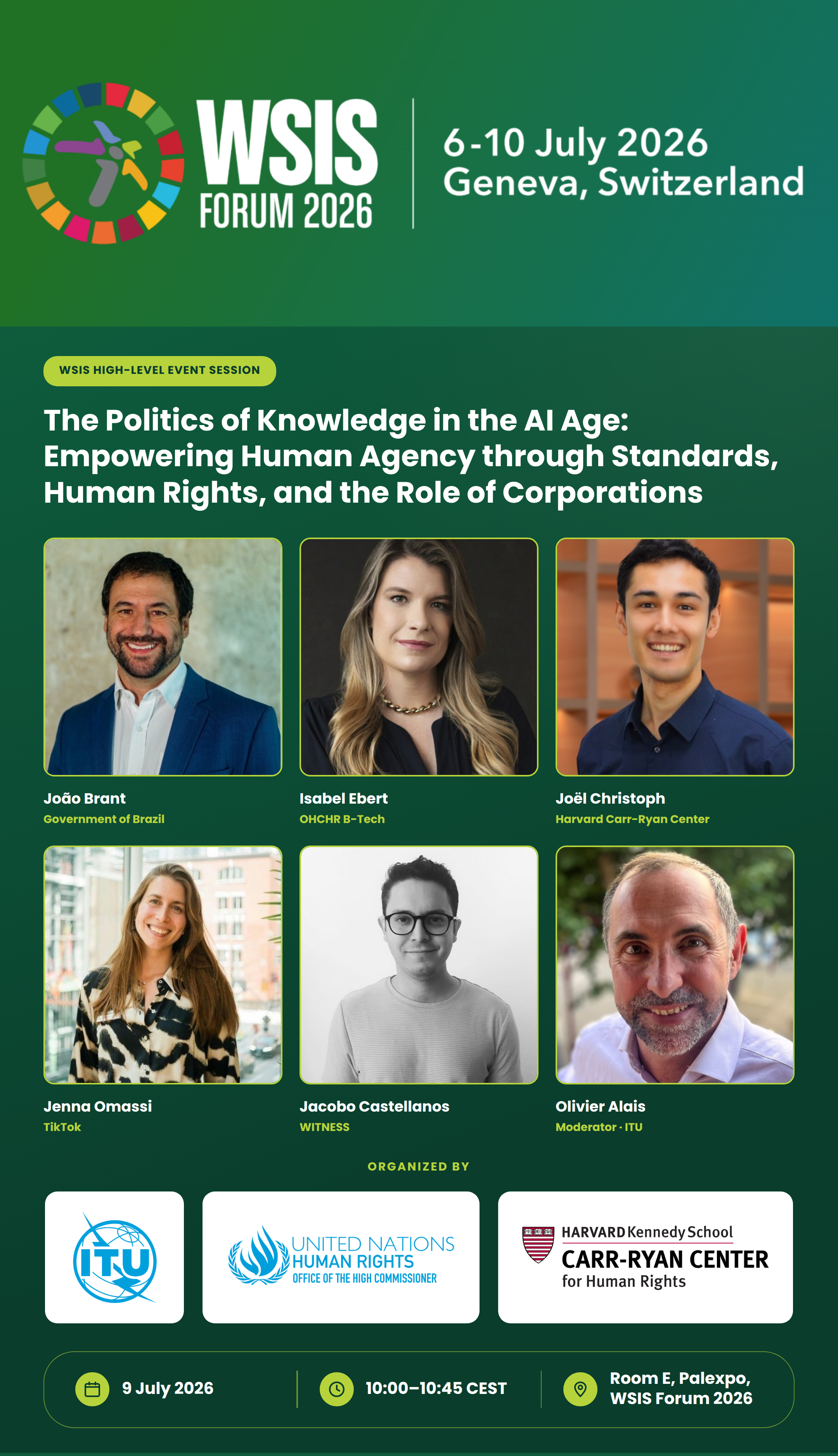
The Politics of Knowledge in the AI Age: Empowering Human Agency through Standards, Human Rights, and the Role of Corporations
International Telecommunication Union, Office of the United Nations High Commissioner for Human Rights and Harvard Kennedy School Carr-Ryan Center
Session 395
Artificial intelligence and data-driven technologies are reshaping not only economies and public services, but the politics of knowledge itself: what can be known, who controls that knowledge, and how it is used to shape individual and collective behavior.
Knowledge distribution and diffusion are increasingly mediated by digital infrastructures that are often privately governed. This triggers a debate about the information environment and how it relates to human rights. In this context, technical standards play a pivotal yet often overlooked role. By shaping data flows, system architectures, interoperability, identity frameworks, content moderation mechanisms, and algorithmic design choices, standards effectively determine how knowledge is produced, circulated, and constrained at scale.
Standards are not neutral: while commonly perceived as purely technical instruments, they increasingly function as infrastructures of governance, influencing power over knowledge and decision-making, with profound implications for human agency, and human rights – such as free expression, access to information, privacy but also freedom of opinion and thought.
This panel explores how AI and technical standards intersect with the politics of knowledge, how they may unintentionally reinforce asymmetries of power, and how human-rights-based approaches to standardization can help realign technical design with democratic values and human rights. The role of the private sector is key here for at least two reasons: first, because companies engage and shape technical standards in standard-development organizations and consortia; and second because these companies also use and adapt to these technical standards. In this sense, it’s useful to coordinate companies’ engagement with a human rights approach, focusing on the UNGPs, and also to understand how human rights and tech standards teams in companies can cooperate to foster a rights-respecting knowledge environment.

Olivier Alais works at the intersection of technology, governance, and human rights, with 20 years of experience across the United Nations, development agencies, and consulting.
At the International Telecommunication Union (ITU), he leads efforts to embed human rights into AI governance, technical standards, and emerging technologies. He also serves as a Fellow at the Harvard Kennedy School’s Carr Center, where he advances research on rights in digital governance.
Previously, he directed major digital programs with the French Development Agency, the World Bank, and USAID, and founded Soukeina, a digital advisory firm delivering projects across Africa, Asia, and Latin America.
His work focuses on building trustworthy, rights-based, and future-ready digital ecosystems that align innovation with equity and accountability.

João Brant is the Secretary of Digital Policy at the Office of Social Communication of the Presidency of the Republic. He holds a Ph.D. in Political Science from Universidade de São Paulo (USP), a master’s degree in Communication Regulation and Policy from the London School of Economics, and a bachelor’s degree in Social Communication from USP. He served as Executive Secretary of the Ministry of Culture (2015–2016) and as Special Advisor to the São Paulo Municipal Secretariat of Culture (2013–2014). He has extensive experience in areas such as freedom of expression, telecommunications infrastructure, and internet rights. He is involved in the formulation and implementation of policies related to AI, focusing on the importance of developing sovereign AI that meets the country’s social and economic needs and is both ethical and inclusive. He has participated in initiatives to promote digital and media education, with the aim of preparing society for the challenges and opportunities of a digital world.

Isabel Ebert is an advisor at the B-Tech Project at UN Human Rights on Business & Human Rights in the technology sector and a member of the OECD AI Group of Experts.
She is also a visiting lecturer at the University of St. Gallen on digital policy and responsible business conduct.
Isabel has been a Technology and Human Rights Fellow at Harvard Kennedy School’s Carr Center and a visiting doctoral researcher at the Oxford Internet Institute. She served as the EU Representative of the Business & Human Rights Resource Centre, based in London and holds a PhD in Business Ethics with a focus on technology governance from the University of St. Gallen.

Joel Christoph is a political economist working on AI governance, technical standards, and human rights. His research examines how standards and AI regulation shape privacy, free expression, and access to information, including recent work proposing a minimal standard for AI provenance and contestability. He has held fellowships at the Centre for the Governance of AI and at Harvard Kennedy School's Carr-Ryan Center for Human Rights Policy, and is a fellow in Globethics' Emerging Leaders in Ethical AI Governance programme. His commentary on AI governance and the EU AI Act has appeared in Lawfare, Tech Policy Press, and the World Economic Forum.

Jenna Omassi is a Public Policy Manager at TikTok where she leads engagement and partnerships with multilateral institutions. She has almost a decade of experience in international technology, security and foreign policy. Prior to working at TikTok, Jenna worked at Ofcom, the UK's communications regulator, and the Government of Canada.

Jacobo Castellanos coordinates the Technology, Threats, and Opportunities team at WITNESS, a global human rights organization supporting communities using video and technology to expose injustice. He examines how emerging technologies, including generative AI and manipulated media, affect the safety, credibility, and agency of people documenting abuses. Jacobo also co-chairs the Threats and Harms Task Force of the Coalition for Content Provenance and Authenticity (C2PA), which develops open standards for verifiable digital content provenance. His work brings a human rights lens to technical design, governance, and advocacy, informed by consultations with grassroots groups, journalists, activists, and technologists worldwide.
-
 C1. The role of governments and all stakeholders in the promotion of ICTs for development
-
 C3. Access to information and knowledge
-
 C4. Capacity building
-
 C5. Building confidence and security in use of ICTs
-
 C6. Enabling environment
-
 C9. Media
-
 C10. Ethical dimensions of the Information Society
-
 C11. International and regional cooperation
This session directly contributes to the WSIS Action Lines by examining how artificial intelligence, data-driven technologies, and technical standards shape the production, circulation, and control of knowledge in the information society. It is particularly relevant to Action Line C3, as it addresses access to information and knowledge in digital environments increasingly mediated by private platforms, algorithmic systems, and technical infrastructures.
The session also contributes to C1 and C11 by bringing together international organizations, academia, civil society, and the private sector to discuss shared responsibilities in AI governance and standardization. It relates to C5, C6, and C10 by exploring how trust, security, ethical considerations, and human rights can be embedded in standards and governance frameworks. Finally, it connects with C9 by addressing the broader information environment, including content moderation, knowledge distribution, and the implications of algorithmic systems for freedom of expression, access to information, privacy, and freedom of thought.
-
 Goal 4: Ensure inclusive and equitable quality education and promote lifelong learning opportunities for all
-
 Goal 9: Build resilient infrastructure, promote sustainable industrialization and foster innovation
-
 Goal 10: Reduce inequality within and among countries
-
 Goal 16: Promote just, peaceful and inclusive societies
-
 Goal 17: Revitalize the global partnership for sustainable development
The session supports the Sustainable Development Goals by addressing how AI governance and technical standards can either reduce or reinforce inequalities in access to information, knowledge, and decision-making power. By focusing on human agency, human rights, and the politics of knowledge in the AI age, the session contributes to SDG 10 and SDG 16, particularly in relation to inclusive societies, accountable governance, and respect for fundamental freedoms.
The discussion also supports SDG 9 by examining the role of technical standards in shaping digital infrastructures and innovation ecosystems. It contributes to SDG 4 by promoting understanding of how knowledge is produced and circulated in AI-mediated environments. Finally, the multi-stakeholder nature of the session, involving ITU, OHCHR, academia, civil society, and the private sector, directly supports SDG 17 by encouraging partnerships for responsible and rights-respecting digital transformation.
- Objective 1: Close all digital divides and accelerate progress across the Sustainable Development Goals
- Objective 3: Foster an inclusive, open, safe and secure digital space that respects, protects and promotes human rights
- Objective 4: Advance responsible, equitable and interoperable data governance approaches
- Objective 5: Enhance international governance of artificial intelligence for the benefit of humanity