Human-Centred Model for Global AI Governance: What Can Be Learned from the Council of Europe’s Framework Convention on Artificial Intelligence (Vilnius Convention)
Permanent Mission of the Republic of Lithuania
Session 229
This session will present the Council of Europe’s Framework Convention on Artificial Intelligence, also known as the Vilnius Convention, as the first comprehensive legally binding international instrument governing artificial intelligence, grounded in human rights, democracy, and the rule of law.
The discussion will explore how the Convention establishes enforceable principles for the design, development, deployment, and oversight of AI systems, including safeguards against discrimination, mechanisms for accountability and transparency, and protections for fundamental freedoms, while also examining its relevance for global AI governance efforts, including ongoing multilateral initiatives such as the United Nations’ Global Dialogue on AI Governance.
By offering a practical regulatory model negotiated among states and open to broader participation, the Convention can serve as a foundational reference point for national legislation and future international norms. The session will also address implementation challenges, capacity-building needs, and opportunities for cooperation with developing countries in support of inclusive and sustainable development. In this context, the Vilnius Convention also contributes to the achievement of the United Nations Sustainable Development Goals, in particular SDG 16 on peace, justice and strong institutions, SDG 10 on reduced inequalities, and SDG 9 on industry, innovation and infrastructure. It provides a policy anchor for aligning AI governance with broader development objectives, including resilient public systems and fair access to digital technologies, while fostering international dialogue and cooperation in support of SDG 17 on global partnerships.
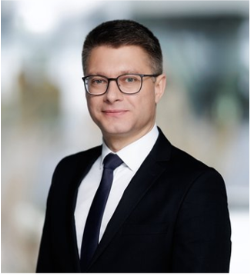
Darius Zailskas is Vice-Minister of the Economy and Innovation. He has more than fifteen years’ experience in technology, data infrastructure and data transmission.
At the Ministry of the Economy and Innovation Vice-Minister oversees the state digitalisation, IT sector development, artificial intelligence development, public procurement and better regulation measures, management of state information resources, electronic identification and trust services, development of the information society and creating a favourable business environment, GovTech.
Previously, he held senior leadership positions at Data Logistics Center, including Chief Executive Officer and Head of the Infrastructure and Technology Department. Earlier in his career, he worked as a Project Manager in the Strategic Projects Department at Technology and Innovation Center. He was also a Member of the Board of Energy Forces (2008 – 2010).

Dr. IMAGAWA Takuo joined Japan’s Ministry of Posts and Telecommunications in 1990 and has since been engaged in various information and communications technology policies at the Ministry of Internal Affairs and Communications (MIC). As Vice-Minister, he has overseen international digital policies, including digital infrastructure, cybersecurity, information integrity, and emerging technologies such as AI. Prior to his current role, he served as Director-General of the Telecommunications Bureau. His career also includes roles as Director-General of the Secretariat, Director-General of the Postal Services Policy Planning Department, and Director-General of the Telecommunications Business Department.
Dr. IMAGAWA holds a B.A.S. and an M.A. in Systems Studies from the University of Tokyo, as well as an M.A. and a Ph.D. in Economics from Harvard University. His academic experience provides a strong theoretical foundation for his policymaking efforts. From 2000 to 2003, he taught economics as an associate professor at Osaka University. He has also served as a visiting scholar at several universities, including the University of Tokyo and Waseda University, and as a research fellow at the Stanford Japan Center-Research. His research interests encompass information economics, industrial organization, and urban economics, and he is the author of numerous books and articles in these fields.

Ambassador Thomas Schneider is leading the Swiss delegation in various fora in the field of digital and internet governance, including AI. In the past 20 years, he has been chairing several international committees and co-initiated several dialogue fora on national and international levels. He is a former Chair (2021-2024) and former Vice-Chair (2024-2025) of the Council of Europe’s Committee on AI (CAI), which negotiated and adopted the Framework Convention.
He is a Bureau Member of the Council of Europe’s Steering Committee on Media and Information Society (he was its Chair in 2018-19 and Vice-Chair in 2020-21). He chaired several CDMSI expert groups. He has also been a member of the bureau of the CoE’s Ad Hoc Committee on Artificial Intelligence in 2019-2021. From 2014-2017, he was the chair of ICANN’s Governmental Advisory Committee and in this role negotiated the compromise among governments and with the other stakeholders regarding the “IANA Stewardship transition”, the biggest reform in the ICANN system. He was a Vice-Chair of the OECD’s Committee for Digital Economy Policy (2020-2022).
He was responsible for the organization of the 12th UN IGF in Geneva in 2017 co-chair of the IGF’s Multistakeholder Advisory Group in 2017. He participated in the meetings of the UN Secretary General’s High-Level Panel on Digital Cooperation, as personal advisor of Swiss President Doris Leuthard (2018-2019). He has also been a co-initiator of the Swiss Internet Governance Forum, since 2013.

Matthias Kloth is the Head of the Council of Europe’s Digital Governance and Sport Department, which is inter alia responsible for Cybercrime, Data Protection and Artificial Intelligence. He has previously worked in the Council of Europe as Adviser in the Office of the Secretary General and the Deputy Secretary General, as Executive Secretary of the Committee on the Evaluation of Anti-Money Laundering Measures and the Financing of Terrorism (MONEYVAL) and as lawyer in the Registry of the European Court of Human Rights. Prior to joining the Council of Europe, he worked as legal officer in the United Nations Office of Legal Affairs and the German Federal Ministry for Economic Affairs and Technology. He holds a doctorate degree in public international law.

Gillian Frost is the Director General for Cyber, Critical Technology and Democratic Resilience. Prior to this assignment she was the Deputy Ambassador in Beijing, China. Previous postings have included Head of Political and Economic Affairs at Canada’s High Commission in Delhi, India; Deputy Head of the Political Section at Canada’s Embassy in Afghanistan; and Second Secretary to the Conference on Disarmament in Geneva. Ms. Frost has occupied various positions in Ottawa, including Executive Director for South Asia (India, Bangladesh, Sri Lanka, Nepal, Bhutan, Maldives) from 2018-2022; Senior Advisor to the Deputy Minister of Foreign Affairs; and, Senior Policy Advisor for the 2010 G20 Summit in Toronto.

Lina Viltrakienė is a career Lithuanian diplomat currently serving as Ambassador-at-Large for Digital and Tech Diplomacy at the Ministry of Foreign Affairs of the Republic of Lithuania. From 2019 to 2024, she served as Lithuania’s first Permanent Representative and Ambassador to the OECD. Throughout her nearly three-decade career at the Lithuanian Ministry of Foreign Affairs, she has focused on trade and economic diplomacy. Prior to 2019, she was the director of the External Economic Relations Department at the Lithuanian MFA. During Lithuania’s EU Council presidency in the second half of 2013, she chaired the Trade Policy Committee/Deputies in Brussels. She has also worked at the Lithuanian Permanent Representation to the WTO in Geneva, Embassy of Lithuania in Oslo. Her portfolio includes EU trade policy, international economic organizations, economic security, economic, digital and tech diplomacy.

P. Pakutinskas also serves as Head of the Legal Tech Centre and Director of the Law, Technology and Business programmes at Mykolas Romeris University.
He is a Board Member of the Artificial Intelligence Association of Lithuania and contributes to European and international initiatives on artificial intelligence governance, regulation and innovation. Among other activities, he serves as Chair of the subgroup on General-Purpose and Agentic Artificial Intelligence within a cooperation framework involving European AI competent authorities.
Professor Pakutinskas’ interdisciplinary research, policy work and publications focus on the intersection of law, business, technology and public policy. His expertise covers artificial intelligence governance, digital regulation, cybersecurity, emerging technologies, innovation ecosystems and responsible digital transformation.
Alongside his academic activities, he works closely with public institutions, industry and technology organisations on the practical deployment and governance of emerging technologies. He has contributed to international initiatives related to AI ethics, regulation, digital governance and capacity-building, while supporting collaboration between academia, government and business communities.
He regularly contributes to international discussions on the future of artificial intelligence, digital governance and innovation policy, with a particular focus on ensuring that technological development remains aligned with human rights, democratic values, economic competitiveness and sustainable societal development
-
 C5. Building confidence and security in use of ICTs
-
 C10. Ethical dimensions of the Information Society
-
 C11. International and regional cooperation
-
 Goal 9: Build resilient infrastructure, promote sustainable industrialization and foster innovation
-
 Goal 10: Reduce inequality within and among countries
-
 Goal 16: Promote just, peaceful and inclusive societies
-
 Goal 17: Revitalize the global partnership for sustainable development
- Objective 3: Foster an inclusive, open, safe and secure digital space that respects, protects and promotes human rights
- Objective 5: Enhance international governance of artificial intelligence for the benefit of humanity