CyberPeace Summit 2026: Multistakeholder Dialogue on WSIS Implementation, WSIS Vision 2035, and WSIS Forum 2026
World Summit on the Information Society and CyberPeace Foundation
Session 110
Hybrid Session - Venue: Golf L1, Bharat Mandapam, New Delhi.
In the context of the WSIS+20 Review outcomes and the newly adopted Global Digital Compact, building trust and security in the digital ecosystem has emerged as a critical enabler for inclusive development. The WSIS+20 UNGA Resolution calls for accelerated multistakeholder action to ensure safe, secure digital spaces while closing persistent digital divides, particularly in developing nations.
This session will showcase global approaches to implementing WSIS Action Lines through the Global CyberPeace Summit's comprehensive program of initiatives. Bringing together governments, civil society, private sector, technical community, and international organizations, the session will highlight practical models of multistakeholder cooperation advancing digital trust, safety, and inclusion worldwide.
The session will feature the iSAFE Hackathon 2026, a global innovation challenge designed to harness technology and generative AI to address emerging threats in online environments, empower digital citizens, and strengthen trust in digital systems. This hackathon exemplifies multistakeholder collaboration in developing technological solutions that advance WSIS Action Lines and sustainable development goals. Learn more at: https://www.itu.int/net4/wsis/forum/2026/Home/Hackathon
Through structured dialogue and case presentations from diverse stakeholders, participants will identify partnership opportunities, exchange best practices on multistakeholder collaboration, and develop recommendations for WSIS implementation toward 2035. The session emphasizes engaging youth and emerging leaders to ensure inclusive participation in shaping digital futures that leave no one behind, demonstrating how WSIS mandates can be translated into concrete action across all Action Lines.
To join the Webinar:
Link: https://us02web.zoom.us/j/85272051178
Passcode:482271
Webinar ID: 852 7205 1178
Passcode: 482271
International numbers available: https://us02web.zoom.us/u/kdsdYGuzAd
Gitanjali Sah is Strategy and Policy Coordinator at the International Telecommunication Union (ITU) and is responsible for the World Summit on the Information Society (WSIS) process. She has more than 15 years of work experience in ICT policy issues at the national, regional and international level. She is an experienced International Civil Servant having worked at several UN Agencies. She holds M.Phil. Development Studies, University of Cambridge, UK and a Masters in Political Science, Jawaharlal Nehru University (JNU), New Delhi, India.

Ms. Cynthia Lesufi is a seasoned Policy and Regulatory Development Manager with over 15 years of experience in the Information and Communications Technology (ICT) sector. In her current role in the Department of Communications and Digital Technologies (DCDT) she is responsible for key areas such as developing and implementing ICTs communications strategies and policies and stakeholder relations engagements. She is the current ITU Minister Council and African Coordinator for ITU Activities in Geneva.

Lieutenant General Rajesh Pant (Retd.) served as the National Cyber Security Coordinator in the Prime Minister's Office and National Security Council Secretariat, Government of India. In this capacity, he was responsible for formulating India's national cybersecurity strategy, coordinating responses to cyber threats, and strengthening cyber resilience across critical infrastructure sectors.
With a distinguished military career spanning over three decades, Lt Gen Pant brings deep expertise in strategic planning, national security, and technology governance. His work has been instrumental in shaping India's cybersecurity architecture, developing public-private partnerships for cyber defense, and fostering international cooperation on cybersecurity issues.
Lt Gen Pant's insights on cyber diplomacy, critical infrastructure protection, and the intersection of national security with digital governance provide valuable perspectives for WSIS implementation in the context of emerging cyber threats and geopolitical challenges.
Vineet Kumar is the Founder and President of the CyberPeace Foundation, a leading civil society organization advancing digital peace, cybersecurity capacity building, and online safety across India and the Asia-Pacific region. Under his leadership, CyberPeace has emerged as a key multistakeholder platform convening governments, industry, civil society, and technical community to address cyber threats and promote trust and safety online.
Mr. Kumar has pioneered several innovative initiatives including the iSAFE program focusing on child online safety, CSAM prevention, and countering technology-facilitated gender-based violence. The WSIS iSAFE Hackathon exemplifies multistakeholder collaboration in developing technological solutions for digital safety challenges.
His work demonstrates practical implementation of WSIS Action Lines C4 (Capacity Building) and C5 (Building Confidence and Security), with particular emphasis on engaging youth, empowering vulnerable populations, and fostering regional cooperation on internet governance and cybersecurity.
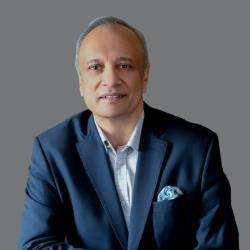
Dr. Samiran Gupta is Vice President, Stakeholder Engagement and Managing Director, Asia Pacific for ICANN.
Before rejoining ICANN in October 2023, Samiran was Senior Director of Global Government Affairs for India and South Asia with Twitter/X Corp. He previously served as ICANN’s Head of India, and Head of Stakeholder Engagement, South Asia from September 2014 until February 2022. Samiran rejoined ICANN to be the Vice President, Government and Intergovernmental Organization (IGO) Engagement for the APAC region, and Stakeholder Engagement for South Asia.
He has extensive experience in business strategy and public policy consulting in sectors including telecom, entertainment, fintech, e-commerce, social media, and energy and renewables. Before joining ICANN, he served as Senior Director with APCO Worldwide where he was responsible for counseling clients in business and public affairs strategy.
He holds a Master’s degree in Business Administration from St Joseph’s University in Philadelphia and a Bachelor of Commerce degree from the University of Calcutta.
He is based in New Delhi.

Jennifer Chung is the Vice President, Policy for DotAsia Organisation. She is a member of the UN IGF Expert Group (2022) convened to discuss and provide recommendations on strengthening and improving the IGF as a space for global multistakeholder discussion on Internet policy issues. She is an appointed member on the United Nations Internet Governance Forum Multistakeholder Advisory Group (2025, and previously from 2018-2020) which advises the UN Secretary General on the annual global UN IGF agenda. Ms. Chung heads the Secretariat for IGFSA which provides support to the global UN IGF, IGF Secretariat, and grants seed funding to National, Regional and Youth Initiatives. She is a part of the Asia Pacific Regional Internet Governance Forum organizing team and works closely with APAC regional partners and communities towards strengthening and amplifying Asia Pacific views and contributions on Internet governance. She is committed to youth capacity building in Internet governance and has designed, supported, and have been invited as guest lecturer at various regional Schools of Internet Governance including APSIG, APIGA, and SSIG (GRULAC).
Ms. Chung represents .Asia Registry at Internet Corporation for Assigned Names and Numbers (ICANN) and is a Generic Names Supporting Organisation (GNSO) councilor, making policies for generic Top-Level Domains. She previously headed the ICG Secretariat that oversaw the transfer of the IANA stewardship from the US government (NTIA) to the global multistakeholder community. Representing DotAsia, she is part of the core Secretariat of the Technical Community Coalition on Multistakeholderism (TCCM), a group of critical Internet infrastructure operators dedicated to strengthening the multistakeholder approach to decisions about the Internet’s future and its governance.
An avid supporter of innovative technology, Ms. Chung is a member of the ISIF.asia Selection Committee that awards grants for research and implementation of technical solutions that support Internet development in Asia Pacific. She works on Internationalized Domain Names policies, previously as part of the CJK coordination for Label Generation Rules for the Han script, and currently on the ICANN IDN Expedited Policy Development Process (IDN EPDP) which will make policy recommendations on the definition and management of IDN variant Top Level Domains. She supports efforts to achieve Universal Acceptance of domain names, a foundational requirement for a truly multilingual Internet, one in which users around the world can navigate entirely in local languages.

Ms. Isabelle Lois works as a Senior Policy Advisor on internet governance, artificial intelligence and digital policy at the Swiss Federal Office of Communications (OFCOM) since 2022. As a legal expert in public international law, she works in policy development at the international level and represents Switzerland in various international fora.
One of her main focuses is AI governance, she is serving as vice-chair of the OECD Working Group on Artificial Intelligence and part of the Steering committee of the Global Partnership on AI (GPAI). She was also actively involved on the swiss delegation negotiating the first convention on AI at the council of Europe with a focus on Human Rights, Democracy and the Rule of Law.
The second core focus is internet governance particularly within the WSIS (World Summit on Information Society) architecture. She is a vice-chair of the UN Commission on Science and Technology for development and actively involved in related process.
On the national level, she is also actively involved in the implementation of Switzerland’s National Action Plan for the safety of media professionals, which was published in May 2023 (available here).
She holds a Master degree (LL.M.) in Public International law, University of Leiden and a Bachelor degree (LL.B) in Swiss Law from the University of Geneva. She is fluent in French, Spanish, Swedish, German and English.
-
 C1. The role of governments and all stakeholders in the promotion of ICTs for development
-
 C2. Information and communication infrastructure
-
 C3. Access to information and knowledge
-
 C4. Capacity building
-
 C5. Building confidence and security in use of ICTs
-
 C6. Enabling environment
-
 C7. ICT applications: benefits in all aspects of life — E-government
-
 C7. ICT applications: benefits in all aspects of life — E-business
-
 C7. ICT applications: benefits in all aspects of life — E-learning
-
 C7. ICT applications: benefits in all aspects of life — E-health
-
 C7. ICT applications: benefits in all aspects of life — E-employment
-
 C7. ICT applications: benefits in all aspects of life — E-environment
-
 C7. ICT applications: benefits in all aspects of life — E-agriculture
-
 C7. ICT applications: benefits in all aspects of life — E-science
-
 C8. Cultural diversity and identity, linguistic diversity and local content
-
 C9. Media
-
 C10. Ethical dimensions of the Information Society
-
 C11. International and regional cooperation
-
 Goal 4: Ensure inclusive and equitable quality education and promote lifelong learning opportunities for all
-
 Goal 5: Achieve gender equality and empower all women and girls
-
 Goal 9: Build resilient infrastructure, promote sustainable industrialization and foster innovation
-
 Goal 16: Promote just, peaceful and inclusive societies
-
 Goal 17: Revitalize the global partnership for sustainable development
- Objective 1: Close all digital divides and accelerate progress across the Sustainable Development Goals
- Objective 2: Expand inclusion in and benefits from the digital economy for all
- Objective 3: Foster an inclusive, open, safe and secure digital space that respects, protects and promotes human rights
- Objective 4: Advance responsible, equitable and interoperable data governance approaches
- Objective 5: Enhance international governance of artificial intelligence for the benefit of humanity