CSW70 WSIS Side Event: Empowering Women and Girls in the Digital Age – Action Toward WSIS 2035
ITU, UNDP, UN Women, WSIS Action Line Facilitators, Albania, Switzerland, South Africa, Women at the Table, APC
Session 108
Zoom Webinar | Virtual Session
The WSIS+20 UNGA Resolution highlights urgent gender gaps in digital access, skills, leadership, and online safety, and calls for accelerated, multistakeholder action to ensure women and girls can participate fully and safely in the digital age. It mandates that gender equality be mainstreamed across all WSIS Action Lines.
To explore how WSIS partners can translate WSIS+20 gender commitments into concrete action by 2035 through:
- Closing gender digital divides
- Strengthening digital skills & leadership
- Ensuring safety and rights online
- Expanding participation of women in digital economies and governance
- Aligning WSIS Action Lines with gender mandates for implementation to 2035
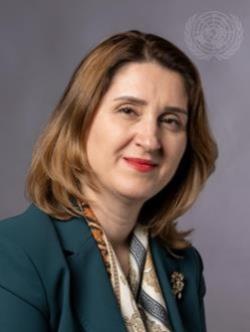
Ms. Janina serves as the Co-Facilitator of the WSIS+20 Review and Permanent Representative of Albania to the United Nations. She brings extensive experience in multilateral diplomacy to this role, having served as Ambassador to the European Union (2014–2024) and General Director for Multilateral Relations at the Ministry of Foreign Affairs (2012–2014). She holds a doctorate in international law from the University of Tirana.

Ms. Isabelle Lois works as a Senior Policy Advisor on internet governance, artificial intelligence and digital policy at the Swiss Federal Office of Communications (OFCOM) since 2022. As a legal expert in public international law, she works in policy development at the international level and represents Switzerland in various international fora.
One of her main focuses is AI governance, she is serving as vice-chair of the OECD Working Group on Artificial Intelligence and part of the Steering committee of the Global Partnership on AI (GPAI). She was also actively involved on the swiss delegation negotiating the first convention on AI at the council of Europe with a focus on Human Rights, Democracy and the Rule of Law.
The second core focus is internet governance particularly within the WSIS (World Summit on Information Society) architecture. She is a vice-chair of the UN Commission on Science and Technology for development and actively involved in related process.
On the national level, she is also actively involved in the implementation of Switzerland’s National Action Plan for the safety of media professionals, which was published in May 2023 (available here).
She holds a Master degree (LL.M.) in Public International law, University of Leiden and a Bachelor degree (LL.B) in Swiss Law from the University of Geneva. She is fluent in French, Spanish, Swedish, German and English.

Cynthia is a seasoned Policy and Regulatory Development Manager with over 15 years of experience in the Information and Communications Technology (ICT) sector. In her current role in the Department of Communications and Digital Technologies (DCDT) she is responsible for key areas such as developing and implementing ICTs communications strategies and policies and stakeholder relations engagements. She is the current ITU Minister Council and African Coordinator for ITU Activities in Geneva.

Yu Ping Chan heads Digital Partnerships and Engagement at UNDP, the United Nations’ development agency. As part of the leadership of UNDP’s Digital, AI and Innovation Hub, Yu Ping helps drive global thought leadership and builds partnerships to support the agency’s digital development work.
Yu Ping previously headed the Rising Nations Initiative Secretariat at the Global Center for Climate Mobility. She has extensive experience with multilateral diplomacy and the United Nations system, having also previously led the Office of the UN Secretary-General’s Envoy on Technology, as well as the Policy and Regional Support teams in the UN Office of Counter-Terrorism. Prior to this, she worked in the UN’s Department of Political Affairs, and in the New York Office of the United Nations Office on Drugs and Crime.
Before joining the UN Secretariat, Yu Ping was a diplomat in the Singaporean Foreign Service. She served at the Singapore Mission to the United Nations in New York as well as at the Ministry of Foreign Affairs, overseeing the Association of Southeast Asian Nations (ASEAN).
Yu Ping has a Bachelor of Arts (magna cum laude) from Harvard University, and a Masters of Public Administration from Columbia University’s School of International and Public Affairs.

Papa Seck is the Chief of UN Women's Research and Data section, where he has been leading statistics since 2009. He spearheaded the development of Women Count, UN Women's global gender data programme in 2016, to improve the production and use of gender data and to help countries monitor the Sustainable Development Goals from a gender perspective.
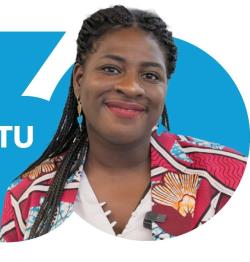
Maud Aba’a is the Associate Gender Affairs Officer at the International Telecommunication Union (ITU), where she works on advancing gender equality and strengthening the participation and leadership of women and girls in the digital sector. Her work focuses on promoting inclusive digital transformation through international cooperation, partnerships and policy dialogue.
She has over seven years of experience working on gender equality, international cooperation and policy across government, European institutions, and multilateral organizations. She holds a Master’s degree in International Relations from the Université Paris Panthéon-Assas and the Sorbonne Université, France and an LL.M. in Public International Law from Leiden University, The Netherlands.

Ms. Kraft-Buchman is the CEO and Founder of Women at the Table and Co-Founder of the A+ Alliance for Inclusive Algorithms, a leader of the UN’s Generation Equality Action Coalition for Technology & Innovation. She leads the AI & Equality: Human Rights Toolbox initiative, which works for a human rights-based approach to AI development. Additionally, she serves as the Civil Society lead for the World Benchmarking Alliance's Collective Impact Coalition for Digital Inclusion and on the Strategic Board of the Laboratory for Women's Rights Online.

Tatyana Kanzaveli is the founder and CEO of Open Health Network and the founder of WomenInGenAI, a global movement accelerating women’s leadership in generative AI. She works at the intersection of emerging tech, policy, and human outcomes—turning AI from hype into practical infrastructure that expands access, trust, and opportunity. A builder and convener, she brings a systems lens to digital inclusion: what must change in data, governance, design, and incentives so women and girls don’t just “use” technology—but shape it. Her work spans healthcare innovation, cross-sector partnerships, and global forums advancing responsible, inclusive digital transformation.

Hija Kamran is the Advocacy Strategist and Lead Editor at the Association for Program Communications (APC). She works at the intersection of technology, human rights, and gender justice informing policy positions on privacy, freedom of expression, platform accountability, and digital inclusion.
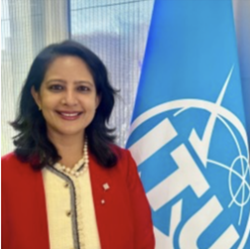
Gitanjali Sah is Strategy and Policy Coordinator at the International Telecommunication Union (ITU) and is responsible for the World Summit on the Information Society (WSIS) process. She has more than 15 years of work experience in ICT policy issues at the national, regional and international level. She is an experienced International Civil Servant having worked at several UN Agencies. She holds M.Phil. Development Studies, University of Cambridge, UK and a Masters in Political Science, Jawaharlal Nehru University (JNU), New Delhi, India.
-
 C1. The role of governments and all stakeholders in the promotion of ICTs for development
-
 C2. Information and communication infrastructure
-
 C3. Access to information and knowledge
-
 C4. Capacity building
-
 C5. Building confidence and security in use of ICTs
-
 C6. Enabling environment
-
 C7. ICT applications: benefits in all aspects of life — E-government
-
 C7. ICT applications: benefits in all aspects of life — E-business
-
 C7. ICT applications: benefits in all aspects of life — E-learning
-
 C7. ICT applications: benefits in all aspects of life — E-health
-
 C7. ICT applications: benefits in all aspects of life — E-employment
-
 C7. ICT applications: benefits in all aspects of life — E-environment
-
 C7. ICT applications: benefits in all aspects of life — E-agriculture
-
 C7. ICT applications: benefits in all aspects of life — E-science
-
 C8. Cultural diversity and identity, linguistic diversity and local content
-
 C9. Media
-
 C10. Ethical dimensions of the Information Society
-
 C11. International and regional cooperation
-
 Goal 1: End poverty in all its forms everywhere
-
 Goal 2: End hunger, achieve food security and improved nutrition and promote sustainable agriculture
-
 Goal 3: Ensure healthy lives and promote well-being for all
-
 Goal 4: Ensure inclusive and equitable quality education and promote lifelong learning opportunities for all
-
 Goal 5: Achieve gender equality and empower all women and girls
-
 Goal 6: Ensure access to water and sanitation for all
-
 Goal 7: Ensure access to affordable, reliable, sustainable and modern energy for all
-
 Goal 8: Promote inclusive and sustainable economic growth, employment and decent work for all
-
 Goal 9: Build resilient infrastructure, promote sustainable industrialization and foster innovation
-
 Goal 10: Reduce inequality within and among countries
-
 Goal 11: Make cities inclusive, safe, resilient and sustainable
-
 Goal 12: Ensure sustainable consumption and production patterns
-
 Goal 13: Take urgent action to combat climate change and its impacts
-
 Goal 14: Conserve and sustainably use the oceans, seas and marine resources
-
 Goal 15: Sustainably manage forests, combat desertification, halt and reverse land degradation, halt biodiversity loss
-
 Goal 16: Promote just, peaceful and inclusive societies
-
 Goal 17: Revitalize the global partnership for sustainable development

- Objective 1: Close all digital divides and accelerate progress across the Sustainable Development Goals
- Objective 2: Expand inclusion in and benefits from the digital economy for all
- Objective 3: Foster an inclusive, open, safe and secure digital space that respects, protects and promotes human rights
- Objective 4: Advance responsible, equitable and interoperable data governance approaches
