


Page 391 - AI for Good Innovate for Impact
P. 391
AI for Good Innovate for Impact


               3      Use Case Requirements

               •    REQ-01: It is critical that the system supports AI-assisted optical beam tracking and
                    alignment to maintain communication stability under environmental disruptions.
               •    REQ-02: It is expected that the solution enables real-time adaptive modulation switching        4.3 - 5G
                    to dynamically respond to changing transmission conditions.
               •    REQ-03: It is critical that atmospheric turbulence models are integrated as input to
                    optimize system performance and predict signal degradation scenarios.
               •    REQ-04: It is expected that the optical hardware and receivers are embedded with AI
                    modules to enable intelligent, on-device processing and decision-making.
               •    REQ-05: It is of added value that the system includes a simulation and testing platform,
                    such as MATLAB Simulink, to validate performance under various operational scenarios.


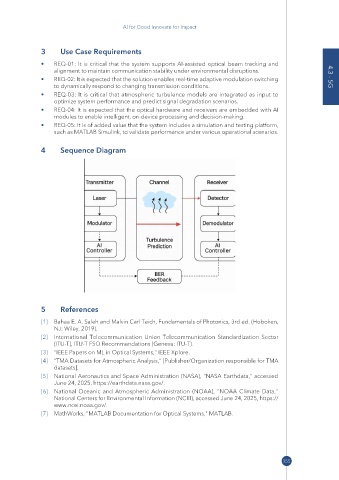
               4      Sequence Diagram


               5      References

               [1]  Bahaa E. A. Saleh and Malvin Carl Teich, Fundamentals of Photonics, 3rd ed. (Hoboken,
                    NJ: Wiley, 2019).
               [2]  International Telecommunication Union Telecommunication Standardization Sector
                    (ITU-T), ITU-T FSO Recommendations (Geneva: ITU-T).
               [3]  "IEEE Papers on ML in Optical Systems," IEEE Xplore.
               [4]  "TMA Datasets for Atmospheric Analysis," [Publisher/Organization responsible for TMA
                    datasets].
               [5]  National Aeronautics and Space Administration (NASA), "NASA Earthdata," accessed
                    June 24, 2025, https:// earthdata .nasa .gov/ .
               [6]  National Oceanic and Atmospheric Administration (NOAA), "NOAA Climate Data,"
                    National Centers for Environmental Information (NCEI), accessed June 24, 2025, https://
                    www .ncei .noaa .gov/ .
               [7]  MathWorks, "MATLAB Documentation for Optical Systems," MATLAB.


                                                                                                    355

