


Page 388 - AI for Good Innovate for Impact
P. 388
AI for Good Innovate for Impact


                          Use Case 20: AI-Driven Free Space Optical Communication System


                      Country: Tanzania

                      Organization: Mbeya University of Science and Technology (MUST)

                      Contact Person(s):

                           Silvester Beatus Mhagama, Email: silv estersilve ster36362@ gmail .com
                           Dr. Joseph Sospeter, Email: joseph.sospeter@ must .ac .tz


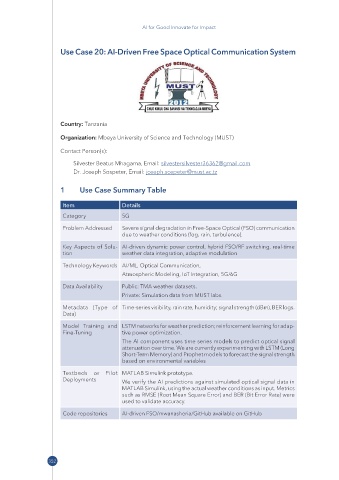
                      1      Use Case Summary Table

                       Item                 Details

                       Category             5G
                       Problem Addressed    Severe signal degradation in Free-Space Optical (FSO) communication
                                            due to weather conditions (fog, rain, turbulence).
                       Key Aspects of Solu- AI-driven dynamic power control, hybrid FSO/RF switching, real-time
                       tion                 weather data integration, adaptive modulation

                       Technology Keywords AI/ML, Optical Communication,
                                            Atmospheric Modeling, IoT Integration, 5G/6G

                       Data Availability    Public: TMA weather datasets.
                                            Private: Simulation data from MUST labs.

                       Metadata (Type of  Time-series visibility, rain rate, humidity; signal strength (dBm), BER logs.
                       Data)

                       Model Training and  LSTM networks for weather prediction; reinforcement learning for adap-
                       Fine-Tuning          tive power optimization.
                                            The AI component uses time series models to predict optical signal
                                            attenuation over time. We are currently experimenting with LSTM (Long
                                            Short-Term Memory) and Prophet models to forecast the signal strength
                                            based on environmental variables

                       Testbeds or Pilot  MATLAB Simulink prototype.
                       Deployments          We verify the AI predictions against simulated optical signal data in
                                            MATLAB Simulink, using the actual weather conditions as input. Metrics
                                            such as RMSE (Root Mean Square Error) and BER (Bit Error Rate) were
                                            used to validate accuracy.

                       Code repositories    AI-driven FSO/mwanasheria/GitHub available on GitHub


                  352

