


Page 389 - AI for Good Innovate for Impact
P. 389
AI for Good Innovate for Impact


               2      Use Case Description


               2�1     Description


               Free Space Optical (FSO) communication offers a promising high-speed alternative to                  4.3 - 5G
               traditional radio frequency (RF) systems, particularly in environments with high bandwidth
               demand. However, the reliability of FSO links is significantly impacted by environmental factors
               such as fog, rain, turbulence, and physical vibrations, which can lead to signal degradation and
               communication loss.


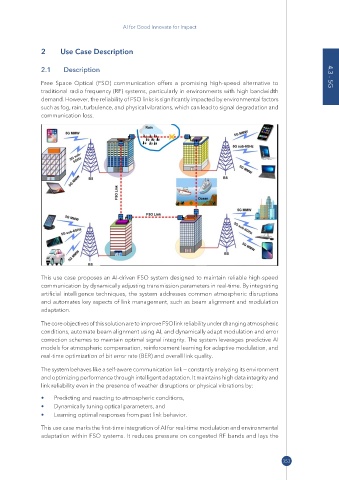
               This use case proposes an AI-driven FSO system designed to maintain reliable high-speed
               communication by dynamically adjusting transmission parameters in real-time. By integrating
               artificial intelligence techniques, the system addresses common atmospheric disruptions
               and automates key aspects of link management, such as beam alignment and modulation
               adaptation.

               The core objectives of this solution are to improve FSO link reliability under changing atmospheric
               conditions, automate beam alignment using AI, and dynamically adapt modulation and error
               correction schemes to maintain optimal signal integrity. The system leverages predictive AI
               models for atmospheric compensation, reinforcement learning for adaptive modulation, and
               real-time optimization of bit error rate (BER) and overall link quality.

               The system behaves like a self-aware communication link — constantly analyzing its environment
               and optimizing performance through intelligent adaptation. It maintains high data integrity and
               link reliability even in the presence of weather disruptions or physical vibrations by:
               •    Predicting and reacting to atmospheric conditions,
               •    Dynamically tuning optical parameters, and
               •    Learning optimal responses from past link behavior.

               This use case marks the first-time integration of AI for real-time modulation and environmental
               adaptation within FSO systems. It reduces pressure on congested RF bands and lays the


                                                                                                    353

