


Page 390 - AI for Good Innovate for Impact
P. 390
AI for Good Innovate for Impact


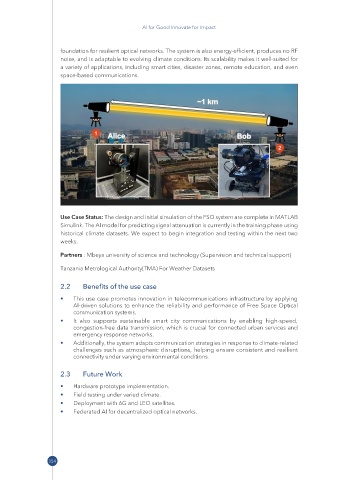
                      foundation for resilient optical networks. The system is also energy-efficient, produces no RF
                      noise, and is adaptable to evolving climate conditions. Its scalability makes it well-suited for
                      a variety of applications, including smart cities, disaster zones, remote education, and even
                      space-based communications.


                      Use Case Status: The design and initial simulation of the FSO system are complete in MATLAB
                      Simulink. The AI model for predicting signal attenuation is currently in the training phase using
                      historical climate datasets. We expect to begin integration and testing within the next two
                      weeks.

                      Partners : Mbeya university of science and technology (Supervision and technical support)

                      Tanzania Metrological Authority(TMA) For Weather Datasets


                      2�2     Benefits of the use case

                      •    This use case promotes innovation in telecommunications infrastructure by applying
                           AI-driven solutions to enhance the reliability and performance of Free Space Optical
                           communication systems.
                      •    It also supports sustainable smart city communications by enabling high-speed,
                           congestion-free data transmission, which is crucial for connected urban services and
                           emergency response networks.
                      •    Additionally, the system adapts communication strategies in response to climate-related
                           challenges such as atmospheric disruptions, helping ensure consistent and resilient
                           connectivity under varying environmental conditions.


                      2�3     Future Work

                      •    Hardware prototype implementation.
                      •    Field testing under varied climate.
                      •    Deployment with 6G and LEO satellites.
                      •    Federated AI for decentralized optical networks.


                  354

