


Page 44 - ITU-T Focus Group Digital Financial Services – Executive Summary
P. 44
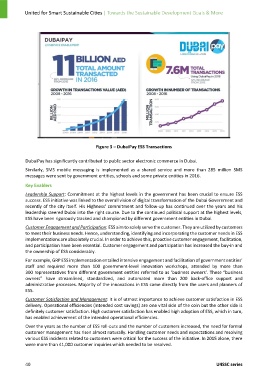
Figure 3 – DubaiPay ESS Transactions


            DubaiPay has significantly contributed to public sector electronic commerce in Dubai.
            Similarly,  SMS  mobile  messaging  is  implemented  as  a  shared  service  and  more  than  285  million  SMS
            messages were sent by government entities, schools and some private entities in 2016.

            Key Enablers
            Leadership Support: Commitment at the highest levels in the government has been crucial to ensure ESS
            success. ESS initiative was linked to the overall vision of digital transformation of the Dubai Government and
            recently of the city itself. His Highness' commitment and follow-up has continued over the years and his
            leadership steered Dubai into the right course. Due to the continued political support at the highest levels,
            ESS have been rigorously tracked and championed by different government entities in Dubai.
            Customer Engagement and Participation: ESS aim to solely serve the customer. They are utilized by customers
            to meet their business needs. Hence, understanding, identifying and incorporating the customer needs in ESS
            implementations are absolutely crucial. In order to achieve this, proactive customer engagement, facilitation,
            and participation have been essential. Customer engagement and participation has increased the buy-in and
            the ownership of ESS considerably.

            For example, GRP ESS implementation entailed intensive engagement and facilitation of government entities’
            staff  and  required  more  than  100  government-level  innovation  workshops,  attended  by  more  than
            300 representatives from different government entities referred to as ‘business owners’. These “business
            owners”  have  streamlined,  standardized,  and  automated  more  than  200  back-office  support  and
            administrative processes. Majority of the innovations in ESS came directly from the users and planners of
            ESS.
            Customer Satisfaction and Management: It is of utmost importance to achieve customer satisfaction in ESS
            delivery. Operational efficiencies (intended cost savings) are one vital side of the coin but the other side is
            definitely customer satisfaction. High customer satisfaction has enabled high adoption of ESS, which in turn,
            has enabled achievement of the intended operational efficiencies.

            Over the years as the number of ESS roll-outs and the number of customers increased, the need for formal
            customer management has risen almost naturally. Handling customer needs and expectations and resolving
            various ESS incidents related to customers were critical for the success of the initiative. In 2015 alone, there
            were more than 41,000 customer inquiries which needed to be resolved.


            40                                                                                   U4SSC series

