


Page 271 - ITU-T Focus Group IMT-2020 Deliverables
P. 271
ITU-T Focus Group IMT-2020 Deliverables                                 4


            3)      Gap E.9 ICN UE provisioning

                    In IMT-2020 networks a user is expected to utilize heterogeneous access technologies, such as WIFI
                    and LTE, at the same time. ICN gives us the opportunity to do this in a natural way. A user can request
                    different pieces of content over different medium, since there is no direct connection between the
                    user and the producer on a particular path. In the PoC we show how we can exploit different access
                    technologies and switch among them, according to the client preferences. The usage of multiple
                    connections increases the bandwidth available at the client and improves the user video experience:
                    the DASH client asks for videos with higher quality, reducing, at the same time, the number of
                    rebuffering events.

            4)      Gap E.6 ICN Protocol Execution
                    In the demo we deploy a virtualized network backhaul, as well as multiple clients that run a DASH
                    video player application. We use an orchestrator to deploy and modify over the time the topology
                    setting.


            5       Functional Chaining System in ICN (Fujitsu Labs of America)
            This POC demonstrates features and capabilities of ICN to dynamically construct functional chains that deliver
            on numerous IMT-2020 goals. Specifically, the functional and performance advantages are highlighted and
            standardization gaps are identified. The POC includes a live demonstration, technical details of which are
            described in Annex B.2.


            5.1     Abstract
            Information-Centric Networking (ICN) is an emerging Internet architecture in which content is accessed by
            its name rather than the IP address of the host that stores the content. By separating content from location,
            ICN is expected to improve network efficiency and reduce the communication cost of accessing popular
            content. While there are several representative ICN designs (Ahlgren, et al. 2012) (Xylomenos, et al. 2014),
            this  demonstration  makes  use  of  the  Named  Data  Networking  (NDN)  (Named  Data  Networking  2016)
            architecture (but its concepts can be applied equally to other ICN architectures).

            ICN principles can be applied to functions as well as to content. Named functions can then be linked to form
            service  chains  that  provide  optimized  service  delivery.  This  demonstration  illustrates  such  a  functional
            chaining system to deliver real-time processed video content to a consumer.

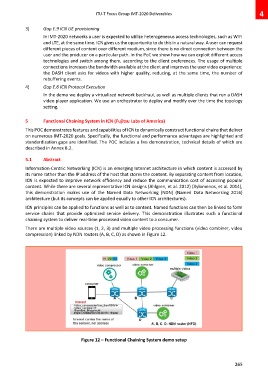
            There are multiple video sources (1, 2, 3) and multiple video processing functions (video combiner, video
            compression) linked by NDN routers (A, B, C, D) as shown in Figure 12.


                                     Figure 12 – Functional Chaining System demo setup


                                                                                                         265

