


Page 270 - ITU-T Focus Group IMT-2020 Deliverables
P. 270
4                                        ITU-T Focus Group IMT-2020 Deliverables


            4       ICN Enhanced Mobile Video at the Network Edge (Cisco)

            ICN provides a unified network and transport layer addressing content by name rather than by location. By
            disrupting  traditional  connection-oriented  communication  model,  ICN  simplifies  data  delivery,  mobility
            management and secure transmission over a heterogeneous network access. In the demo, we select DASH
            video delivery as use case and show the benefits of ICN mobility management, in-network control (rate/loss)
            and  network-assisted  bitrate  adaptation  for  a multi-homed  user  device.  We  also  illustrate  how  ICN  can
            effectively reduce transport cost via native edge caching and multi-point/multi-source communications over
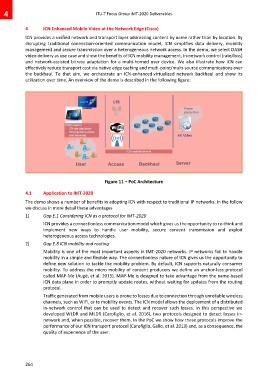
            the  backhaul.  To  that  aim,  we  orchestrate  an  ICN-enhanced virtualized  network  backhaul  and  show  its
            utilization over time. An overview of the demo is described in the following figure:


                                                Figure 11 – PoC Architecture


            4.1     Application to IMT-2020
            The demo shows a number of benefits in adopting ICN with respect to traditional IP networks. In the follow
            we discuss in more detail these advantages
            1)      Gap E.1 Considering ICN as a protocol for IMT-2020
                    ICN provides a connectionless communication model which gives us the opportunity to re-think and
                    implement  new  ways  to  handle  user  mobility,  secure  content  transmission  and  exploit
                    heterogeneous access technologies.
            2)      Gap E.8 ICN mobility and routing
                    Mobility is one of the most important aspects in IMT-2020 networks. IP networks fail to handle
                    mobility in a simple and flexible way. The connectionless nature of ICN gives us the opportunity to
                    define new solution to tackle the mobility problem. By default, ICN supports naturally consumer
                    mobility. To address the micro mobility of content producers we define an anchor-less protocol
                    called MAP-Me (Augé, et al. 2015). MAP-Me is designed to take advantage from the name-based
                    ICN data plane in order to promptly update routes, without waiting for updates from the routing
                    protocol.
                    Traffic generated from mobile users is prone to losses due to connection through unreliable wireless
                    channels, such as WIFI, or to mobility events. The ICN model allows the deployment of a distributed
                    in-network  control  that  can  be  used  to  detect  and  recover  such  losses.  In  this  perspective  we
                    developed WLDR and MLDR (Carofiglio, et al. 2016), two protocols designed to detect losses in-
                    network and, when possible, recover them. In the PoC we show how these protocols improve the
                    performance of our ICN transport protocol (Carofiglio, Gallo, et al. 2013) and, as a consequence, the
                    quality of experience of the user.


            264

