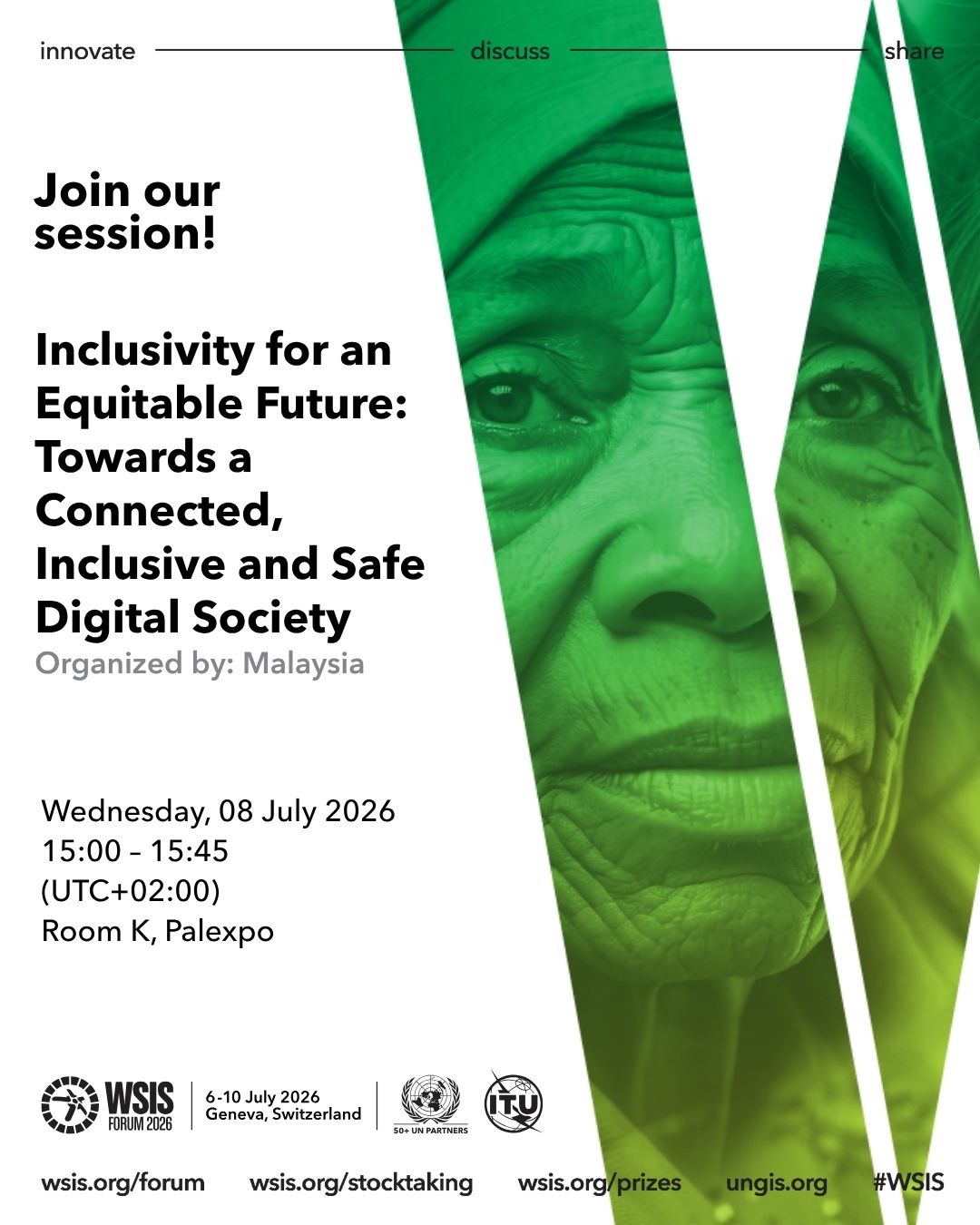
Inclusivity for an Equitable Future: Towards a Connected, Inclusive and Safe Digital Society
Malaysia
Session 492
As digital transformation accelerates, ensuring that it remains connected, inclusive and safe is essential to achieving equitable and sustainable development. This session will showcase Malaysia's digital transformation journey, anchored by the MCMC Five-Year Plan 2026–2030 (MCMC FYP 2030), a human-centred digital governance blueprint guiding the nation's digital future.
The session will highlight three key initiatives that bring this vision to life: the ASEAN 5G Capacity Building Initiative to strengthen regional digital connectivity and skills, the National Technology Innovation Sandbox (NTIS) to foster inclusive innovation and technology adoption, and Sebenarnya.my to enhance digital trust and combat misinformation.
**The panellists will be updated.**

Abdul Karim Fakir bin Ali has over 30 years of experience in the telecommunications sector, spanning mobile, fixed, and international domains, with leadership roles across Malaysia and Southeast Asia. He held key positions at Maxis, Digi, and DTAC Thailand from 1994 to 2013, where he led major network deployments and regional collaborations.
From 2014 to 2025, he served as Chief Technology Strategy Officer and Chief Network Officer at Maxis, where he drove national mobile coverage initiatives and industry-wide cooperation frameworks, contributing significantly to Malaysia’s digital connectivity landscape.
Since July 2025, he has been the Managing Director of the Malaysian Communications and Multimedia Commission (MCMC), where he plays an active role in shaping Malaysia’s digital regulatory agenda and advancing international regulatory cooperation.
He is an active participant in global digital and regulatory forums, representing Malaysia in high-level discussions on digital transformation, connectivity, and emerging technologies. His recent engagements include speaking at the Global Symposium for Regulators (GSR-25 and GSR-26), where he contributed to discussions on inclusive digital ecosystems and regulatory frameworks for safe and meaningful digital markets. He has also participated in the APEC Global Digital and AI Forum 2025, sharing Malaysia’s progress in connectivity, digital inclusion, cybersecurity, and regional cooperation, as well as the Mobile World Congress (MWC) Doha 2025, where he contributed to dialogues on spectrum policy, digital investment, and cybersecurity.
He holds a First-Class Honours degree in Electrical Engineering from the University of Malaya and has received several prestigious academic awards.

A seasoned corporate leader with over 20 years of international experience, Syahrilazli has held senior leadership and board positions across diverse sectors, including telecommunications, information technology, energy, agriculture, finance, manufacturing, government, and management consulting. His career spans both the public and private sectors, with extensive experience in driving organisational transformation, business strategy, digital innovation, and international partnerships across ASEAN and beyond.
Prior to joining MCMC, he advised multinational corporations, state-owned enterprises and governments on strategic transformation, digitalisation and business development, while also leading major initiatives in agriculture, oil and gas, and economic development. Earlier in his career, he served in Malaysia’s Prime Minister’s Department, contributing to the Economic Transformation Programme (ETP), and held various regional leadership roles at Shell, where he managed large-scale commercial operations and received multiple international awards for excellence.
Syahrilazli is a Sloan Fellow in Leadership and Strategy from London Business School, where he specialised in strategic innovation, digital organisations and corporate transformation. Having travelled to more than 50 countries, he brings a global perspective on digital development, innovation ecosystems and international cooperation.

Syed Fikril leads the Corporate Planning function under the Strategy Planning Division at the Malaysian Communications and Multimedia Commission (MCMC), advancing strategic planning, foresight and institutional transformation to support Malaysia’s digital ambitions. He works at the intersection of digital governance, regulatory innovation and organisational strategy, contributing to the development of strategies and initiatives that foster a trusted, inclusive and future-ready digital ecosystem.
He has represented Malaysia at high-level regional and international platforms, including the International Telecommunication Union (ITU) and the Asia-Pacific Telecommunity (APT), contributing to dialogues on digital policy, connectivity, emerging technologies and regulatory cooperation. His expertise spans strategic foresight, digital policy, regulatory transformation and international collaboration to support resilient and sustainable digital development.

Rizal Azwir is the Lead of the National Technology & Innovation Sandbox (NTIS) and Global Testbed & Sandbox Alliance (GTSA) at MRANTI, where he leads programme implementation and works closely with Ministry of Science, Technology and Innovation (MOSTI) and partner agencies to drive operational excellence. He is also a certified Registered Technology Transfer Professional (RTTP) with strong expertise in innovation and technology transfer.
With over a decade of experience in R&D, technology transfer, and IP, Rizal has served at Universiti Kebangsaan Malaysia (UKM), represented Malaysia at the Japan Patent Office (JPO), and contributed to PlaTCOM.
Ventures in advancing R&D commercialization. His work has given him deep insights into supporting researchers and SMEs in bringing innovations to market.

Mohd Nazrol Marzuke currently leads TM’s regulatory strategy, compliance, and stakeholder engagement across economic, technical, and consumer protection domains, ensuring alignment with regulatory frameworks while safeguarding the company’s commercial interests. He drives regulatory outcomes through policy advocacy, industry representation, risk assessment, and collaboration with internal and external stakeholders to support business objectives and regulatory compliance.
Prior to joining corporate world, he had served 21 years in Public Service with stints at Prime Minister’s Department, Federal Court of Malaysia, Public Service Department, Embassy of Malaysia at Washington DC, Ministry of Science, Technology & Innovation (MOSTI), Malaysia Board of Technologists (MBOT) and Ministry of Communications with the last position prior as the Undersecretary of Infrastructure & Application Division.
Nazrol holds a Master of Science from Rochester Institute of Technology (RIT), New York as well as Bachelor in Engineering from Multimedia University (MMU), Malaysia. In addition, he is also a certified Professional Technologist (P.Tech) and Associate Fellow of ASEAN Academy of Engineering & Technology (AFAAET).
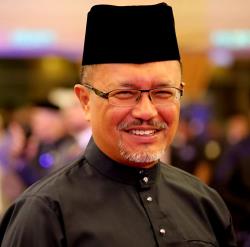
Roslan Rosli is the Head of Government Affairs at CelcomDigi, Malaysia's largest telecommunications service provider. With over 30 years of experience in telecommunications regulation and public policy, he has helped shape Malaysia's communications industry since its liberalisation, including contributions to the Communications and Multimedia Act (CMA), the Access Regime and Universal Service Provision (USP) policy. He previously served on the Boards of Malaysia's Access Forum and Consumer Forum, and participated at various International Telecommunication Union (ITU) forums, including WRC-95 in Geneva and several ITU Plenipotentiary Conferences.
He currently leads CelcomDigi's policy advocacy, government relations and stakeholder engagement, supporting Malaysia's digital transformation and the sustainable development of the communications sector.

Noor Wahida Abu Bakar is a telecommunications regulatory and policy professional with over 10 years of experience in the communications industry. She holds a degree in Electrical Engineering from the University of Toronto, providing a strong technical foundation that complements her expertise in regulatory affairs and strategic policy development.
Throughout her career, Wahida has developed extensive experience in Universal Service Provision (USP), spectrum management, network rollout, project management, and telecommunications policy. She has successfully led and supported regulatory initiatives, stakeholder engagements, spectrum-related matters, and large-scale network deployment projects, helping to drive industry development and enhance connectivity nationwide.
At U Mobile, Wahida plays a key role in managing regulatory and policy matters, ensuring compliance with evolving industry requirements while supporting the company's business and strategic objectives. Her ability to bridge technical, regulatory, and commercial considerations enables her to effectively navigate complex challenges and deliver impactful outcomes.
With a deep understanding of the telecommunications landscape, Wahida is passionate about advancing digital inclusion, promoting consumer benefits, and contributing to the sustainable growth and innovation of Malaysia's communications sector.
-
 C1. The role of governments and all stakeholders in the promotion of ICTs for development
-
 C2. Information and communication infrastructure
-
 C3. Access to information and knowledge
-
 C4. Capacity building
-
 C5. Building confidence and security in use of ICTs
-
 C6. Enabling environment
-
 C7. ICT applications: benefits in all aspects of life — E-government
-
 C7. ICT applications: benefits in all aspects of life — E-business
-
 C7. ICT applications: benefits in all aspects of life — E-learning
-
 C7. ICT applications: benefits in all aspects of life — E-health
-
 C7. ICT applications: benefits in all aspects of life — E-employment
-
 C7. ICT applications: benefits in all aspects of life — E-environment
-
 C7. ICT applications: benefits in all aspects of life — E-agriculture
-
 C7. ICT applications: benefits in all aspects of life — E-science
-
 C8. Cultural diversity and identity, linguistic diversity and local content
-
 C9. Media
-
 C11. International and regional cooperation
-
 Goal 3: Ensure healthy lives and promote well-being for all
-
 Goal 4: Ensure inclusive and equitable quality education and promote lifelong learning opportunities for all
-
 Goal 5: Achieve gender equality and empower all women and girls
-
 Goal 8: Promote inclusive and sustainable economic growth, employment and decent work for all
-
 Goal 9: Build resilient infrastructure, promote sustainable industrialization and foster innovation
-
 Goal 10: Reduce inequality within and among countries
-
 Goal 11: Make cities inclusive, safe, resilient and sustainable
-
 Goal 12: Ensure sustainable consumption and production patterns
-
 Goal 16: Promote just, peaceful and inclusive societies
-
 Goal 17: Revitalize the global partnership for sustainable development

- Objective 1: Close all digital divides and accelerate progress across the Sustainable Development Goals
- Objective 2: Expand inclusion in and benefits from the digital economy for all
- Objective 3: Foster an inclusive, open, safe and secure digital space that respects, protects and promotes human rights
- Objective 4: Advance responsible, equitable and interoperable data governance approaches
- Objective 5: Enhance international governance of artificial intelligence for the benefit of humanity