WSIS Action Line C5 Building confidence and security in the use of ICTs
ITU
Session 294
Cybersecurity for Space-Enabled Information and Communications Technologies
Satellite communications, positioning, navigation and timing services, remote sensing, and environmental monitoring systems are now deeply embedded in global ICT infrastructure. Improving confidence and security in these space-related ICTs is a growing priority for governments, industry, and the technical community.
This session presents early findings from a joint research initiative by the George Washington University Space Policy Institute, the Global Cybersecurity Forum, and ITU on cybersecurity for space-related ICTs. The study examines current and evolving cyber threats to satellite communications and other space-enabled systems, drawing on expert interviews with government, industry, and academic stakeholders across multiple regions. Panelists will discuss the threat landscape for space-enabled ICT infrastructure, emerging policy and technical approaches to strengthening cyber resilience in the space domain, and opportunities for international cooperation to address shared vulnerabilities.
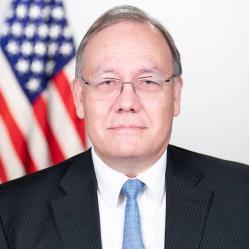
Dr. Scott Pace is the Director of the Space Policy Institute and a Professor of the Practice of International Affairs at George Washington University’s Elliott School of International Affairs. In addition, he formerly served as the Director of the International Institute of Science and Technology Policy as well as the Master of Arts program in International Science and Technology Policy. Dr. Pace is also a member of the faculty of the Trachtenberg School of Public Policy and Public Administration. His research interests include civil, commercial, and national security space policy, and the management of technical innovation.
Dr. Pace rejoined the faculty of the Elliott School in January 2021 after serving as Deputy Assistant to the President and Executive Secretary of the National Space Council from 2017-2020. From 2005-2008, he served as the Associate Administrator for Program Analysis and Evaluation at NASA. Prior to NASA, Dr. Pace was the Assistant Director for Space and Aeronautics in the White House Office of Science and Technology Policy (OSTP). From 1993-2000, Dr. Pace worked for the RAND Corporation's Science and Technology Policy Institute (STPI). From 1990 to 1993, Dr. Pace served as the Deputy Director and Acting Director of the Office of Space Commerce, in the Office of the Deputy Secretary of the Department of Commerce. He received a Bachelor of Science degree in Physics from Harvey Mudd College in 1980; Master’s degrees in Aeronautics & Astronautics and Technology & Policy from the Massachusetts Institute of Technology in 1982; and a Doctorate in Policy Analysis from the RAND Graduate School in 1989.
Dr. Pace received the Order of the Rising Sun with Gold and Silver Stars from the Government of Japan in 2021, the Office of the Secretary of Defense Group Achievement Award in 2020, the NASA Outstanding Leadership Medal in 2008, the US Department of State’s Group Superior Honor Award (GPS Interagency Team) in 2005, and the NASA Group Achievement Award (Columbia Accident Rapid Reaction Team) in 2004. He has been a member of the US Delegation to the World Radiocommunication Conferences in 1997, 2000, 2003, and 2007. He was also a
member of the US Delegation to the Asia-Pacific Economic Cooperation Telecommunications Working Group, 1997-2000. More recently, he has served as a member of the U.S. Delegation to the UN Committee on the Peaceful Uses of Outer Space in 2009, 2011-17, and 2022-2024. Dr. Pace was a member of the NOAA Advisory Committee on Commercial Remote Sensing (ACCRES) from 2012-2017 and was the Vice-Chair. Dr. Pace is a former member of the Board of Trustees, Universities Space Research Association, a Member of the International Academy of Astronautics, an Associate Fellow of the American Institute of Aeronautics and Astronautics, and a Fellow of the American Astronautical Society.

Ms Hunter has had a distinguished 20+ career in cyber affairs, including in the Australian Cyber Security Centre, recently as the First Assistant Director General Cyber Security Resilience.
She has served overseas as Head of Cyber Threat Operations Technical Teams, National Cyber Security Centre, in the United Kingdom’s Government Communications Headquarters (GCHQ); and was seconded to the United States’ National Security Agency (NSA) as Deputy Australian Liaison Officer.
Ms Hunter holds a Bachelor of Asian Studies, a Bachelor of Arts, and a Master of Strategic Studies from the Australian National University.

Abdurahman Al Hassan is the CEO of the Global Cybersecurity Forum (GCF). Under his leadership, the GCF has evolved into a premier convening platform for policymakers, decision-makers, and experts dedicated to strengthening global cyber resilience.
He guides the delivery of the forum's research, platforms, and initiatives—including Child Protection in Cyberspace and Women Empowerment in Cybersecurity. Furthermore, he has expanded the GCF's reach through an impactful set of activities, such as its Centers of Excellence, and the Centre for Cyber Economics, which build enduring hubs to anchor cyber research and economic collaboration.
He also chairs the Standardization Advisory Group at the UN's specialized ICT agency, shaping the technical norms that will govern tomorrow's digital infrastructure. A Harvard alumnus, he holds executive credentials from MIT and George Washington University, and a master's degree in communication engineering from King Saud University.
.jpeg?maxwidth=250)
Gretchen Bueermann works on emerging technology policy at the International Telecommunication Union (ITU), where she covers frontier topics including space connectivity, resilience, bridging the digital divide. She supports ITU's Academic Advisory Body on Emerging Technologies and leads Space Connect, ITU's series on space and telecommunications policy. Prior to ITU, she was a Lead at the World Economic Forum's Centre for Cybersecurity and a Global Data Science Officer at IOM. She holds an MA in International and Development Economics from Yale University.

Alexandre Vallet is the current Chief of the Space Services Department in the Radiocommunication Bureau of the International Telecommunication Union (ITU), since November 2017. As such, he leads the team responsible for the maintenance of the international registry of satellite radio frequencies, which allows all countries around the world to coordinate their use in order to avoid radio interference in outer space. He began to work in 2000 in the R&D center of Orange dealing with communications satellites. In 2006, he joined the satellite operator Eutelsat where he was in charge of regulatory matters. From 2007 to 2017, he was the Head of the Regulatory affairs and Spectrum/Orbit Resources Department at the French Agency in charge of radio spectrum management (Agence Nationale des Fréquences – ANFR).
-
 C5. Building confidence and security in use of ICTs
The session is aligned with WSIS Action Line C5 and its focus on building confidence and security in the use of ICTs, including network security, incident response, and the promotion of secure and reliable applications. It invites multistakeholder input ahead of the study's publication later in 2026.
-
 Goal 9: Build resilient infrastructure, promote sustainable industrialization and foster innovation
-
 Goal 16: Promote just, peaceful and inclusive societies
-
 Goal 17: Revitalize the global partnership for sustainable development
The session contributes primarily to SDG 9 by addressing the security and resilience of space-enabled ICT infrastructure. It also supports SDG 16 through efforts to build trust, security, and resilience in digital systems, and SDG 17 through international and multistakeholder cooperation on shared cybersecurity challenges affecting space-related ICTs.
- Objective 3: Foster an inclusive, open, safe and secure digital space that respects, protects and promotes human rights