From Access to Leadership: AI for Women’s Empowerment and Inclusive Growth
Her Symbiosis and 499 Group
Session 178
.png)
As the world accelerates toward a digital future, Artificial Intelligence (AI) presents a dual reality for gender equality. On one hand, AI risks perpetuating historical biases, deepening the digital divide and excluding women from economic opportunities. On the other hand, when designed inclusively, AI offers unprecedented tools to leapfrog structural barriers. However, the needs of women and girls are not monolithic. A young girl in a rural community needs AI literacy to complete basic education. Her Symbiosis initiative explores the role of artificial intelligence as a catalyst for advancing gender equality and expanding opportunities for women worldwide. It focuses on enabling access to education and digital skills for women in developing regions, while supporting women in more advanced economies to drive innovation, entrepreneurship, and leadership in emerging technologies.
Her Symbiosis is dedicated to connecting women technology leaders, academia, innovation ecosystems and civil society to explore how digital technologies and artificial intelligence can serve humanity and a sustainable future.

Li Ran has long been engaged in building and connecting international cooperation platforms, entrepreneurial communities, and innovation ecosystems. She has extensive experience in supporting young entrepreneurs, integrating cross-border resources, and advancing the international development of platforms. As one of the founders of the APEA Asia-Pacific Youth Entrepreneurs Forum, she has played an active role in platform building and in the development of multiple international exchange and cooperation initiatives, while maintaining a strong focus on technology innovation, entrepreneurship support, and women’s development.
At this side event on “AI for Global Women’s Development,” Li Ran will share insights from the perspective of international platform collaboration and entrepreneurial empowerment. She will discuss how artificial intelligence, innovation networks, and cross-sector collaboration can create more opportunities for women at different stages of development and in different regions around the world, particularly in education, personal growth, entrepreneurship, and leadership. She will also introduce the vision, values, and future direction of Her Symblosis, and explore how to bring together more female innovators, founders, and leaders to help build a more inclusive, sustainable, and future-oriented global ecosystem for women’s development.

H.E. Ms. Lavina Ramkissoon serves as the co-chair of the African Union Science Technology Commission ASRIC/ASTR Council on 4IR. She is a visionary figure in the advancement of responsible AI, dedicated to harnessing technology for good and unlocking humanity’s potential. Recognised as a Top 10 Leader advancing AI globally. A true full-stack human Amb. Lavina combines her expertise in psychology, technology, and economics to bring a unique and insightful perspective to AI development.
Her dedication and achievements are evident in her numerous accolades including top 10 leaders shaping AI. A futurist who’s vision is to accelerate the world’s augmentation of data by creating a more intelligent tomorrow through the footprints of collective humane knowledge. She’s not just a leader; she’s an inspiration, earning the title #aiMOM for fostering responsible development for a better tomorrow.
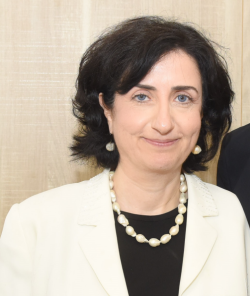
Dr. Mariette Awad is the Director of the Artificial Intelligence, Data Science and Computing Hub at the American University of Beirut (AUB), Lebanon, and a tenured Associate Professor in the Department of Electrical and Computer Engineering. Her academic contributions are globally recognized; she ranked among the top 2% of the world’s most-cited researchers since 2022 and is a career impact (Stanford–Elsevier citation database). In 2024, she received the Abdul Hameed Shoman Award for Arab Researchers in Engineering and Technological Sciences, and the Intissar Ahdab Award for Women’s Excellence and Impact in Research. She has published over 140 peer-reviewed manuscripts and secured research funding from organizations such as Meta, the NIH, and the Qatar Foundation. Her bestselling book Efficient Learning Machines was ranked #1 among BookAuthority’s “Best-Selling Machine Theory Books of All Time” and was among the top downloads by Springer Nature.
Dr. Awad’s scholarly work extends into global AI policy and open science governance. She is a Lead Certified Assessor in Ethical AI, a graduate of an AI Policy Clinic, and a contributor to the drafting of the Munich Convention on AI, Data and Human Rights, which was discussed at the UN General Assembly in 2025. Her human rights-related work also includes collaboration with the African Commission on Human and Peoples’ Rights. She co-authored the Principles of AI Use in Health for the Guidelines International Network, ensuring ethical, regulatory, and technical frameworks for AI in clinical decision-making. She served as a consultant to the International Science Council on AI, scientific research, and innovation policy, as well as to the United Nations Economic and Social Commission for Western Asia (UN-ESCWA) on the socioeconomic impact of AI in the MENA region, including its implications for employment. In 2024, she co-authored for UN-ESCWA the report The Metaverse and the Future of the Arab Region: Public Policy Choices and Actions. Her contributions to UN-ESCWA’s Arab Vision 2045, particularly the innovation and scientific development pillars, were integrated into the regional framework endorsed by the Arab Summit in Baghdad in 2025.

Kamala Zhu has been actively engaged in building global innovation ecosystems, international collaboration platforms, and decentralized networks. With a multidisciplinary background spanning advertising, the internet industry, Web3, and artificial intelligence, she brings a unique perspective on how technology reshapes human collaboration and value creation.
She began her career at Ogilvy and later worked at Baidu before entering the blockchain and decentralized technology space in 2018. Since then, she has focused on connecting founders, researchers, developers, investors, and ecosystem builders across global technology communities.
As a Co-Founder of 499, Kamala has helped build one of the earliest and most influential decentralized global communities operating at the intersection of AI, Web3, and frontier technologies. Since its founding, 499 has organized over 150 international events across more than 50 cities, connecting participants from over 50 countries and regions. The organization has established deep collaborations with more than 440 global projects and ecosystem partners, including Binance, Ethereum Foundation, Solana Foundation, Base, Google Cloud, and PayPal Ventures, while continuously bridging Web3-native ecosystems with traditional technology institutions and global capital.

Hazel as has been a sucessful speaker since 2017. She got the opportunity to co-invest in large-scale AI projects via family business since 2017. Moreover, she has founded and led several big data solutions project for universities and she equally serves as a Guest Lecturer at Lignan University. Her achievements in advancing digital technology and innovation have been greatly acclaimed as she was awarded the distinguished Hong Kong Government Youth Entrepreneurship Fund. Moreover, she has figured in a couple of media interviews as a business leader attracting over $900 million in project finance.
Over the years, Hazel has empowered several women and young entrepreneurs towards raising capital and capacity development in the AI industry. She has invested in some AI projects to support the women and acheive over 200 million USD market capital. Hazel also manage over 300 employee in a U.S listed company. During AI for Good and WSIS Forum 2026, she will share her experience in women’s development and how to empower women in the AI industry.

Serena Deng is a cross-border advisor and ecosystem builder dedicated to connecting finance, technology, and human development across global innovation communities.
Her career spans more than a decade across private banking, digital assets, venture ecosystems, and emerging technologies. She began her career in wealth management at UBS in Hong Kong, and later joined AMINA Bank in Switzerland, one of the world’s pioneering crypto banks. Having worked in both traditional finance and Web3, Serena brings a unique perspective on how innovation, capital, and collaboration can create new pathways for economic participation and inclusive growth.
As Advisor to NewChic Capital Family Office, she supports founders and emerging companies in AI, blockchain, and frontier technologies through fundraising, strategic partnerships, and ecosystem expansion. As Founder of Block Central, she leads a global platform that facilitates dialogue among entrepreneurs, investors, researchers, and policymakers shaping the future of technology and finance.
Through her work across Europe and Asia, Serena actively advocates for greater participation of women in innovation ecosystems and believes that artificial intelligence can become a powerful tool for expanding opportunity, strengthening leadership, and enabling more inclusive economic development worldwide.

Dr. Lionel Mbanda is a policy, research, knowledge management, strategic communication and program management expert. He has over 8 years of experience, supporting climate policy, sustainable development, energy markets and development finance across Africa and Central Asia. His work focuses on bridging the gap between research, capacity development and decision-making in advancing sustainability, innovation and global governance. Ensuring that data, local knowledge and stakeholder’s perspectives are translated into actionable insights that inform public policies and strategies. He has led and contributed to numerous initiatives in policy analysis, programme evaluation, project management, advocacy strategy, and knowledge production, collaborating with international organizations, universities, NGOs, research institutions, and UN agencies including; UNITAR, Global SDGs and Leadership Development Center, ITU (U4SSC), UNESCO, REN21, MFPP and Navinor.
Lionel has particular expertise in facilitating project coordination, designing and delivering learning, technical advisory, strategy and knowledge-sharing processes, and producing high-quality outputs, including policy briefs, position papers, and strategic reports. He has also supported networks and platforms in strengthening their advocacy influence, amplifying diverse voices, and fostering partnerships across sectors and countries.
-
 C2. Information and communication infrastructure
-
 C3. Access to information and knowledge
-
 C4. Capacity building
-
 C7. ICT applications: benefits in all aspects of life — E-business
-
 C7. ICT applications: benefits in all aspects of life — E-learning
-
 C7. ICT applications: benefits in all aspects of life — E-science
-
 C8. Cultural diversity and identity, linguistic diversity and local content
Currently, the WSIS Action Lines (particularly C2, C4, C7) and the AI for Good framework lack a lifecycle approach to gender empowerment. Most interventions focus solely on "entry-level" digital inclusion or "elite-level" leadership, missing the critical middle stages of professional advancement and technical participation. Therefore, the Her Symblosis platform tends to support women tech entrepreneurs by using AI across all stages of project development.
-
 Goal 1: End poverty in all its forms everywhere
-
 Goal 4: Ensure inclusive and equitable quality education and promote lifelong learning opportunities for all
-
 Goal 5: Achieve gender equality and empower all women and girls
-
 Goal 8: Promote inclusive and sustainable economic growth, employment and decent work for all
-
 Goal 10: Reduce inequality within and among countries
-
 Goal 11: Make cities inclusive, safe, resilient and sustainable
-
 Goal 12: Ensure sustainable consumption and production patterns
-
 Goal 16: Promote just, peaceful and inclusive societies

- Objective 1: Close all digital divides and accelerate progress across the Sustainable Development Goals
- Objective 2: Expand inclusion in and benefits from the digital economy for all
- Objective 3: Foster an inclusive, open, safe and secure digital space that respects, protects and promotes human rights
- Objective 4: Advance responsible, equitable and interoperable data governance approaches

.png?maxwidth=2160)


