


Page 536 - AI for Good Innovate for Impact
P. 536
AI for Good Innovate for Impact


                      REQ-15 Machine or software operations: operators must learn to use the machine or the various
                      functions of the software to program the machines (e.g.: CNC);

                      REQ-16 Maintenance: operators need to acquire basic skills for routine machine maintenance
                      or troubleshooting when needed. Often, operators turn to the trainer outside of training hours
                      for on-the-job support through calls or video monitoring (e.g.: Team Viewer).

                      REQ-17 Focus on practical training. Training primarily focuses on the practical use of machines
                      or software. Generally, support materials such as slides or manuals are not used, except for
                      asynchronous online training (e.g.: video courses). Participants typically try to memorise what
                      they see through practice and repetition of the steps shown by the trainer, but without the
                      support of traditional technologies or tools (e.g.: written notes).

                      REQ-18 Need for personalised training. Training should be tailored to the different needs
                      and levels of experience of operators. Sometimes, this turns out to be the main critical issue
                      encountered.

                      REQ-19 The system must convey a positive perception of automation. Trainers generally view
                      automation as a way to simplify processes, increase precision, and reduce human error. Trust
                      in automation is present, but not absolute. Operators have more trust in machines when there
                      is adequate support or when they understand how the system works. Safety is a key factor for
                      trust in automation.


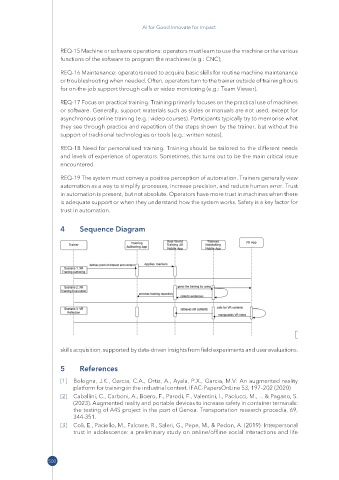
                      4      Sequence Diagram


                      skills acquisition, supported by data-driven insights from field experiments and user evaluations.


                      5      References

                      [1]  Bologna, J.K., Garcia, C.A., Ortiz, A., Ayala, P.X., Garcia, M.V: An augmented reality
                           platform for training in the industrial context. IFAC-PapersOnLine 53, 197–202 (2020)
                      [2]  Caballini, C., Carboni, A., Boero, F., Parodi, F., Valentini, I., Paolucci, M., ... & Pagano, S.
                           (2023). Augmented reality and portable devices to increase safety in container terminals:
                           the testing of A4S project in the port of Genoa. Transportation research procedia, 69,
                           344-351.
                      [3]  Colì, E., Paciello, M., Falcone, R., Saleri, G., Pepe, M., & Pedon, A. (2019). Interpersonal
                           trust in adolescence: a preliminary study on online/offline social interactions and life


                  500

