


Page 285 - ITU-T Focus Group IMT-2020 Deliverables
P. 285
ITU-T Focus Group IMT-2020 Deliverables                                 4


            Inside the ICN network, the core network functions as outlined above are realized, namely the rendezvous
            (RV), topology management (TM) and forwarding (FN) function. Although implementable over general L2
            networks,  we  assume  in  most  deployments  an  SDN-based  forwarding  solution,  based  on  the  BF-based
            forwarding as presented in Section 2.2 and is the basis for our demo. The combined RV and TM functions
            fulfill  the  more  traditional  path  computation  element  (PCE)  role  found  in  SDN  environments.  Figure  20
            presents the various elements of our architecture.
            In the case of services across multiple domains, the establishment of a single domain IP-based autonomous
            system in Figure 20 reduces this case to that of a standard inter-domain IP-based operation. In other words,
            a service request stemming from a cNAP in one domain will be sent via the ICN GW of the originating domain,
            governed via standard BGP (Border Gateway Protocol) mechanisms, to the receiving domain. If this domain
            is another IP-over-ICN domain, the request will enter through the ICN GW of the receiving domain and will
            be forwarded accordingly within the network, as defined by the operations in our PoC.

            10.2.2  Showcase Proof-of-Concept

            The demonstration to run IP services over an ICN-based infrastructure and leveraging the novel coincidental
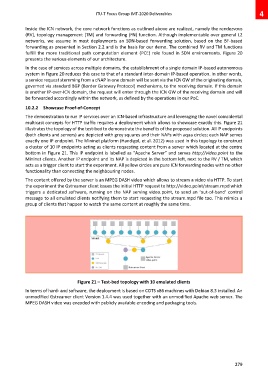
            multicast concepts for HTTP traffic requires a deployment which allows to showcase exactly this. Figure 21
            illustrates the topology of the test-bed to demonstrate the benefits of the proposed solution. All IP endpoints
            (both clients and servers) are depicted with grey squares and their NAPs with aqua circles; each NAP serves
            exactly one IP endpoint. The Mininet platform (Handigol, et al. 2012) was used in this topology to construct
            a cluster of 10 IP endpoints acting as clients requesting content from a server which located at the centre
            bottom in Figure 21. This IP endpoint is labelled as “Apache Server” and serves http://video.point to the
            Mininet clients. Another IP endpoint and its NAP is depicted in the bottom left, next to the RV / TM, which
            acts as a trigger client to start the experiment. All yellow circles are pure ICN forwarding nodes with no other
            functionality than connecting the neighbouring nodes.
            The content offered by the server is an MPEG DASH video which allows to stream a video via HTTP. To start
            the experiment the Gstreamer client issues the initial HTTP request to http://video.point/stream.mpd which
            triggers a dedicated software, running on the NAP serving video.point, to send an ‘out-of-band’ control
            message to all emulated clients notifying them to start requesting the stream.mpd file too. This mimics a
            group of clients that happen to watch the same content at roughly the same time.


                                   Figure 21 – Test-bed topology with 10 emulated clients
            In terms of hard- and software, the deployment is based on COTS x86 machines with Debian 8.3 installed. An
            unmodified Gstreamer client Version 1.4.4 was used together with an unmodified Apache web server. The
            MPEG DASH video was encoded with publicly available encoding and packaging tools.


                                                                                                         279

