


Page 289 - ITU-T Focus Group IMT-2020 Deliverables
P. 289
ITU-T Focus Group IMT-2020 Deliverables                                 4


            10.2.6  Flow Control

            Since  our  solution  directly  transfers  HTTP  requests  and  responses  over  the  ICN,  it  implements  its  own
            lightweight transport protocol in order to support possible multicast delivery of responses in a flow controlled
            manner. Due to the possibility to run TCP services that are not HTTP applications over the solution – these
            services will then be transmitted via an IP-over-ICN solution that works similar to the described HTTP one –
            our lightweight HTTP transport protocol is TCP.


            10.3    ICN transport for mmWave Networks (KDDI)
            Sony and Tokyo Tech had previously developed experimental 60 GHz wireless complementary metal–oxide–
            semiconductor (CMOS) large-scale integrated circuits (LSIs) that operated with a data rate of 6.3 Gbps in the
            physical (PHY) layer in 2012 (Sony and Tokyo Tech 2012). Now, they have developed a 60 GHz wireless
            module with high frequency usage efficiency, i.e., a data rate of 6.57 Gbps in the PHY layer that uses a
            2.16 GHz bandwidth, based on the use of a 6 dBi slab-waveguide antenna (developed by Ando-Hirokawa Labs
            at Tokyo Tech), a 65 nm CMOS 60 GHz direct-conversion radio-frequency (RF) LSI and analog circuit with
            40 nm  CMOS  process  that  includes  a  2.3  GSample/s  7-bit  analog-to-digital  converter  (developed  by
            Matsuzawa-Okada Labs at Tokyo Tech), and a 40 nm CMOS baseband (BB) LSI that incorporates a media-
            access control (MAC) layer and PHY layer that uses the above analog circuit and rate-compatible low-density
                                    8
            parity-check (LDPC) codes with code rates of 14/15 and 11/15 (developed by Sony). The design of this 60
                                                                           9
            GHz wireless module is based on the first draft of the IEEE802.15.3e  standard. They also developed a file
            transfer system with a high cache memory capacity that can be accessed directly from the wireless module
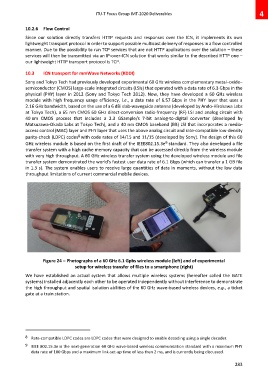
            with very high throughput. A 60 GHz wireless transfer system using the developed wireless module and file
            transfer system demonstrated the world’s fastest user data rate of 6.1 Gbps (which can transfer a 1 GB file
            in 1.3 s). The system enables users to receive large quantities of data in moments, without the low data
            throughput limitations of current commercial mobile devices.


                    Figure 24 – Photographs of a 60 GHz 6.1 Gpbs wireless module (left) and of experimental
                                  setup for wireless transfer of files to a smartphone (right)

            We  have  established  an  actual  system  that  allows multiple  wireless  systems (hereafter  called  the  GATE
            systems) installed adjacently each other to be operated independently without interference to demonstrate
            the high throughput and spatial isolation abilities of the 60 GHz wave-based wireless devices, e.g., a ticket
            gate at a train station.


            8    Rate-compatible LDPC codes are LDPC codes that were designed to enable decoding using a single decoder.
            9    IEEE 802.15.3e is the next-generation 60 GHz wave-based wireless communication standard with a maximum PHY
               data rate of 100 Gbps and a maximum link-set-up time of less than 2 ms, and is currently being discussed.

                                                                                                         283

