


Page 290 - ITU-T Focus Group IMT-2020 Deliverables
P. 290
4                                        ITU-T Focus Group IMT-2020 Deliverables


            A high-gain slot-array antenna (using approximately 1000 elements in experiments) that enabled spatial
            isolation was developed by Tokyo Tech (at Ando-Hirokawa Labs). In addition, the radio waves do not spread
            out and are confined for more than 10 m in a cylindrical service area.
            In the scenario where users pass through the communication area within a short period of time, Sony has
            also implemented a MAC protocol on the RF-BB LSIs, enabling reduced link-setup times that allow users to
            start communications within 2 ms or less. JRC has integrated these technologies to form the GATE system.


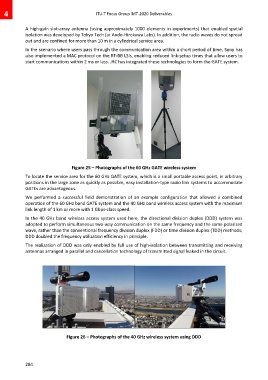
                                 Figure 25 – Photographs of the 60 GHz GATE wireless system
            To locate the service area for the 60 GHz GATE system, which is a small portable access point, in arbitrary
            positions in the large zone as quickly as possible, easy installation-type radio link systems to accommodate
            GATEs are advantageous.
            We  performed  a  successful  field  demonstration  of  an  example  configuration  that  allowed  a  combined
            operation of the 60 GHz band GATE system and the 40 GHz band wireless access system with the maximum
            link length of 1 km or more with 1 Gbps-class speed.

            In the 40 GHz band wireless access system used here, the directional division duplex (DDD) system was
            adopted to perform simultaneous two-way communication on the same frequency and the same polarized
            wave, rather than the conventional frequency division duplex (FDD) or time division duplex (TDD) methods;
            DDD doubled the frequency utilization efficiency in principle.
            The realization of DDD was only enabled by full use of high-isolation between transmitting and receiving
            antennas arranged in parallel and cancellation technology of transmitted signal leaked in the circuit.


                               Figure 26 – Photographs of the 40 GHz wireless system using DDD


            284

