How to combine blockchain technology to revolutionize the supply chain?
WSIS
Session 283
In recent years, there is a growing potential for the supply chain management application, especially in supply chain innovation. Blockchain as an emerging application model has been widely used in different industries. In the fields of finance, Internet of Things, social welfare and supply chain, there have been a lot of explorations and attempts of application. Among them, the supply chain field has become a "place of use" for blockchain technology due to its large market scale, multiple trust subjects and multi-party collaboration. Supply chain is an early development and relatively high maturity of blockchain applications.
The supply chain can be seen as a network of suppliers, manufacturers, warehouses, distribution centers and channels. The core of the supply chain concept is to establish trust between subjects, collaborate and cooperate, form a chain of originally loose enterprises, and collect and integrate discrete chain information. As the scope of supply chain becomes more and more extensive, enterprises coordinate their own and external resources through effective chain management so as to meet market demand. In the future, as the application of blockchain in the field of supply chain tends to mature, blockchain technology is expected to promote and complete the disruptive innovation of the entire supply chain industry and help realize the deep integration of traditional industries with the new generation of information.
This workshop will discuss some of the current problems in the supply chain, as well as the new challenges encountered in the supply chain in the era of the epidemic, and how to propose solutions in using Blockchain technologies to solve these problems.

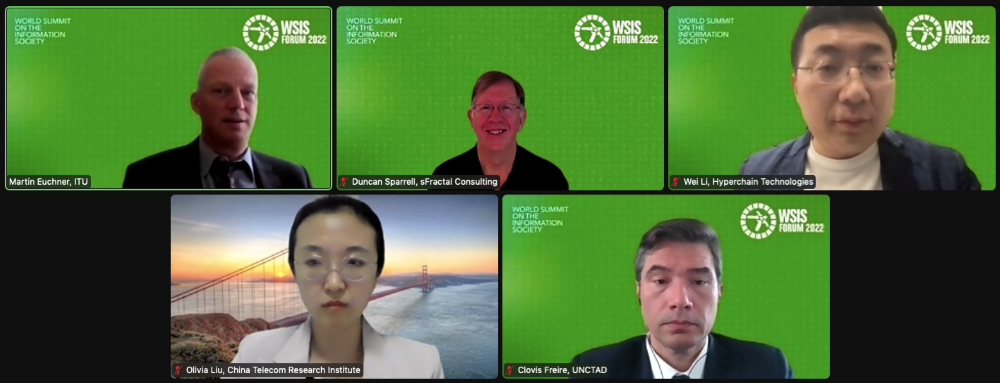
Xiaoou Liu, Deputy Director of Blockchain and Metaverse Team, China Telecom Research Institute, who has taken charge of standardization the blockchain standardization of China Telecom. Activily participation in ITU-T (SG13, SG11, SG16), GLF-CBAN, CCSA(TC1,TC3, TC5) and other international and national standardization work. Working as the editor of 12 ITU-T standard work items, of which 5 have been published and 7 are under development. These mainly involve technical standards of blockchain/DLT in the future network, 5G, multimedia field and so on. More than 60 contributions were submitted for discussion and adopted. Including firstly proposed the concept of NRS-DLT (network resource coordination based on blockchain) in ITU-T, and created a series of standards. Published a book, blockchain Thinking: Evolution from the Internet to the New Digital Economy. Won the second prize of China Telecom Technology Progress Award.


Dr. Wei Li is the Founder and CEO of Hyperchain Technology. He has a PhD in Engineering from the School of Computer Science and Technology with the title of senior engineer. Meanwhile, He was awarded as High-level talents in Zhejiang Province. Hyperchain, a leading global provider of blockchain technology and solution services, was founded by Dr. Wei Li in 2016. The company became the first unicorn company in the domestic blockchain industry in 2021.

Duncan Sparrell is Chief Cyber Curmudgeon at sFractal Consulting and has been an active participant in the ITU for over 40 years. Back in the last century, he coauthored many voice-coding and packet-speech standards, and served as Rapporteur, and then Working Party Chairman in SG15. Since the millennium, he has been more focused on cybersecurity in SG17, and is also a member of the ITU Kaleidoscope Technical Program Committee. He retired as AT&T's Chief Security Architect, and now spends most of his retirement doing pro-bono cybersecurity standards work. Besides SG17, Duncan is very active in OASIS where he chairs the Open Command & Control (OpenC2) Technical Committee, and contributes to many committees on cybersecurity automation. One of his passions is supplychain cybersecurity and he has been very active for many years on the topic of Software Bill of Materials (SBOM) where there is some interesting blockchain work evolving. Duncan has 7 patents, the 1994 US Intelligence Community Seal Medallion, the 2010 AT&T Science & Technology Medal, and the 2021 OASIS Distinguished Contributor Award.

Since December 2010, Martin Euchner serves ITU-T Study Group 17 as Advisor where he is managing the Study Group 17 meetings and Recommendations.
Martin began his career as a security engineer in Siemens R & D labs 1991 where he researched, developed and implemented cryptography, network security and security for multimedia systems in various international, national and company internal projects.
He joined security standardization where he has been making numerous active contributions to Voice-over-IP security standards such as H.323/H.235 in ITU-T, ETSI TIPHON/TISPAN, IETF and IMTC. He was also been actively involved in cable standardization such as the IPCablecom projects in ITU-T SG9 and in ETSI TC AT-D.
Involved in VoIP security standardization since 1997, he took leadership roles in security standardization as editor and Rapporteur since 2000 in ITU-T where he has progressed H.235 Recommendation into version 4.
Martin had been actively involved in standardizing security for Next Generation Networks. He was co-chairing as vice chairman of working group 7 in ETSI TISPAN where he was driving forward as editor/Rapporteur the Next Generation Network Release 1 security initiative and has produced important NGN security standards. Martin was further an active contributor to ITU-T's Next Generation Network initiative in ITU-T SG13, was involved in ITU-T SG17 general security standardization, in cybersecurity standards and in the ITU-T Focus Group on Identity Management.
From 2006 till 2010, Martin was working as senior security standardization expert in the fixed network department and then for the CTO within Nokia Siemens Networks.
During his career, Martin has gained broad security expertise in various fields. He oversees the international security standardization landscape.
Martin received a master's degree in computer science from Goethe University/Frankfurt.