Consolidation of programmes
The OneGoal Initiative, Zurich AR/VR Meetup
Session 231
Avoiding redundancies and contradictions, Internal and external coherence and optimality of the resulting overall actions taken
This workshop is about a harmonization and consolidation for an internal and external coherence and optimality of the resulting overall actions taken, avoiding redundancies and contradictions.
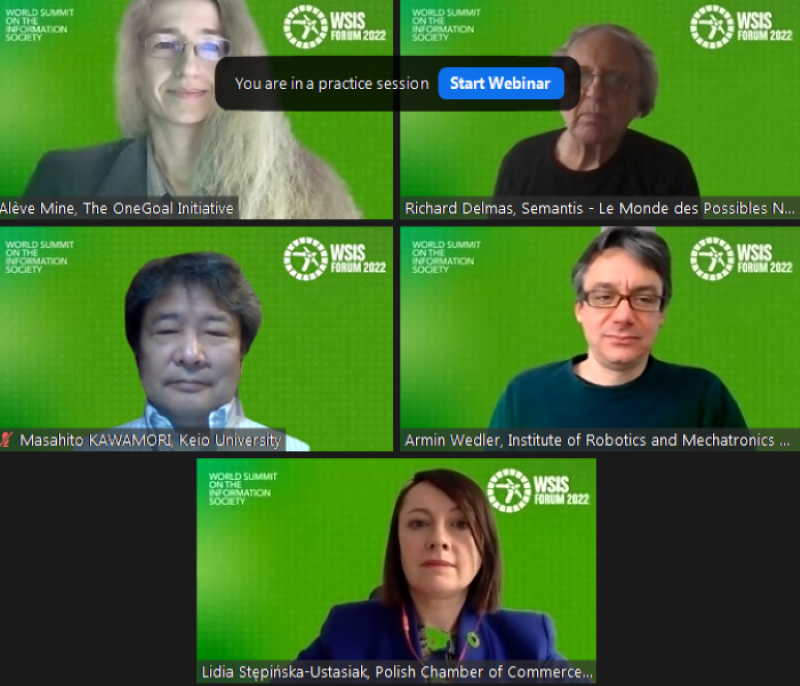
We will take in particular the concrete case of aerospace activities in the experience of our keynote speaker Dr Wedler and reflect on those via our respective experiences, each panelist in their own field(s).
In the midst of multifaceted efforts to toward sustainability, we are still introducing new technologies to markets and being confronted with substantial additional challenges. Those layered shifts in the overall status of our systems on top of the mosaic of activities in governance are pulling the various aspects of our system in various directions among which we want to maintain coherence.
The aim of this workshop is to approach chipping away at any mutual hindrances, inconsistencies, unnecessary redundancies or gaps among projects or programmes. It is to get the discussion at least started, because as tuning does with machinery or precision with learning, so can consolidation enhance governance.

Dr Lidia Stępińska-Ustasiak is an International Cooperation Expert for the Polish Chamber of Commerce for Electronics and Telecommunications. She previously worked as the Deputy director for the Department of Foreign Affairs in Office of Electronic Communications for the Republic of Poland, and is the chairwoman of Group on Capacity Building Initiatives ITU. She was in charge of the International Organizations Unit as well as the Social and Economic Cooperation Unit, responsible for NRA’s relations with entrepreneurs including Polish and international SMEs and startups, chambers of commerce, units of public administration, and academic institutions. In 2019, she became the Chairwoman of the Steering Committee of the ITU Centres of Excellence network of partners specializing in telecommunications and ICT training. She has been a member of the Group on Capacity Building Initiatives since 2018, advising the Director of the ITU Telecommunication Development Bureau, and was appointed to a position of chairwoman in 2019. She was a member of the IGF 2021 Program Committee. Her PhD in sociology focused on the social impact of technology, digital skills and the implications of ICT for human and institutional capacity building. She received her MA in Social Science from the University of Warsaw and a British MA degree in Social Sciences awarded by the University of Lancaster. She’s a CSR, public affairs and communications expert with more than 15 years of experience in telecommunication and the ICT sector, and the co-author of reports, the author of publications, and a lecturer and public speaker.

Since 2009, he is the Rapporteur of Question 28 "Multimedia Framework for e-Health Applications" in Study Group 16 of ITU-T. He appeared as speakers at several conferences on e-health, including IEEE-ICC, WSIS, and Telecom World, all in 2011. He actively participated in the collaboration between ITU-T, ITU-D and WHO, and was an active participant in the Joint ITU-WHO Workshop on e-Health Standards and Interoperability, Geneva, 2012.
After joining the Information Science Lab, NTT Basic Research Labs, in 1989, he did research and development in artificial intelligence.
Since 1998 until 2002, he was a research member of "Creating the Brain" Research Project of the JST (Japan Science and Technology Agency)'s CREST ("Core Research for Evolutional Science and Technology") Program. He was also a lecturer, 1998-2006, at the School of Allied Health Sciences, Kitasato University, Japan. In 2004, he led the development with the University of Tokyo, Japan, on a health information system using wearable sensors that measured the hippocampal function in the brain to detect early signs of dementia.
He is also a co-chair of ITU-T's Focus Group on Media Accessibility as well as the coordinator of IPTV-Global Standards Initiative.

Richard Delmas is a diplomat, political scientist and Co-Founder of the Semantis- Le Monde des Possibles NGO, Liège, Belgium, and a former official at the Council of Europe in Strasbourg as well as at the European Commission in Luxemburg and Brussels. At the European Commission, he was notably Head of project for language technologies, in charge of international relations for the Internet, and Head of the Office of the Governmental Advisory Commitee of ICANN.
With the NGO Semantis, he now conducts projects for multilinguism, education and the creation of digital content, in particular in Eastern and Central Europe. He ensures the regular participation and contribution of Semantis and its partners, notably Eurolinc, to the WSIS process and the Internet Governance Forum.
Author of numerous papers on policy and the legal aspects of cyberspace, he co-published «Vers la Société de l’Information» (Ed. Apogée, 1995). He runs a blog in "Le Courrier des Balkans" and wrote the book «Belgrade/Beograd» (Ed. Dadoclem, Bordeaux, 2017).

Dr. Armin Wedler received his diploma and bachelor's degree in mechanical engineering and robotics in 2004 and his doctorate on "Adaptive passive compliant systems for use in robotics" in 2010 from the University of Hannover. He started his professional career in 2006, also at the university as a research assistant, and moved to DLR German Aerospace Center, Institute of Robotics and Mechatronics in 2008. He focused on the design and development of advanced mobile space robotics systems for planetary exploration. After gaining experience as a scientific developer, he was able to continuously expand his expertise as a system engineer, technical manager and finally as project manager and coordinator. With his contributions to national and international projects such as EXOMARS (ESA), DEXHAND (DLR-ESA), Mobile Payload Element (DLR- MPE), Next Lunar Lander (ESA-NLL), ROBEX (HGF), ARCHES (HGF), MASCOT (DLR, CNES, JAXA), Rover for MMX (DLR, CNES, JAXA) he was able to further expand his expertise, experience and knowledge base. Through his role as head of the planetary exploration domain within the DLR Robotics Institute as well as his team leadership for the development of innovative mobile robotic systems, he was able to demonstrate his coordination skills. Mr. Wedler is also active in various committees, e.g. ISCEG as well as in scientific and technical topic groups for robotics in harsh environments.
-
 C3. Access to information and knowledge
-
 C6. Enabling environment
-
 C7. ICT applications: benefits in all aspects of life — E-government
-
 C7. ICT applications: benefits in all aspects of life — E-science
-
 C11. International and regional cooperation
This would add a paragraph to C3 in that it would enhance the access of the decision makers themselves to knowledge; to C6 in that a possible optimal consolidation would act in a similar way to interoperability, empowering any intended activity based on governance structures; to C7 helping build on scientific knowledge through a common reference model for governance; and to C11 as a basic requirement for all players to collaborate.
-
 Goal 17: Revitalize the global partnership for sustainable development
This supports SDG 17 for partnerships for the goals in that it encourages and supports a more powerfully coordinated global action. In particular, targets 17.13 to “enhance global macroeconomic stability, including through policy coordination and policy coherence” and 17.14 “Enhance policy coherence for sustainable development” in question.