


Page 803 - AI for Good Innovate for Impact
P. 803
AI for Good Innovate for Impact


                    define associated bandwidth requirements and uplink reliability thresholds to ensure
                    consistent communication performance.
               •    REQ-03: It is critical to differentiate between static data collection (for offline model
                    training) and real-time telemetry (for online inference), while also detailing spatial-
                    temporal data coverage expectations and data modalities including GPS, LiDAR, and              Transport  4.10: Intelligent
                    RSSI.
               •    REQ-04: It is mandatory to define specific technical capabilities for the simulation platform,
                    including support for multi-radio vehicular mobility, stochastic channel modeling, and
                    integration with SDN/MEC emulators such as Mininet-WiFi, OMNeT++, or NS-3[6], to
                    accurately emulate real-world transport scenarios.
               •    REQ-05: It is critical to separate and articulate the requirements for dynamic machine
                    learning models, including support for online learning, explainability (via eXplainable
                    AI/XAI), model quantization for efficient edge deployment, and real-time adaptability to
                    domain shifts using techniques like transfer learning or continual learning.


               4      Sequence Diagram


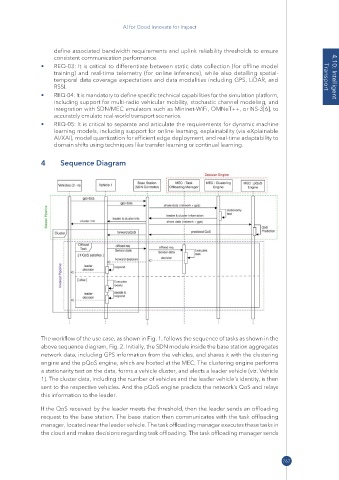
               The workflow of the use case, as shown in Fig. 1, follows the sequence of tasks as shown in the
               above sequence diagram, Fig. 2. Initially, the SDN module inside the base station aggregates
               network data, including GPS information from the vehicles, and shares it with the clustering
               engine and the pQoS engine, which are hosted at the MEC. The clustering engine performs
               a stationarity test on the data, forms a vehicle cluster, and elects a leader vehicle (viz. Vehicle
               1). The cluster data, including the number of vehicles and the leader vehicle's identity, is then
               sent to the respective vehicles. And the pQoS engine predicts the network’s QoS and relays
               this information to the leader.

               If the QoS received by the leader meets the threshold, then the leader sends an offloading
               request to the base station. The base station then communicates with the task offloading
               manager, located near the leader vehicle. The task offloading manager executes these tasks in
               the cloud and makes decisions regarding task offloading. The task offloading manager sends


                                                                                                    767

