


Page 798 - AI for Good Innovate for Impact
P. 798
AI for Good Innovate for Impact


                      2      Use Case Description


                      2�1     Description


                      In the emerging world of intelligent transportation systems, Vehicle-to-Everything (V2X)
                      communication is evolving to provide safer and more efficient road networks. Some of the
                      promising applications of V2X for wireless control use cases are Platooning, Cooperative
                      Transport of Goods, Cooperation between Automated Guided Vehicles (AGVs) and Stationary
                      Robots, etc. [1]. These applications require frequent exchange of data between vehicle sensors
                      and wireless networks to fulfill Quality of Service (QoS) requirements for safe and coordinated
                      movement.

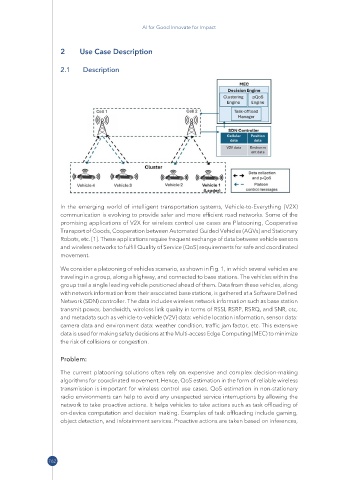
                      We consider a platooning of vehicles scenario, as shown in Fig. 1, in which several vehicles are
                      traveling in a group, along a highway, and connected to base stations. The vehicles within the
                      group trail a single leading vehicle positioned ahead of them. Data from these vehicles, along
                      with network information from their associated base stations, is gathered at a Software Defined
                      Network (SDN) controller. The data includes wireless network information such as base station
                      transmit power, bandwidth, wireless link quality in terms of RSSI, RSRP, RSRQ, and SNR, etc,
                      and metadata such as vehicle-to-vehicle (V2V) data: vehicle location information, sensor data:
                      camera data and environment data: weather condition, traffic jam factor, etc. This extensive
                      data is used for making safety decisions at the Multi-access Edge Computing (MEC) to minimize
                      the risk of collisions or congestion.


                      Problem:

                      The current platooning solutions often rely on expensive and complex decision-making
                      algorithms for coordinated movement. Hence, QoS estimation in the form of reliable wireless
                      transmission is important for wireless control use cases. QoS estimation in non-stationary
                      radio environments can help to avoid any unexpected service interruptions by allowing the
                      network to take proactive actions. It helps vehicles to take actions such as task offloading of
                      on-device computation and decision making. Examples of task offloading include gaming,
                      object detection, and infotainment services. Proactive actions are taken based on inferences,


                  762

