


Page 614 - AI for Good Innovate for Impact
P. 614
AI for Good Innovate for Impact


                      Integrated statistical tests (e.g., demographic parity, disparate impact ratio) to ensure threshold
                      updates do not introduce or exacerbate bias, with regular reporting to regulators.

                      •    REQ-08: Visualization Dashboard

                      Interactive dashboard (e.g., within Google Colab or web User Interface(UI)) displaying current
                      values of threshold levels, profit curves, feature importances, and MCMC trace plots for
                      stakeholder validation.


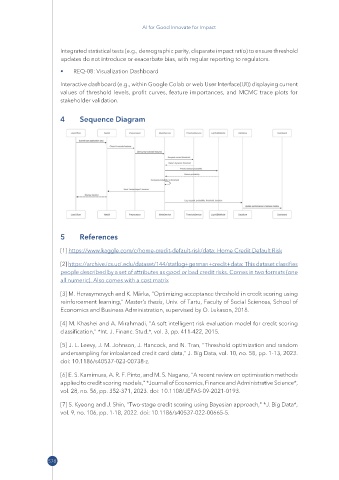
                      4      Sequence Diagram


                      5      References

                      [1] https:// www .kaggle .com/ c/ home -credit -default -risk/ data: Home Credit Default Risk

                      [2] https:// archive .ics .uci .edu/ dataset/ 144/ statlog+ german+ credit+ data: This dataset classifies
                      people described by a set of attributes as good or bad credit risks. Comes in two formats (one
                      all numeric). Also comes with a cost matrix

                      [3] M. Herasymovych and K. Märka, "Optimizing acceptance threshold in credit scoring using
                      reinforcement learning," Master’s thesis, Univ. of Tartu, Faculty of Social Sciences, School of
                      Economics and Business Administration, supervised by O. Lukason, 2018.

                      [4] M. Khashei and A. Mirahmadi, "A soft intelligent risk evaluation model for credit scoring
                      classification," *Int. J. Financ. Stud.*, vol. 3, pp. 411-422, 2015.

                      [5] J. L. Leevy, J. M. Johnson, J. Hancock, and N. Tran, "Threshold optimization and random
                      undersampling for imbalanced credit card data," J. Big Data, vol. 10, no. 58, pp. 1-13, 2023.
                      doi: 10.1186/s40537-023-00738-z.

                      [6] E. S. Kamimura, A. R. F. Pinto, and M. S. Nagano, "A recent review on optimisation methods
                      applied to credit scoring models," *Journal of Economics, Finance and Administrative Science*,
                      vol. 28, no. 56, pp. 352-371, 2023. doi: 10.1108/JEFAS-09-2021-0193.

                      [7] S. Kyeong and J. Shin, "Two-stage credit scoring using Bayesian approach," *J. Big Data*,
                      vol. 9, no. 106, pp. 1-18, 2022. doi: 10.1186/s40537-022-00665-5.


                  578

