


Page 371 - AI for Good Innovate for Impact
P. 371
AI for Good Innovate for Impact


               frameworks TensorFlow for RNNs, Stable-Baselines3 for RL policies, and OpenMMLab [7]
               for data augmentation—to train and deploy models on GPU clusters. All code, simulation
               configurations, and data schemas will be made publicly available on GitHub under an MIT
               license.                                                                                             4.3 - 5G

               Standards Development: Close collaboration with ITU and other standardization bodies will be
               undertaken to establish guidelines for AI-driven network optimization under adverse weather.
               This will include developing industry benchmarks that ensure seamless integration with existing
               infrastructures and promote the adoption of resilient communication networks.


               3      Use Case Requirements

               •    REQ-01: It is critical that real-time weather ingestion is enabled via continuous high-
                    resolution meteorological feeds (e.g., rain rate, humidity, visibility) through APIs or IoT
                    streams.
               •    REQ-02: It is expected that standardized propagation models are incorporated within
                    the inference pipeline to provide baseline estimates of signal impairment.
               •    REQ-03: It is critical that the system captures raw Channel State Information (CSI) including
                    amplitude and phase, along with per-beam RSSI/SINR data from mmWave transceivers.
               •    REQ-04: It is critical that GPU-accelerated edge or cloud compute infrastructure is used
                    to achieve sub-100 ms latency for RNN or reinforcement learning-based inference.
               •    REQ-05: It is of added value that data is structured using standardized JSON or CSV
                    formats with consistent field naming, SI units, and per-epoch manifest records to enhance
                    interoperability.

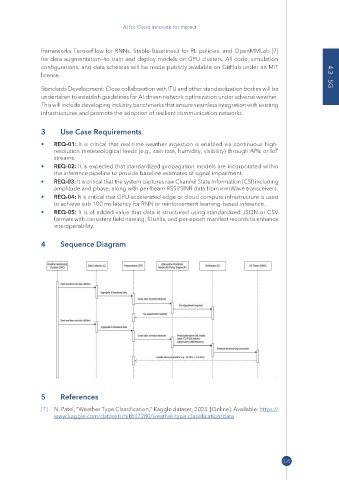
               4      Sequence Diagram


               5      References

               [1]  N. Patel, “Weather Type Classification,” Kaggle dataset, 2023. [Online]. Available: https://
                    www .kaggle .com/ datasets/ nikhil7280/ weather -type -classification/ data


                                                                                                    335

