


Page 91 - ITU-T Focus Group Digital Financial Services – Executive Summary
P. 91
1.2 Challenge and response
Dubai’s rapid development in various economic sectors meant that traditional processes needed to be
continuously enhanced to ensure efficiency and speed. Government effectiveness became increasingly
important imperative especially in Government to Consumer (G2C) and Government to Government (G2G)
services.
In particular, the growth of the business, construction and tourism sectors saw the Government needing
tighter controls over activities such as permissions (e.g. permits and No Objection Certificates (NoCs)) and
transaction verification and tracking. Simple processes were getting ever more complicated with the addition
of activities that were now in demand by the city’s new businesses and residents. It was clear that Dubai
needed an agile solution to streamlining its growing Government processes.
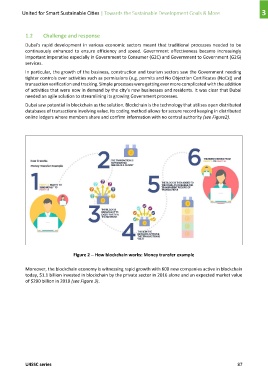
Dubai saw potential in blockchain as the solution. Blockchain is the technology that utilises open distributed
databases of transactions involving value. Its coding method allows for secure record keeping in distributed
online ledgers where members share and confirm information with no central authority (see Figure2).
–
Figure 2 How blockchain works: Money transfer example
Moreover, the blockchain economy is witnessing rapid growth with 600 new companies active in blockchain
today, $1.1 billion invested in blockchain by the private sector in 2016 alone and an expected market value
of $290 billion in 2019 (see Figure 3).
U4SSC series 87

