


Page 90 - ITU-T Focus Group Digital Financial Services – Executive Summary
P. 90
1 Introduction
1.1 Background
Dubai is one of the seven emirates that constitute the United Arab Emirates (UAE). It is the most populous
city and Emirate, with a gross domestic product of 82 billion USD.
Over the last 40 years, Dubai has succeeded in transforming itself into a global city, regional business centre
and tourism hub. Dubai has successfully established its international reputation of being an economic and
investment centre, attracting several international companies that have set up their regional headquarters
in the Emirate’s many free zones. The Emirate of Dubai has been able to achieve this success by diversifying
its gross domestic product through accelerated development in sectors such as tourism, real estate, retail,
travel and logistics. It has also been recognised for attracting skilled talent from around the world.
Underlying this economic growth has been a visionary, strong and productive Government sector that has
embraced technology and committed to excellence and digital city transformation. The city’s technological
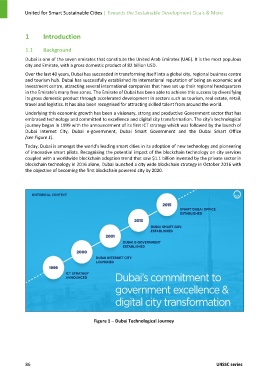
journey began in 1999 with the announcement of its first ICT strategy which was followed by the launch of
Dubai Internet City, Dubai e-government, Dubai Smart Government and the Dubai Smart Office
(see Figure 1).
Today, Dubai is amongst the world’s leading smart cities in its adoption of new technology and pioneering
of innovative smart pilots. Recognising the potential impact of the blockchain technology on city services
coupled with a worldwide blockchain adoption trend that saw $1.1 billion invested by the private sector in
blockchain technology in 2016 alone, Dubai launched a city wide blockchain strategy in October 2016 with
the objective of becoming the first blockchain powered city by 2020.
Figure 1 Dubai Technological Journey
86 U4SSC series

