


Page 278 - ITU-T Focus Group IMT-2020 Deliverables
P. 278
4                                        ITU-T Focus Group IMT-2020 Deliverables


            8       ICN transport for mmWave Networks (KDDI)

            Tokyo Institute of Technology (Tokyo Tech), Sony Corporation (Sony), Japan Radio Co. Ltd (JRC) and KDDI R&D
            Laboratories  Inc.  (KDDI  Labs)  announced  they  have  jointly  developed  and  successfully  implemented  a
                               3
                   2
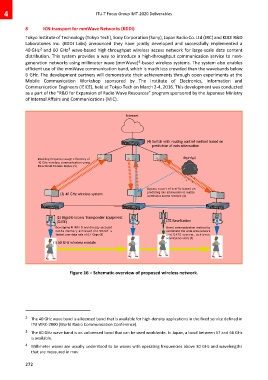
            40 GHz  and  60  GHz  wave-based  high-throughput  wireless  access  network  for large-scale  data content
            distribution. This system provides a way to introduce a high-throughput communication service to next-
                                                               4
            generation networks using millimeter wave (mmWave) -based wireless systems. The system also enables
            efficient use of the mmWave communication band, which is much less crowded than the wavebands below
            6 GHz. The development partners will demonstrate their achievements through open experiments at the
            Mobile  Communication  Workshop  sponsored  by  The  Institute  of  Electronics,  Information  and
            Communication Engineers (IEICE), held at Tokyo Tech on March 2-4, 2016. This development was conducted
            as a part of the “R&D for Expansion of Radio Wave Resources” program sponsored by the Japanese Ministry
            of Internal Affairs and Communications (MIC).


                                Figure 16 – Schematic overview of proposed wireless network.


            2    The 40 GHz wave band is a licensed band that is available for high-density applications in the fixed service defined in
               ITU WRC-2000 (World Radio Communication Conference).
            3   The 60 GHz wave band is an unlicensed band that can be used worldwide. In Japan, a band between 57 and 66 GHz
               is available.
            4    Millimeter waves are usually understood to be waves with operating frequencies above 30 GHz and wavelengths
               that are measured in mm.

            272

