


Page 822 - AI for Good Innovate for Impact
P. 822
AI for Good Innovate for Impact


                      infrastructures. The long-term vision is to seamlessly integrate AI-enabled 6G V2X technologies
                      into smart cities, enhancing mobility while minimizing environmental impact.


                      3      Use Case Requirements

                      •    REQ-01: It is mandatory that the system supports wireless infrastructure with ultra-low
                           latency and high data throughput to enable real-time V2X communication[5].
                      •    REQ-02: It is critical to implement a Deep Reinforcement Learning (DRL) algorithm—
                           specifically Proximal Policy Optimization (PPO)—to dynamically manage vehicle-to-RSU
                           assignments.
                      •    REQ-03: It is critical that the DRL agent adapts in real time to network changes such as
                           traffic density, RSU load, and vehicle mobility.
                      •    REQ-04: It is mandatory to incorporate a retraining mechanism that updates the DRL
                           model based on evolving traffic patterns and urban layouts.
                      •    REQ-05: It is mandatory that each vehicle be assigned to exactly one RSU at any given
                           time, ensuring a valid and exclusive communication link.
                      •    REQ-06: It is critical that the system minimizes energy consumption across RSUs while still
                           satisfying quality of service (QoS) constraints such as latency and bandwidth.
                      •    REQ-07: It is critical for the DRL agent to continuously learn from environmental feedback
                           to enhance future decision-making and improve resource efficiency.


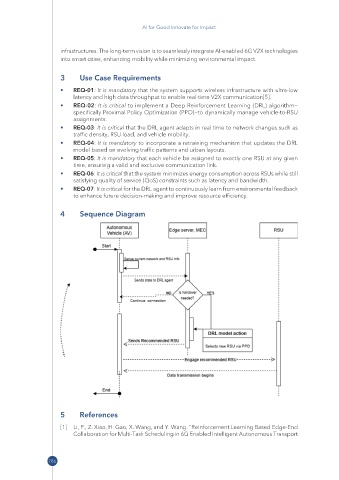
                      4      Sequence Diagram


                      5      References

                      [1]  Li, P., Z. Xiao, H. Gao, X. Wang, and Y. Wang. "Reinforcement Learning Based Edge-End
                           Collaboration for Multi-Task Scheduling in 6G Enabled Intelligent Autonomous Transport


                  786

