


Page 820 - AI for Good Innovate for Impact
P. 820
AI for Good Innovate for Impact


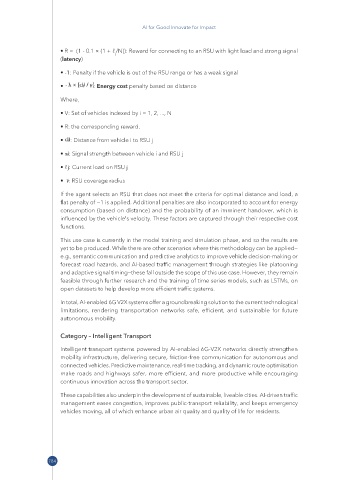
                      • R =  (1 - 0.1 × (1 + ℓ/N)): Reward for connecting to an RSU with light load and strong signal
                                         j
                      (latency)

                      • -1: Penalty if the vehicle is out of the RSU range or has a weak signal

                      •           : Energy cost penalty based on distance

                      Where,

                      • V: Set of vehicles indexed by i = 1, 2, ..., N

                      • R: the corresponding reward.

                      •  : Distance from vehicle i to RSU j

                      •  : Signal strength between vehicle i and RSU j

                      • ℓj: Current load on RSU j

                      •   : RSU coverage radius

                      If the agent selects an RSU that does not meet the criteria for optimal distance and load, a
                      flat penalty of −1 is applied. Additional penalties are also incorporated to account for energy
                      consumption (based on distance) and the probability of an imminent handover, which is
                      influenced by the vehicle's velocity. These factors are captured through their respective cost
                      functions.

                      This use case is currently in the model training and simulation phase, and so the results are
                      yet to be produced. While there are other scenarios where this methodology can be applied—
                      e.g., semantic communication and predictive analytics to improve vehicle decision-making or
                      forecast road hazards, and AI-based traffic management through strategies like platooning
                      and adaptive signal timing—these fall outside the scope of this use case. However, they remain
                      feasible through further research and the training of time series models, such as LSTMs, on
                      open datasets to help develop more efficient traffic systems.


                      In total, AI-enabled 6G V2X systems offer a groundbreaking solution to the current technological
                      limitations, rendering transportation networks safe, efficient, and sustainable for future
                      autonomous mobility.


                      Category – Intelligent Transport

                      Intelligent transport systems powered by AI-enabled 6G-V2X networks directly strengthen
                      mobility infrastructure, delivering secure, friction-free communication for autonomous and
                      connected vehicles. Predictive maintenance, real-time tracking, and dynamic route optimisation
                      make roads and highways safer, more efficient, and more productive while encouraging
                      continuous innovation across the transport sector.

                      These capabilities also underpin the development of sustainable, liveable cities. AI-driven traffic
                      management eases congestion, improves public-transport reliability, and keeps emergency
                      vehicles moving, all of which enhance urban air quality and quality of life for residents.


                  784

