


Page 788 - AI for Good Innovate for Impact
P. 788
AI for Good Innovate for Impact


                      operational expertise, Apollo Go has restructured its technology stack to center around
                      advanced vision-based models. Apollo ADFM—the Autonomous Driving Foundation Model—
                      is the first of its kind globally to enable Level 4 autonomous driving at scale, delivering the
                      intelligence and adaptability required for complex urban scenarios.

                      REQ-02: It is critical that safety frameworks in autonomous vehicles exceed traditional standards
                      to ensure dependable operation under all conditions. The sixth-generation Apollo Go robotaxi
                      introduces a pioneering 10-layer redundancy architecture, paired with a six-layer Multi-level
                      Redundancy Control (MRC) system. These deeply integrated safety mechanisms reduce the
                      probability of system failure to less than 10‐⁸, approaching the aviation-level reliability of
                      China’s C919 commercial aircraft.
                      REQ-03: It is critical that autonomous vehicles maintain full situational awareness in dynamic
                      and adverse environments. The sixth-generation vehicle integrates 40 high-performance
                      sensors across 7 categories, enabling five-layer, 360-degree environmental perception with a
                      detection range of up to 440 meters. An adaptive cleaning system ensures continuous sensor
                      functionality in rain, snow, and fog, empowering the vehicle to see clearly even when human
                      visibility is compromised.

                      REQ-04: It is critical that autonomous systems process massive volumes of data in real time to
                      make precise, life-critical decisions. The Apollo Go robotaxi is equipped with dual AI multicore
                      chips delivering over 1,200 trillion operations per second (TOPS). This high-performance
                      computing platform functions as the vehicle’s intelligent "brain," enabling faster, more accurate
                      decisions than those made by human drivers.
                      REQ-05: It is critical that autonomous vehicles provide intuitive and accessible user experiences
                      to accommodate a wide range of passengers. The sixth-generation Apollo Go robotaxi integrates
                      Baidu’s ERNIE large language model to enable sophisticated, natural voice interaction.
                      Passengers can adjust cabin conditions—including seat massage, temperature, windows, and
                      music—through voice commands. The system also supports complex conversational Q&A,
                      enhancing accessibility for visually impaired users and overall ride comfort for all.


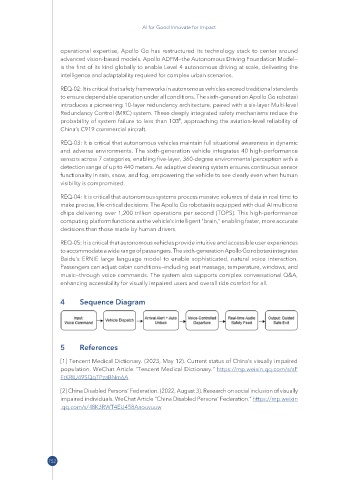
                      4      Sequence Diagram


                      5      References

                      [1] Tencent Medical Dictionary. (2023, May 12). Current status of China’s visually impaired
                      population. WeChat Article “Tencent Medical Dictionary.” https:// mp .weixin .qq .com/ s/ sF
                      FtKRIU49SQ qTPzaBNm6A

                      [2] China Disabled Persons’ Federation. (2022, August 3). Research on social inclusion of visually
                      impaired individuals. WeChat Article “China Disabled Persons’ Federation.” https:// mp .weixin
                      .qq .com/ s/ -I 8K3RWT4EU4 58Aaouvuuw


                  752

