


Page 487 - AI for Good Innovate for Impact
P. 487
AI for Good Innovate for Impact                                         4.5: Manufacturing


               Operational Mode

               Morphing-BOT operates in semi-autonomous mode, autonomously navigating and mapping
               pipelines using sensor fusion (IMU, Lidar, acoustic sensors). Remote control is available for
               manual intervention in complex or highly obstructed areas.


               Data Utilization

               The datasets are utilized to train AI models for anomaly detection (cracks, leaks, deformation),
               predictive maintenance prediction, asset condition rating, and navigation optimization (route
               mapping and obstacle avoidance).

               AI Architecture & On-Device Functions

               Our intelligent inspection robot uses multimodal sensor data, including high-resolution
               images, vibration signals, acoustic measurements, and IMU data, to detect pipeline anomalies.
               To process this data, we employ Convolutional Neural Networks (CNNs) for image-based
               defect detection, Recurrent Neural Networks (RNNs) for time-series vibration and acoustic
               analysis, and Transformer-based architectures for multimodal feature fusion and anomaly
               prediction. The on-device AI facilitates real-time processing and decision-making, performing
               immediate obstacle detection and avoidance, defect recognition and classification without
               external computing support, route adjustment for unexpected conditions, and energy-efficient
               navigation. Deploying AI models directly on the robot hardware ensures low-latency, robust,
               and autonomous inspection even with limited communication.


               Customer Validation & Market Interest

               Our intelligent inspection solution has been successfully validated through pilot projects with
               four Korean municipalities: Jindo, Siheung, Jeju, and Jeonju. Municipalities expressed high
               satisfaction with the robot's precise navigation, accurate defect detection, and efficient data
               acquisition.

               These large-scale deployments yielded over 110,000 high-quality multimodal datasets (images,
               vibration, acoustic, IMU data), which were independently validated by TTA (Telecommunications
               Technology Association of Korea) for accuracy, consistency, and completeness, enabling
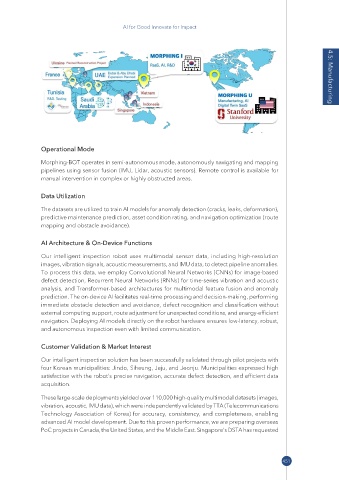
               advanced AI model development. Due to this proven performance, we are preparing overseas
               PoC projects in Canada, the United States, and the Middle East. Singapore's DSTA has requested


                                                                                                    451

