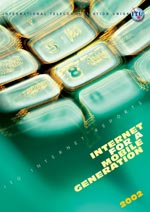
Internet for a Mobile Generation
A new major ITU Report*
Challenges to the industry: Build the
network
“Internet for a Mobile Generation” is the title of a new
report released by the International Telecommunication Union at the beginning of
September 2002. This year’s edition is the fourth in the series “ITU
Internet Reports”, previously known as “Challenges to the Network”. The
report was written by a team of authors from the ITU Strategy and Policy Unit (SPU),
who state that “this edition could equally have been entitled ‘Challenges to
the industry: Build the network’, because the reality is that the network
which will be needed to sustain the mobile Internet is still being built”.
Summary of the Report
In its introductory chapter, the 240-page Report defines the
mobile Internet in the larger context of technological convergence and market
demand. Chapter two focuses on technologies and applications, provides a
technical overview of high-speed mobile networks and available services and
applications for the mobile Internet, and goes on to examine the competition or
co-existence of various network technologies. Chapter three discusses market
trends, and puts the spotlight on the changing landscape and the commercial
challenges involved in creating a mass market for mobile Internet services.
Regulatory and policy aspects are covered in chapter four, which also examines
the hurdles faced by regulators and policy-makers in a converging market
environment. Chapter five contains the latest data on the licensing and
deployment of third-generation (3G) mobile systems. It draws on country case
studies carried out by ITU to highlight a number of lessons from the diverse
experiences these cases present. Chapter six, entitled “Towards a mobile
information society”, looks ahead to the broader societal implications of the
mobile Internet. Finally, the Report contains an 80-page statistical annex with
data on over 200 economies. The tables include a specially prepared
Mobile/Internet Index that attempts to gauge the likelihood of adoption of the
mobile Internet in different economies.
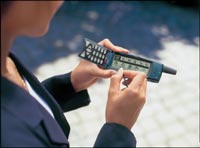
Operators have been able to raise revenues
by offering newer services such as short message service (SMS) to existing users
ITU 020153/Ericsson
|
The mobile revolution
Internet for a Mobile Generation looks at ways in which the
mobile revolution — past, present and future — is changing the way people
around the world live and work. From analogue cellular networks, commercialized
in the early 1980s, to digital cellular ones, launched in the early 1990s, and
now 3G to kick off the new millennium, the revolution rages on. In 1991, only
one per cent of the world’s inhabitants had a mobile phone. Ten years later at
year-end 2001, almost one in every six, or 948 million, of the world’s
inhabitants had a mobile phone. The phenomenal growth of mobile has surpassed
even the most optimistic projections and many economies now have more mobile
phones than fixed lines. This is true not only in developed economies, but also
in developing ones (see the charts and figures). By the end
of 2002, it is predicted that there will be more mobile phones than fixed lines
in the entire world.
Another reason mobile penetration has increased so quickly is
the advent of prepaid calling cards. Many users in developing countries do not
have easy access to credit, which they would need to sign up for a fixed-line
telephone. Operators in many countries have done away with the need for credit
by adopting prepaid calling plans, thus attracting large numbers of new users.
This has been a boon for mobile operators who previously could not provide
access to those they considered to present credit risks. This results in a huge
increase in the number of mobile users in developing and least developed
countries that can now afford to have telephone service.
Developed countries have also been quick to adopt mobile
technologies, but with different underlying user incentives. Users in developed
countries adopt mobile phones primarily for mobility and convenience, rather
than necessity, as most users also have fixed lines at work or home. The latest
trend in developed countries is that users are choosing to drop their fixed
connection altogether, rather than paying for both a mobile and fixed line.

The problem for handset manufacturers lies
in the fact that certain markets, namely Western Europe and parts of Asia, are
nearing saturation levels. This leaves manufacturers and operators with the
conundrum of how to stimulate demand for new handsets when most users already
have a mobile phone
ITU 020154/PhotoDisc
|
Handsets
The advent of the mobile Internet could serve to revitalize the
mobile handset market. Handset manufacturers enjoyed a period of strong growth
up until 2001 when, for the first time, mobile handset sales actually fell from
one year to the next. This followed a 60 per cent compound annual growth rate
from 1996 to 2000. The drop in sales is certainly not due to lack of demand for
mobile communications: on the contrary, people are using mobile services more
than ever. Rather, the problem for handset manufacturers lies in the fact that
certain markets, namely Western Europe and parts of Asia, are nearing saturation
levels. This leaves manufacturers and operators with the conundrum of how to
stimulate demand for new handsets when most users already have a mobile phone.
The answer is two-fold. First, they must find ways to increase revenues from
existing users. Second, they need to offer new services that require phones with
enhanced functionality and colour screens.
While the solution may sound simple, it has been much more
difficult to implement in practice. Operators have been able to raise revenues
by offering newer services such as SMS to existing users. However, equipment
manufacturers have found it a difficult task to convince users to upgrade to
newer phones with additional features. Even with the promise of Internet
services over general packet radio service (GPRS) networks in Europe,
manufacturers have not been able to produce large numbers of phones to capture
the initial demand. In addition, as with personal computers, many users wait
until the very last moment to purchase handsets in order to obtain the most
features and value for their money.
Handset manufacturers are also feeling pressure from personal
digital assistant (PDA) manufacturers that have built wireless connections into
their devices. While the PDAs are not yet in wide circulation, they may serve to
stimulate take-up of high-speed services such as GPRS and 3G, because their
larger colour screens are better suited for multimedia viewing and delivery.
Also, in the mobile market as a whole, enhanced data services are fast becoming
a lucrative source of revenue.
Security issues
The issue of security is a very important one, as concerns in
recent years about viruses, cyberterrorism, hackers, and so forth, have shown.
Data protection for mobile transactions is also an important security issue.
Data in digital form are particularly vulnerable to being copied or modified by
a third party, and there is the added complication that such data can be
produced anonymously, making it difficult to identify malicious intruders or “spoofers”.
In addition, with wireless becoming the network of choice,
issues such as access to emergency services and the role of location-based
services are being examined. The main vulnerabilities occur at the translation
point between the wireless protocols and the wireline (fixed) protocols. Others
exist once the transmission arrives at the wired Internet and becomes subject to
the vulnerabilities of that network.
ITU’s Internet Reports are a contribution to the development
of the Internet and to extending the benefits of new information and
communication technologies, such as mobile technology, to all the world’s
inhabitants. This is in line with Resolution 101 of the Plenipotentiary
Conference (Minneapolis, 1998), which calls upon ITU to “fully embrace the
opportunities for telecommunication development that arise from the growth of
IP-based services”.
| * The
present article has been compiled from extracts from ITU’s latest
must-read Report entitled: “Internet for a Mobile Generation”. In
addition, the POLICY AND STRATEGY TRENDS
pull-out in the centre pages of
this issue of ITU News gives a snapshot of the current development of the
mobile Internet, including an analysis of market and regulatory trends
worldwide. Internet for a Mobile Generation was prepared by the ITU
Strategy and Policy Unit, and may be ordered electronically from the ITU
website at www.itu.int/publications |
|