| * ITU Internet Reports 2002:
Internet for a Mobile Generation, prepared by the ITU Strategy and
Policy Unit (SPU), is the fourth in the series “ITU Internet Reports”
(previously known as “Challenges to the Network”). This edition (240
pages) examines the possibilities and challenges emerging from the
convergence of two distinct sectors of the telecommunication economy, the
Internet, and mobile telephony. It includes an 80page annex of Mobile/Internet
Statistical Tables, with data on over 200 economies worldwide. For information on the contents or on ordering the report, or to
download the Executive Summary, visit the website at: www.itu.int/osg/spu/publications/mobileinternet/ |
Internet for a Mobile Generation*
The mobile Internet: the big gamble
“It requires no great leap of the imagination to
believe that the convergence of mobile communications and the Internet will
produce something big… but it may take longer than you think”
Mobile communications and the Internet were the two major demand drivers for
telecommunication services in the last decade of the twentieth century. Combine
the two — Mobile Internet — and you have one of the major demand drivers of
the first decade of the twenty-first century. So goes the theory.
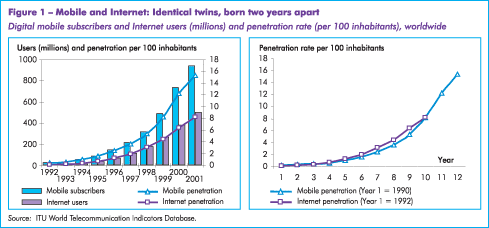
As Figure 1 shows, the two
industries have exhibited remarkably similar growth patterns since the start of
the 1990s, but with a lag of about two years. Exploiting the new opportunities
offered by the mobile Internet will require high levels of capital investment,
possibly higher than ever before in the telecommunication industry. Investors
want to see proof that a market for mobile Internet services exists. But
operators cannot provide that proof until they build the networks. Because of
this “chicken and egg” conundrum, the mobile Internet is potentially the
biggest gamble the telecommunication industry has ever taken on. The lesson so
far is that pioneers often get their fingers burnt: to date, more than USD
100 billion has been invested in acquiring third-generation (3G) licences,
even before network construction and service roll-out costs are taken into
account.
 |
As previous waves of technological convergence have shown, we should not
necessarily expect to see the commercial fruit of the mobile Internet for some
ten or fifteen years yet. It is worth remembering that the “hype” generated
by a particular technological development often falls flat before market
development begins to take off. Consequently, the popular view is that a
particular development has “failed”, whereas the more accurate explanation
is that market development has not yet taken off properly.
Towards convergence and interoperability
“We have learned from second–generation (2G)
communications that person-to-person messaging, simple interfaces and timely
content delivery will be the key to 3G success… On a technical level,
continued efforts towards the interoperability of radio interfaces and the
evolution to an IP-based core network will be crucial”
The combination of mobile and Internet technologies — for instance in the
form of short message service (SMS) — is already transforming the way people
interact and the way business is done. Some 24 billion SMS messages were sent
worldwide in the first quarter of 2002 alone. Messaging services have also
brought information technology closer to groups that have traditionally had
limited access to it, such as children and the hard-of-hearing. High-speed data
services combined with additional functionality, such as location technologies
and improved security, will further enhance the user experience.
On a technical level, the viability of future 3G services will rely on
continued efforts towards the interoperability of radio interfaces, the
evolution to an Internet protocol-based core network and the harmonization of
formats for content delivery. At the service level, convergence between the
fixed and mobile Internet is already happening, through services such as mobile
instant messaging and fixed-line SMS. This interoperability will eventually
encompass complementary and alternative network technologies, such as wireless
local area networks, short-range connectivity technologies and fixed broadband
networks. Regulators and industry players alike need to realize that there are a
number of different options for providing mobile Internet services, and that 3G
services must be considered in their global context.
Market trends
“The mobile Internet should not be considered as a
substitute for the fixed-line Internet…”
There are a number of factors that will enable the rapid and successful
development of the mobile Internet. Firstly, the rapid deployment of high-speed
3G networks will be crucial in facilitating the uptake of mobile multimedia
services. Secondly, the availability and affordability of adequate
Internet-enabled handsets will be a prerequisite for users. Thirdly, it will be
necessary to foster unrestricted and non-proprietary mobile Internet content;
players should be discouraged from imposing commercial restrictions on content
providers or establishing “walled gardens” of content. Finally, simple and
transparent billing models will be required, taking into account the difference
between voice and data services and the growing importance of content. In all
cases, the mobile Internet should not be considered as a substitute for the
fixed-line Internet.
With regard to content, the fixed-line Internet established a tradition of
largely free and non-proprietary information access, though this is now
changing. In particular, virtually unlimited messaging (e-mail) is still
available free of charge. Mobile communications, by contrast, have always come
at a premium. Users seem quite willing to pay per message for SMS, per packet
for i-mode** content and premium rates for voice calls while roaming.
Moreover, a direct relationship exists between the individual user and the
mobile operator, facilitating billing for a variety of add-on services.
| ** First introduced in Japan in 1999, i-mode is a revolutionary packet-based
mobile multimedia service providing users with e-mail and instant access to a
wealth of Internet content. |
On the
whole, this bodes well for the future of paid digital content services on mobile
devices. Combined with high worldwide mobile penetration and short-range
technologies, it may mean greater success for mobile business-to–consumer
commerce than has hitherto been seen over the fixed-line Internet.
Regulatory and policy aspects
“Regulators’ first mission is to ensure fair
competition throughout all stages of the licensing process… but the story does
not end with licensing”
Fair competition policy has been what has worked best in the development of
both the mobile and Internet markets. In the mobile Internet era, it will still
be regulators’ first mission to secure fair competition throughout all stages
of the licensing process.
But the story does not end with licensing. After licences have been awarded,
regulators have other crucial roles to play. One of these is the need to monitor
the mobile market structure so as not to allow dominant operators to abuse their
market position over less established ones. The introduction of Internet access
into the mobile market creates potential new bottlenecks such as portals, and
new breeds of billing system. Mobile operators have a strong potential influence
on the market for Internet platforms, and regulators are responsible for
ensuring that platforms are as open to competition as possible.
Regulators also need to cooperate and harmonize approaches to global roaming
and terminal circulation capabilities internationally. In an increasingly
globalized economy, both these capabilities will be necessary for the mobile
Internet market to flourish. International and regional organizations have a
role to play in guiding regulators in this regard.
Security is also a key issue, both in terms of network vulnerabilities and of
data privacy. As interconnection between wireless, and wired networks becomes
easier, so hitherto controlled and traceable information becomes more vulnerable
to malicious usage. Furthermore, marketing tools, such as spamming, can overstep
the line of acceptability and become a nuisance to users.
Assuming that most mobile users have little knowledge of mobile technology
and legal issues, it is imperative that consumer rights be protected.
Box 1 — Mobile data in the Republic of Korea
The Republic of Korea has one of the fastest-growing mobile penetration rates in the Asia-Pacific region: mobile phone subscribers topped 29 million at the end of 2001, representing over 56 per cent of total telephone subscribers, with a mobile penetration of 60.84 per cent. It has also been estimated that some 59 per cent of Korean mobile subscribers already have phones equipped with mobile Internet browsers, although, according to some analysts, actual mobile Internet use may be lower than these figures suggest. Korea’s experience provides some valuable insights into the demographics of the mobile Internet marketplace.
- The first key message is that it is the residential market, not the business market, which is driving usage. Although service providers like SK Telecom recognize business users as a specific market segment, only half of them use mobile data and their contribution provides just 2 per cent of total
revenue.
- By contrast, teenagers are the main market drivers. Although teenagers have the second lowest (after users aged over 50) total average revenue per user (ARPU) at USD 27 per month, more than one-third of this is spent on data applications. Data ARPU diminishes sharply with age with 20-24 year-olds spending less than a half as much as teenagers, despite their greater spending power, and by the age of thirty, users are spending less than USD 1 per month on average, on data applications.
- A breakdown of content shows that applications designed to appeal to the teenage market, such as ring tones or cartoon animations, games and entertainment, form more than three-quarters of the total. By contrast, information services aimed at older age groups, such as traffic information or stock prices, do less well. Of course, viewing the market by value, rather than by volume, may produce a different picture, but most mobile content is available elsewhere (for instance, over the Internet).
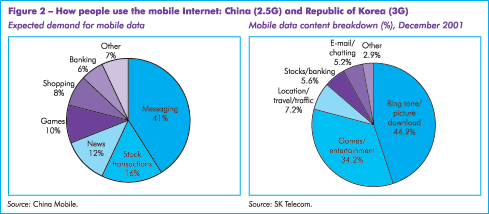
- The usage breakdown contrasts markedly with that of other countries. Compare with China in Figure 2. There, the main mobile data application is e-mail (41 per cent) followed by stock transactions (16 per cent) and news (12 per cent). These three categories account for two-thirds of the market demand in China, but only 13 per cent in the Republic of Korea. Once China acquires mobile data networks that run as fast as those in the Republic of Korea, then the two usage patterns may converge.
Source: ITU country case study on broadband in the Republic of Korea.
|
Towards a mobile information society
“In the future, we may each own dozens of
miniaturized mobile communication devices. A new era of pervasive computing is
dawning with huge implications for our personal lifestyles and values”
The mobile revolution is changing the way we live and work. Mobile phones are
already pervasive in all major developed economies and in an increasing number
of developing ones too. But with the advent of the mobile Internet, wireless
gadgets are set to invade new areas of personal life and work. The mobile
Internet is a powerful enabling technology that will make possible new services
and applications. But it may also threaten traditional values of privacy,
security and courtesy.
In the 1980s and 1990s, the microchip spread from the computer into hundreds
of other devices, from computers to washing machines to cars. Most families in
developed nations already own dozens of microchips embedded in different
devices. The next stage in this process of pervasive computing is for those
microchips to gain the ability to communicate and to report on their location
and status. The technology to make this happen is already available — for
instance, nanotechnology, cellular communications, cheap processing power,
location-tracking systems — but the networks and the billing systems are not
yet in place. The mobile Internet will make that possible.
In the mobile information society, the amount of data about our personal
lives that could theoretically be collected, stored and traded will increase
dramatically. We may want to use that data ourselves, for instance for improved
health or security, but who else do we want to have access to it?
The major uses of the 2.5G mobile Internet are likely to be messaging as is
the case in China today (see Figure 2, left chart); but the extra bandwidth of
3G will allow for download, video streaming and multiplayer games — the
Republic of Korea provides a good example of this (see Figure 2, right
chart). That country’s experience, as described in Box 1, also provides some
valuable insights into the demographics of the mobile Internet marketplace.
|
Initial experiences with 3G mobile Internet services, in the Republic of
Korea and Japan for instance, indicate that it is teenagers who are driving the
market. In the Republic of Korea, for example, teenagers are spending around
three times more per user on mobile data services than older age groups. In
Japan, video messaging has proved immensely popular among young people. What
this suggests is that the younger the users, the more likely they are to be
comfortable with the intrusive nature of mobile communications. Youngsters also
have more time for playing games and sending frivolous or flirtatious messages.
The key question is whether they will continue to use the mobile Internet when
they are older and have more spending power. If they do, then the 3G gamble will
seem like money well spent for the operators. If not, then it is time for
investors to start worrying.
For further information on Policy and Strategy Trends, please contact: ITU Strategy and Policy Unit,
International Telecommunication Union,
Place des Nations, CH-1211 Geneva 20 (Switzerland).
Fax: +41 22 730 6453.
E-mail: spumail@itu.int
Website: www.itu.int/osg/spu/
|
|


