


Page 28 - ITU-T Focus Group Digital Financial Services – Executive Summary
P. 28
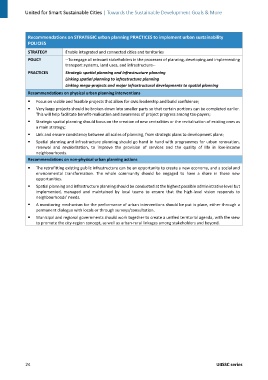
Recommendations on STRATEGIC urban planning PRACTICES to implement urban sustainability
POLICIES
STRATEGY Enable integrated and connected cities and territories
POLICY --To engage all relevant stakeholders in the processes of planning, developing and implementing
transport systems, land uses, and infrastructure--
PRACTICES Strategic spatial planning and infrastructure planning
Linking spatial planning to infrastructure planning
Linking mega-projects and major infrastructural developments to spatial planning
Recommendations on physical urban planning interventions
Focus on visible and feasible projects that allow for civic leadership and build confidence;
Very large projects should be broken down into smaller parts so that certain portions can be completed earlier.
This will help facilitate benefit-realisation and awareness of project progress among tax-payers;
Strategic spatial planning should focus on the creation of new centralities or the revitalisation of existing ones as
a main strategy;
Link and ensure consistency between all scales of planning, from strategic plans to development plans;
Spatial planning and infrastructure planning should go hand in hand with programmes for urban renovation,
renewal and revalorization, to improve the provision of services and the quality of life in low-income
neighbourhoods.
Recommendations on non-physical urban planning actions
The retrofitting existing public infrastructure can be an opportunity to create a new economy, and a social and
environmental transformation. The whole community should be engaged to have a share in these new
opportunities.
Spatial planning and infrastructure planning should be conducted at the highest possible administrative level but
implemented, managed and maintained by local teams to ensure that the high-level vision responds to
neighbourhoods’ needs.
A monitoring mechanism for the performance of urban interventions should be put in place, either through a
permanent dialogue with locals or through surveys/consultation.
Municipal and regional governments should work together to create a unified territorial agenda, with the view
to promote the city-region concept, as well as urban-rural linkages among stakeholders and beyond.
24 U4SSC series

