


Page 255 - ITU-T Focus Group IMT-2020 Deliverables
P. 255
ITU-T Focus Group IMT-2020 Deliverables                                3


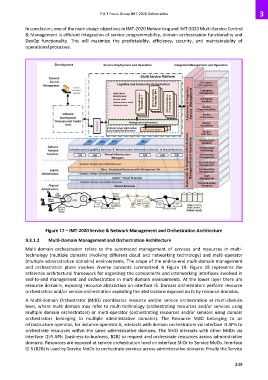
            In conclusion, one of the main design objectives in IMT-2020 Networking and IMT-2020 Multi-Service Control
            & Management is efficient integration of service programmability, domain orchestration functionality and
            DevOp  functionality.  This  will  maximize  the  predictability,  efficiency,  security,  and  maintainability  of
            operational processes.


                     Figure 17 – IMT-2020 Service & Network Management and Orchestration Architecture

            9.3.1.2    Multi-Domain Management and Orchestration Architecture
            Multi-domain  orchestration  refers  to  the  automated  management  of  services  and  resources  in  multi-
            technology  (multiple  domains  involving  different  cloud  and  networking  technology)  and  multi-operator
            (multiple administrative domains) environments. The scope of the end-to-end multi-domain management
            and  orchestration  plane  involves  diverse  concepts  summarized  in  Figure  18.  Figure  18  represents  the
            reference architectural framework for organizing the components and interworking interfaces involved in
            end-to-end management and  orchestration  in  multi-domain  environments.  At  the  lower  layer  there are
            resource domains, exposing resource abstraction on interface I5. Domain orchestrators perform resource
            orchestration and/or service orchestration exploiting the abstractions exposed on I5 by resource domains.
            A  Multi-domain  Orchestrator  (MdO)  coordinates  resource  and/or  service  orchestration  at  multi-domain
            level,  where multi-domain  may  refer  to multi-technology  (orchestrating  resources  and/or  services  using
            multiple  domain orchestrators) or multi-operator  (orchestrating  resources  and/or  services  using  domain
            orchestrators  belonging  to  multiple  administrative  domains).  The  Resource  MdO  belonging  to  an
            infrastructure operator, for instance operator A, interacts with domain orchestrators via interface I3 APIs to
            orchestrate resources within the same administrative domains. The MdO interacts with other MdOs via
            interface I2-R APIs (business-to-business, B2B) to request and orchestrate resources across administrative
            domains. Resources are exposed at service orchestration level on interface Sl-Or to Service MdOs. Interface
            I2-S (B2B) is used by Service MdOs to orchestrate services across administrative domains. Finally the Service


                                                                                                         249

