

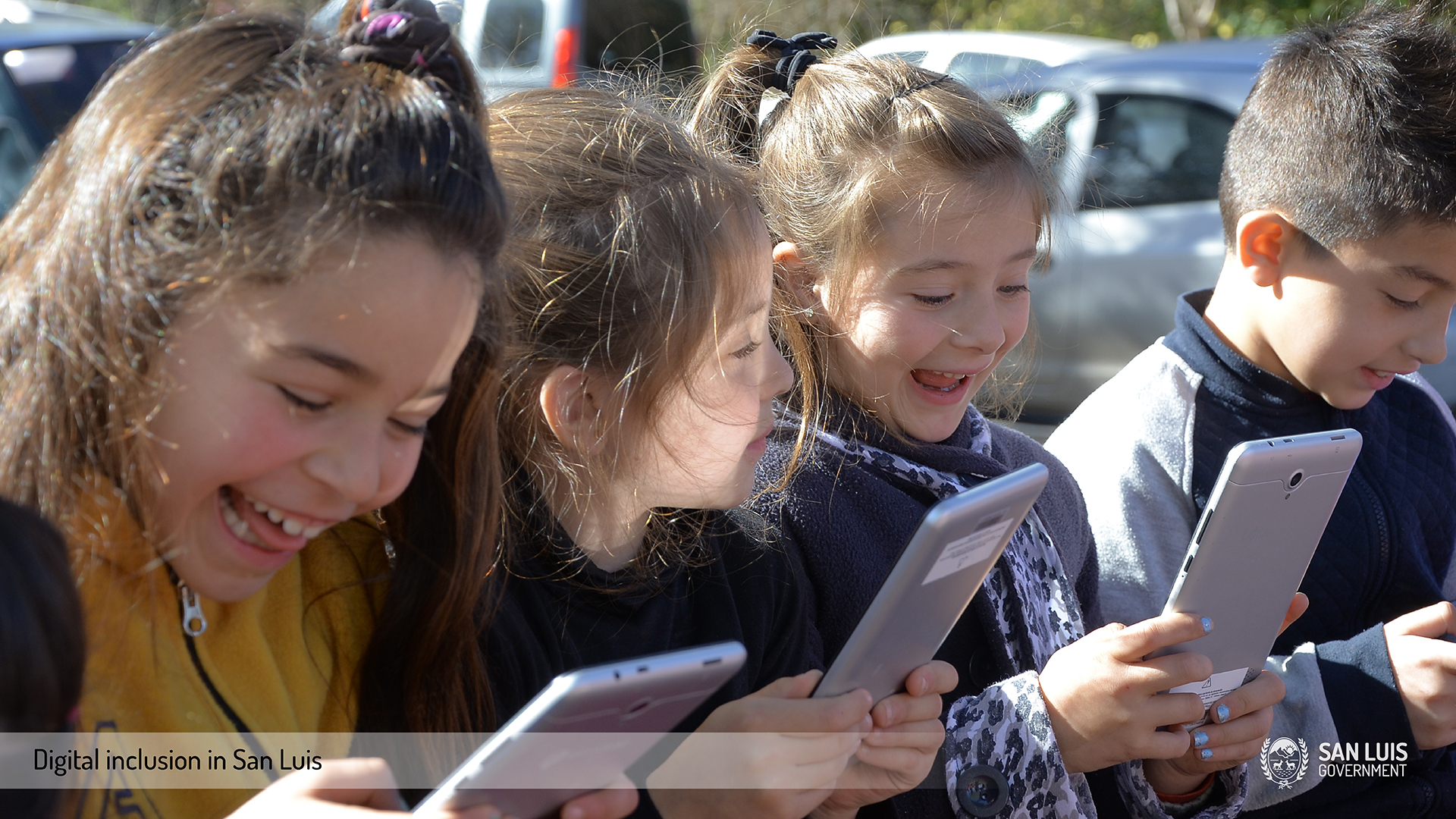
Description
Digital Inclusion lies on three pillars:
connectivity
devices
training
In each of these pillars, the Government of San Luis has public policies to achieve the digital inclusion of the whole society.
Free connectivity throughout the province.
Until November of 2018, 122,500 devices were delivered to the following recipients:
Retirees, pensioners, beneficiaries of social plans, and people with disabilities.
Teachers
Police officers
Health workers
Students of 1st, 2nd, and 3rd grade of primary school.
Each of these groups receives a specific training that is constantly updated.
All actions are then focused on improving the quality of life of senior citizens using the technological tools made available to them by the provincial government with its inclusive policies. To improve the efficiency of health workers, police, and teachers in their specific tasks, and for children to be included digitally, thus allowing them to develop the skills needed for today's world.
An amount of 122,500 tablets has been delivered and beneficiaries are receiving training, and the impact can already be seen on Internet bandwidth consumption that went from 14 Gbps to 21 Gbps, a 50% increase.
One of the indicators of the digital inclusion of San Luis society is the number of people, 28,541, who are studying online university careers. These students are comprised by 68% are women, 90% of which will be the first generation of university students in their families, and 34% are from the interior of the province.
Action lines related to this project
- AL C3. Access to information and knowledge 2019
Sustainable development goals related to this project
- Goal 1: No poverty
- Goal 2: Zero hunger
- Goal 3: Good health and well-being
- Goal 4: Quality education
- Goal 5: Gender equality
- Goal 11: Sustainable cities and communities
Coverage
- San Luis province, Argentina
Target beneficiary group(s)
- Youth
- Older persons
- Women
- Indigenous and nomadic peoples
- People with disabilities
- The unemployed
- The poor
- Migrants
- Refugees and internally displaced people
- Remote and rural communities
- the complete population
Replicability
The development and success of this initiative in San Luis is the result of the political decision to invest heavily, during the last 20 years, in infrastructure, connectivity, and in facilitating access to devices for the population, as well as training. This initiative is replicable successfully only in this context.
Sustainability
Digital Inclusion as a Fundamental Human Right, a commitment assumed by the Government of San Luis and embodied in the Provincial Constitution in 2011, guarantees the continued investment of public resources towards a more inclusive, digitized and innovative society.
WSIS values promotion
The government of San Luis promotes strong policies against the fight against poverty, the strengthening of digital inclusion, gender equality, care for the environment, among others, through multiple initiatives and public policies.
The development of a connectivity infrastructure, with a fiber optic network of more than 3,260 kilometers that allows free connectivity of the entire population throughout the territory, the delivery of devices, the development of digital platforms and ICT training they contribute strongly in these purposes.
States that invest in ICT and develop development police improve the quality of
life of the population. To date, those who have gained the most were those who could access the digital world.