E-commerce and sustainable development in China
GTI
Session 284
The workshop focuses on three areas of e-commerce and the speakers will highlight the following issues.
(1) E-commerce policy
The prosperity and development of e-commerce requires effective governance. It’s essential that the central and local governments formulate appropriate policies to develop and regulate the e-commerce. Basically, Chinese government has implemented supportive policies for the e-commerce since 2006. After that, logistics network and payment systems, which are indispensable for the development of e-commerce, were rapidly developed in China. Also, the central government introduced cross border e-commerce policy in 2020 to make further expansion. This newly emerging industry, on the other hand, has brought many challenges regarding to the laws and regulations.
(2) E-commerce and sustainable development
E-commerce promotes sustainable development in the fields of economic growth, poverty reduction and international cooperation, etc. It provides people with decent work and increases economic growth. With the development of e-commerce, new jobs are created and more than 425 million people are employed in this industry. China's online retail transactions reach 7.18 trillion yuan. In addition, e-commerce reduces poverty. It provides opportunities for poor families to sell products by connecting potential customers with sellers. Besides, cross border e-commerce promotes international cooperation.
(3) E-commerce and cybersecurity
There are some problems in the development of e-commerce. One of the most serious problems of e-commerce is cybersecurity, including transaction security and customers' information security, etc. Thus, the Chinese government makes relevant policies such as Measures for data security management.

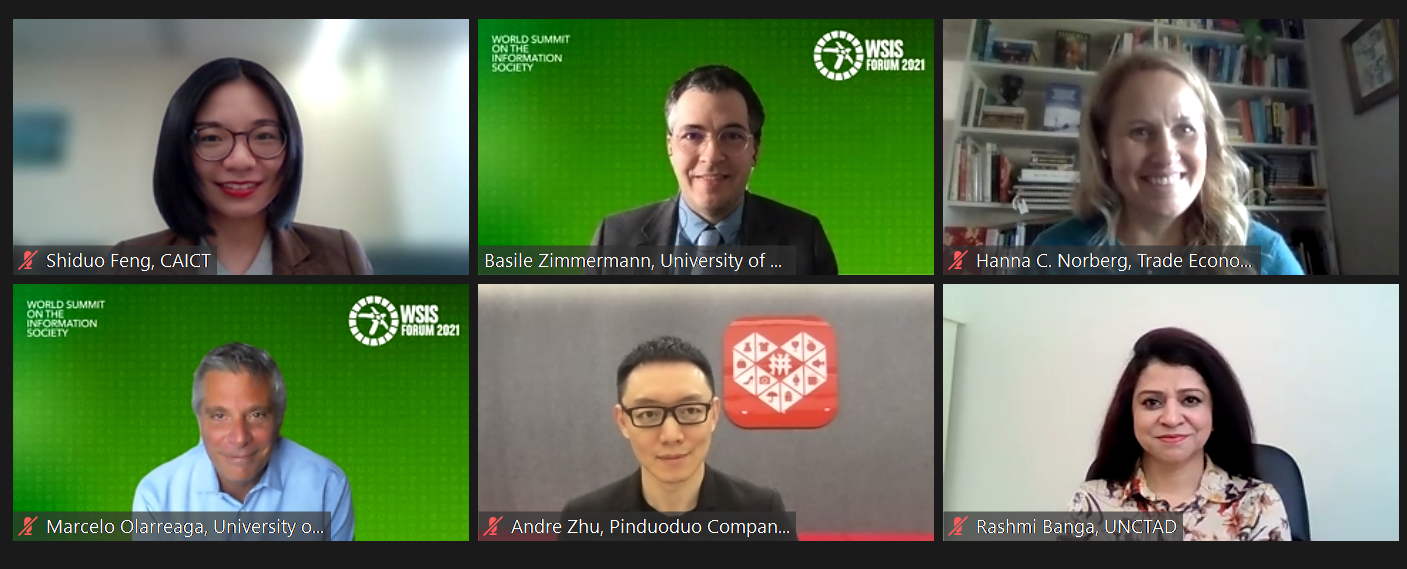
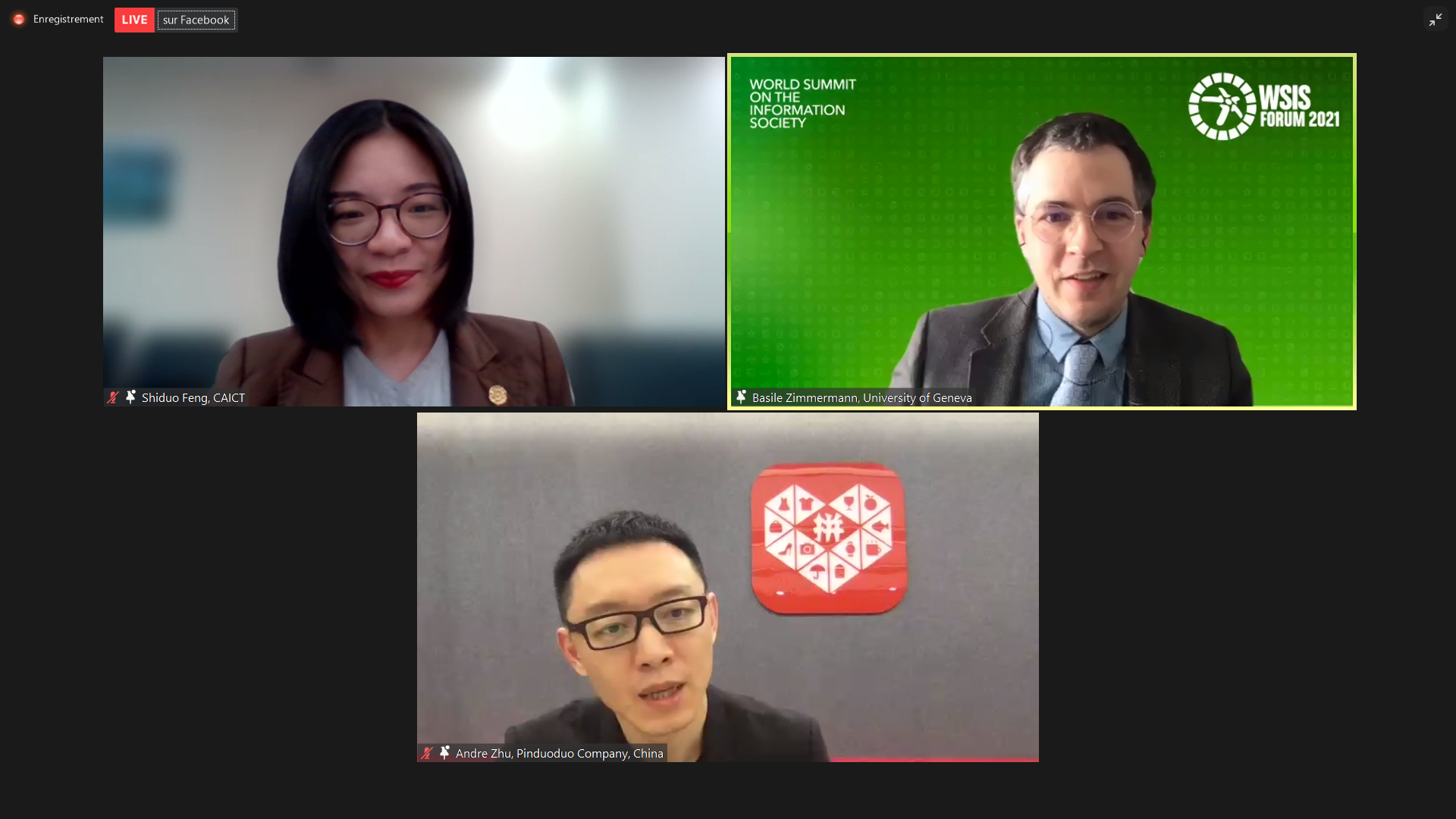
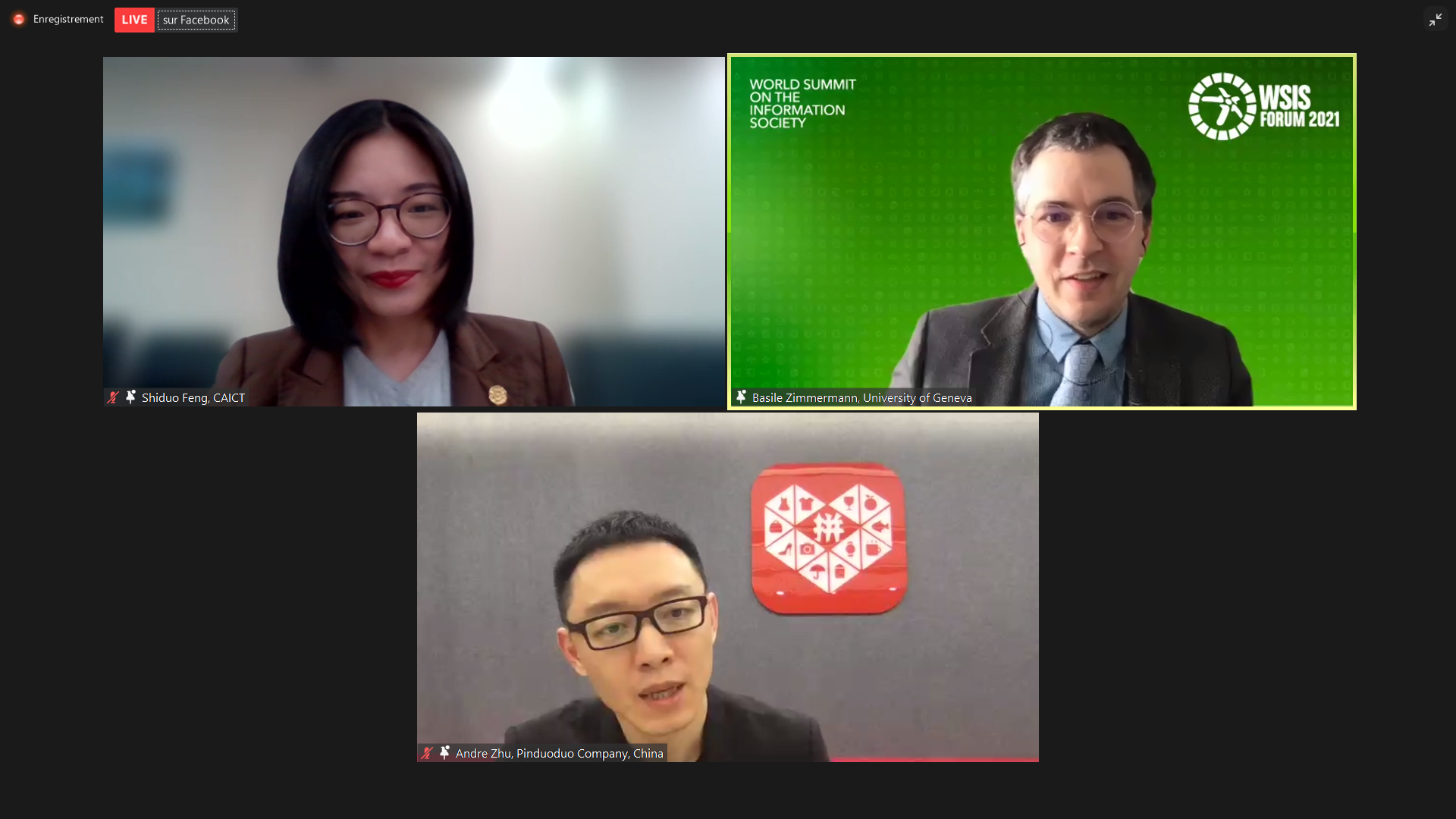
Mr. Basile Zimmermann is an anthropologist and a sociologist of technology. He is Senior Lecturer and Director of the Institute Confucius at the University of Geneva in Switzerland, a multidisciplinary research and teaching center on contemporary China. He is the author of Waves and Forms: Electronic Music Devices and Computer Encodings in China (MIT Press, Inside Technology series, 2015), and Popular Humanities, or the Culture of Things [in French] (Les Belles Lettres, Paris, forthcoming). His current research projects focus on anthropology of innovation in China and the Middle East.

Ms. Shiduo FENG has been working for China Academy of Information and Communication Technology (CAICT) on cyber security and Internet international governance since 2014. She is the deputy director of industrial cybersecurity business department. She has experience in international communication and cooperation. During her work, she served as experts of the 5th United Nations Governmental Group of Expert (UNGGE) on information security, the Chinese delegation to participate in the Asia-Pacific Tele community Cyber security Forum. Also, she organized the China-ASEAN Cybersecurity Industry Exchange and Cooperative Development Seminar in 2019 and 2020, etc.

Andre has served as Senior Vice President of Pinduoduo since 2018 and has been appointed as
General Counsel since July 2020. He leads Pinduoduo’s corporate strategy and operations and
oversees domestic and international legal matters of the company. Before joining Pinduoduo,
Andre was a partner in the Beijing office of White & Case LLP. From 2010 to 2017, he was an
associate and then counsel in Skadden, Arps, Slate, Meagher & Flom LLP. Andre received his
bachelor’s degree in English language and literature from Tsinghua University, and his Juris Doctor’s
degree from University of California Hastings College of the Law.

Rashmi Banga is a Senior Economic Affairs Officer in the Unit on Economic Cooperation and Integration among Developing Countries (ECIDC), Division of Globalisation and Development Strategies (GDS), UNCTAD. She is former Adviser and Head, Trade Competitiveness in Commonwealth Secretariat, where the Division provided policy support to more than 30 countries. She has worked as a Senior Economist and Officer-in-Charge in DFID-funded UNCTAD’s project for five years which provided policy support to the Ministry of Commerce, India. She was a Professor of Economics in Jawaharlal Nehru University and Delhi University and is an Honorary Professor at the University of Zhengzhou, China. She received her doctorate from Delhi School of Economics, specializing in development economics, international trade and econometrics. She has published extensively in refereed journals on South-South Cooperation, digital issues, international trade, global value chains and FDI issues. She has been awarded International Economic Development Research Award by Export-Import Bank of India and has been a recipient of two Gold Medals for her research on globalization and development from Global Development Network, World Bank.
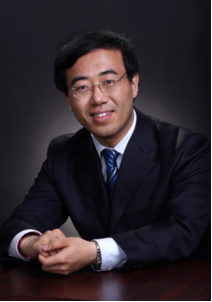
Dr. LIANG Zheng now serves as the Professor of the School of Public Policy and Management, Tsinghua University, as well as the research fellow and deputy director of China Institute for Science &Technology Policy at Tsinghua University (CISTP), the research fellow and vice president of Institute for AI International Governance, Tsinghua University (AIGI).
Dr. Liang got his doctor’s degree of economics at Nankai University (2003) and accomplished the senior executive training program on leadership at Kennedy School of Government, Harvard University (2010). He had visited at MIT Industrial Performance Center (MIT IPC) as the Fulbright Visiting Research Scholar for one year (2012).

Marcelo Olarreaga is Professor of Economics and currently Dean of the Geneva School of Economics and Management at the University of Geneva. He is also a Research Fellow at the Centre for Economic Policy Research (CEPR) in London. Before joining the University of Geneva he worked in the Research Department of the World Bank, as well as in the Economics Research Division of the World Trade Organization. He has also been invited professor at CERDI (France), the Graduate Institute (Switzerland), INSEAD (France), Institute CLAEH (Uruguay), SciencePo-Paris (France), Universidad de la República (Uruguay) and the University of Antwerp (Belgium). He holds an MA from the University of Sussex, and a PhD in Economics from the University of Geneva.
His research focuses at the intersection of international trade and economic development with an important focus on political economy issues. His research has been published in the Journal of Political Economy, Economic Journal, Review of Economic and Statistics, the International Economic Review, the Journal of International Economics, and the Journal of Development Economics.
You can contact him at marcelo.olarreaga@unige.ch

Dr. Hanna C. Norberg is an independent researcher and trade policy advisor.
Founder of TradeEconomista.com and TradeExperettes.org, Co-founder of TradePolicyResearchForum.org and Co-Director of DigitalTradePolicy.org
She specializes in research related to trade policy and conducting training/teaching and mastermind events for policy makers and organizations looking to understand the underlying issues and dynamics of modern trade topics and find the best way to deal with them from a policy perspective.
Hanna holds a Ph.D. in International Economics from Lund University, Sweden, with the thesis largely written during a study visit to Columbia University and the NBER office in NY. Apart from academic research, she has substantial experience in applied economics- doing numerous trade policy impact assessment projects for the European Commission ECFIN, OECD, WTO and national governments. She also has considerable practical experience; working on implementing FTAs, surveying SMEs, and studying economic development thru private public partnerships. Her primary academic research interests are trade, trade policy, economic integration, sustainable development, digital trade, data flows and blockchain.
-
 C5. Building confidence and security in use of ICTs
-
 C7. ICT applications: benefits in all aspects of life — E-business
-
 C11. International and regional cooperation
-
 Goal 1: End poverty in all its forms everywhere
-
 Goal 2: End hunger, achieve food security and improved nutrition and promote sustainable agriculture
-
 Goal 8: Promote inclusive and sustainable economic growth, employment and decent work for all
-
 Goal 10: Reduce inequality within and among countries
-
 Goal 17: Revitalize the global partnership for sustainable development