


Page 860 - AI for Good Innovate for Impact
P. 860
AI for Good Innovate for Impact


                      Further efforts will focus on optimizing AI models for faster performance on edge devices to
                      support real-time decision making. Potential areas for scale up include forming partnerships
                      for broader deployment and extending the system to support multi crop disease detection
                      for wider agricultural impact.


                      3      Use Case Requirements
                      •    REQ-01: It is required to collect high resolution images of tomato leaves for accurate
                           disease detection and model training.
                      •    REQ-02: It is required to deploy edge computing hardware such as Raspberry Pi to enable
                           real time image processing on-site.
                      •    REQ-03: It is required to install IoT sensors to monitor environmental conditions,
                           specifically temperature and humidity, in tomato fields.
                      •    REQ-04: It is required to develop a mobile application equipped with a camera interface
                           and alert system to provide real-time notifications to farmers.
                      •    REQ-05: It is required to ensure stable power supply and uninterrupted internet
                           connectivity to support continuous data transmission and system updates.

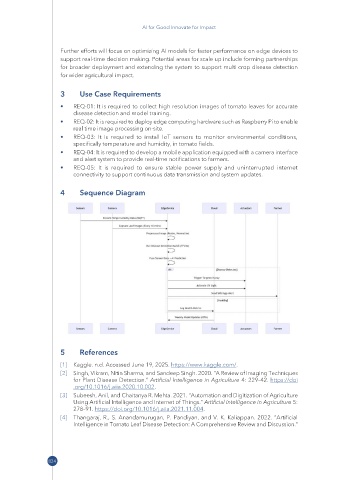
                      4      Sequence Diagram


                      5      References

                      [1]  Kaggle. n.d. Accessed June 19, 2025. https:// www .kaggle .com/ .
                      [2]  Singh, Vikram, Nitin Sharma, and Sandeep Singh. 2020. “A Review of Imaging Techniques
                           for Plant Disease Detection.” Artificial Intelligence in Agriculture 4: 229–42. https:// doi
                           .org/ 10 .1016/  .aiia .2020 .10 .002.
                                       j
                      [3]  Subeesh, Anil, and Chaitanya R. Mehta. 2021. “Automation and Digitization of Agriculture
                           Using Artificial Intelligence and Internet of Things.” Artificial Intelligence in Agriculture 5:
                                                        j
                           278–91. https:// doi .org/ 10 .1016/  .aiia .2021 .11 .004.
                      [4]  Thangaraj, R., S. Anandamurugan, P. Pandiyan, and V. K. Kaliappan. 2022. “Artificial
                           Intelligence in Tomato Leaf Disease Detection: A Comprehensive Review and Discussion.”


                  824

