


Page 765 - AI for Good Innovate for Impact
P. 765
AI for Good Innovate for Impact


               inconveniences they encounter, and will help us identify specific requirements for future visually
               impaired UI/UX design.

               Second, we plan to analyze in detail the Operating System (OS) types and specifications of
               digital devices such as Personal Computers (PCs), phones, and pads that are mainly used by           4.9: Accessibility
               visually impaired people. By doing so, we will design optimized UI/UX for each device and
               explore ways to solve the limitations that arise from specific devices or platforms. We will also
               compare the differences in accessibility features between various devices and aim to design
               a common interface that can compensate for them.

               Third, we will identify these improvement points and develop customized UI/UX enhancements
               for the visually impaired. Specifically, we will implement innovative technical solutions that reflect
               the characteristics of each device and user feedback to substantially improve accessibility. This
               will create a technical standard that can be utilized consistently across different environments.


               3      Use Case Requirements

               REQ-01: Touch UIs for visually impaired users should be designed for consistent usability,
               with key function buttons large and clearly placed. Each button should contain only essential
               functions and provide a simplified layout that users find intuitive.

               REQ-02: The tactile display should work reliably via Bluetooth and provide real-time feedback
               to the user through tactile sensations.

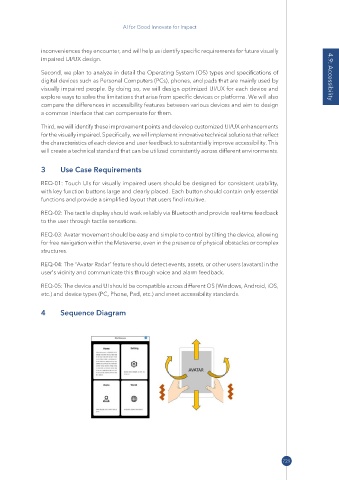
               REQ-03: Avatar movement should be easy and simple to control by tilting the device, allowing
               for free navigation within the Metaverse, even in the presence of physical obstacles or complex
               structures.

               REQ-04: The “Avatar Radar” feature should detect events, assets, or other users (avatars) in the
               user's vicinity and communicate this through voice and alarm feedback.

               REQ-05: The device and UI should be compatible across different OS (Windows, Android, iOS,
               etc.) and device types (PC, Phone, Pad, etc.) and meet accessibility standards.


               4      Sequence Diagram


                                                                                                    729

